Wednesday, April 05, 2006

Egg Masses II:

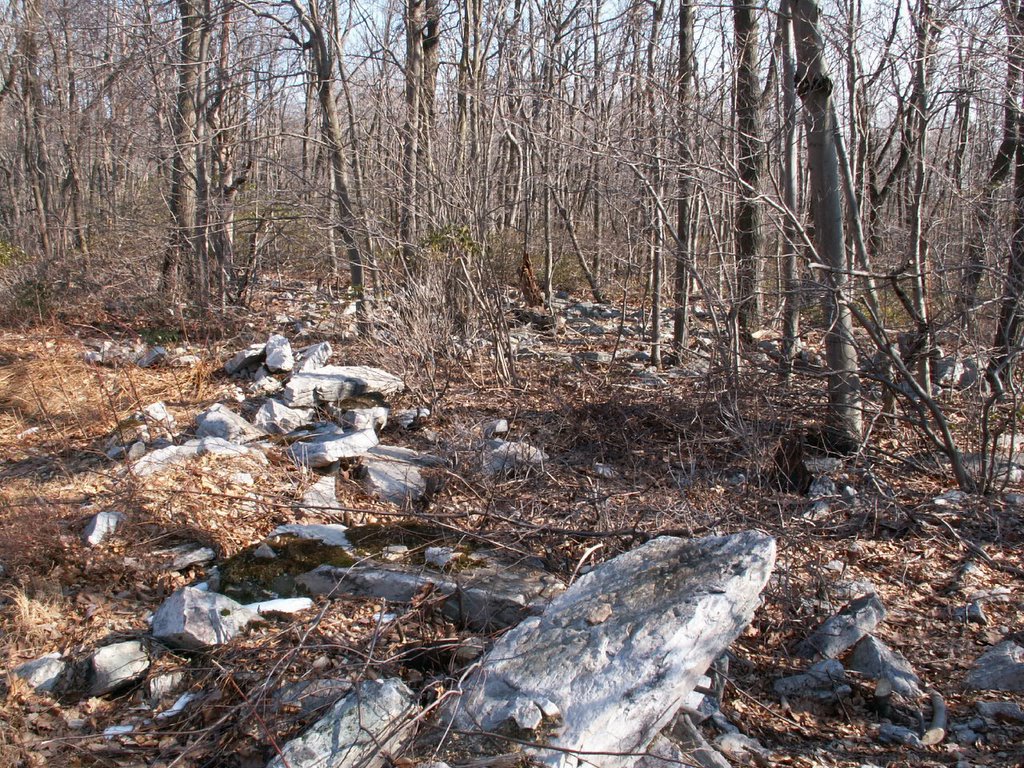
My trip on Sunday was supposed to be a snake trip. I have been scouting the ridgeline just north of I-78 at the border of Berks and Schuylkill Counties for rocky outcroppings on south-facing slopes. These are classic timber rattlesnake (Crotalus horridus) den habitat. Timber rattlesnakes hibernate together in cracks and cavities deep in such hillsides. In the spring they tend to hang out around the outcroppings before dispersing. The return in the fall, catch some rays at their den site before things get too cold, and then hibernate.

I have found some great den sites, but I know that not all of them are occupied. Timber rattlesnakes live on this ridgeline, but they are not common, and so the challenge will be figuring out which of the hundreds of potential den sites over a few dozen miles of ridgeline are occupied.
Timber rattlesnake dens are a delicate topic in PA herping. Timber rattlers are rare and, in my opinion as well as that of most herpers I talk to, should be given greater protection than they are currently given under state law. Since rattlers from several square miles hibernate together in communal dens, it is really easy to extirpate them from an area. All one has to do is find the den and show up in the spring or fall with a shotgun or with a few pillowcases and a snake stick. That happens more often than you might think.

So, I was somewhere on that ridgeline (covered by several state game lands and at least one state forest) on Sunday with Scott, who is a third-generation Philly herper who knows the region a lot better than I do. He’s also an intern in emergency medicine, which struck me as a valuable characteristic in a herping companion as I we scrambled over ankle-twisting rocky outcroppings and slopes of loose boulders in search of venomous snakes. We made it out without breaking any limbs, but without finding any snakes either.

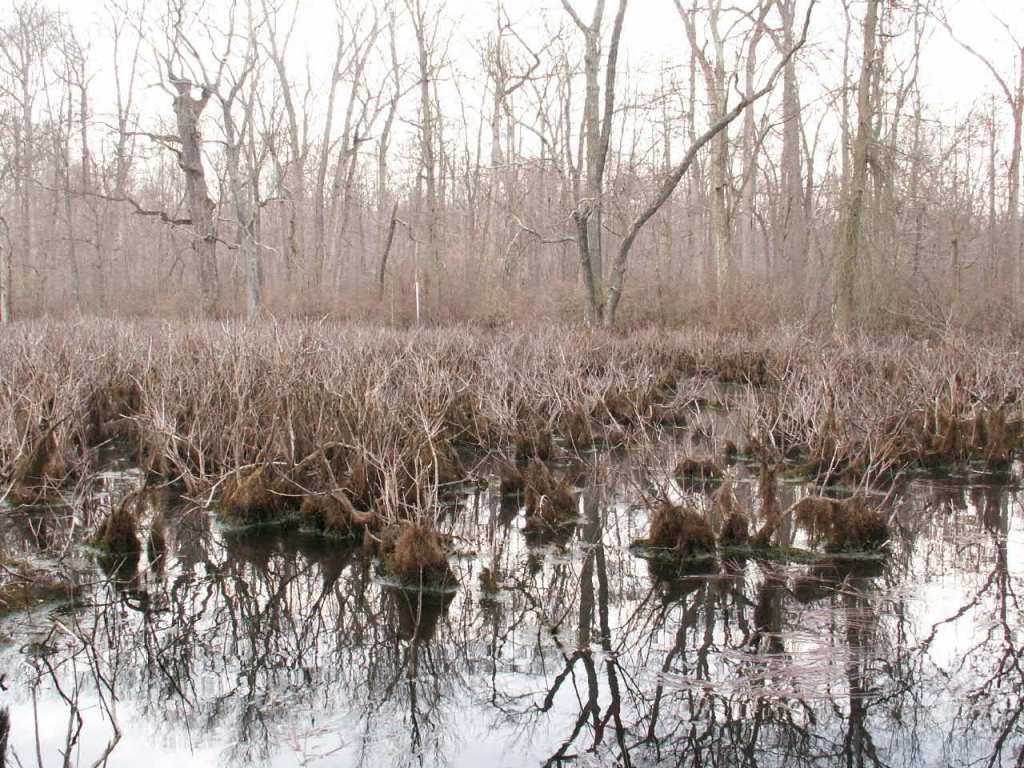
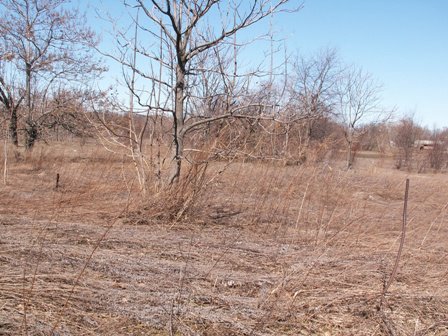
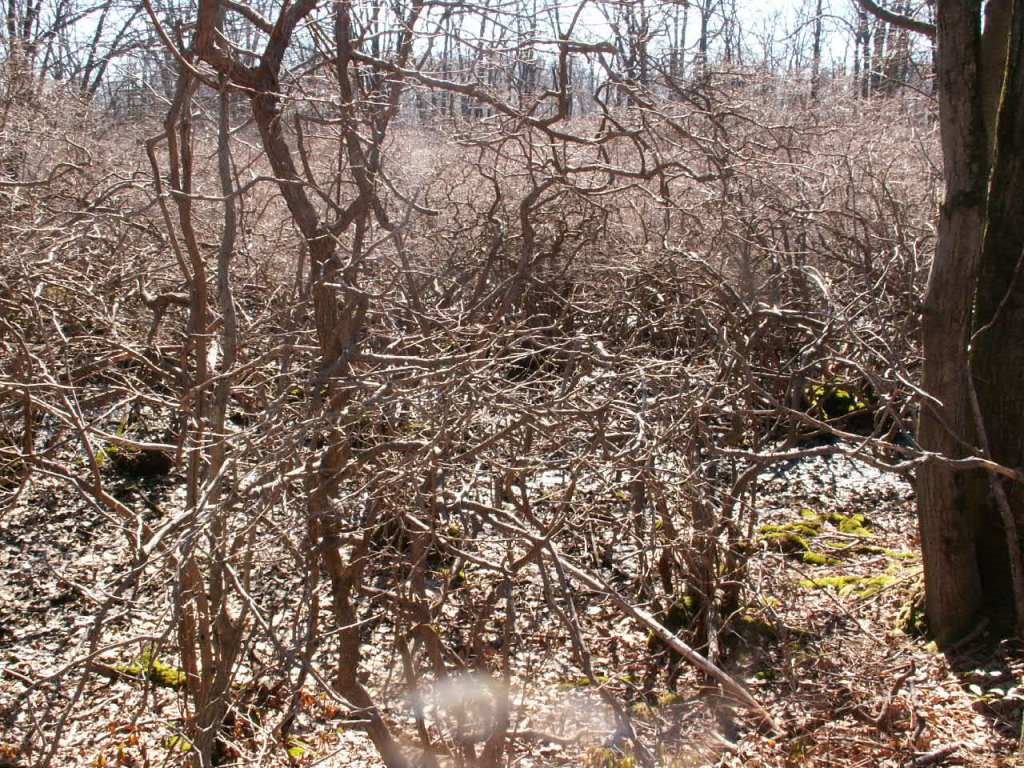
The big find was all the action going on at the ridge top. I had found this mountain bog a few weeks ago when it looked like this:
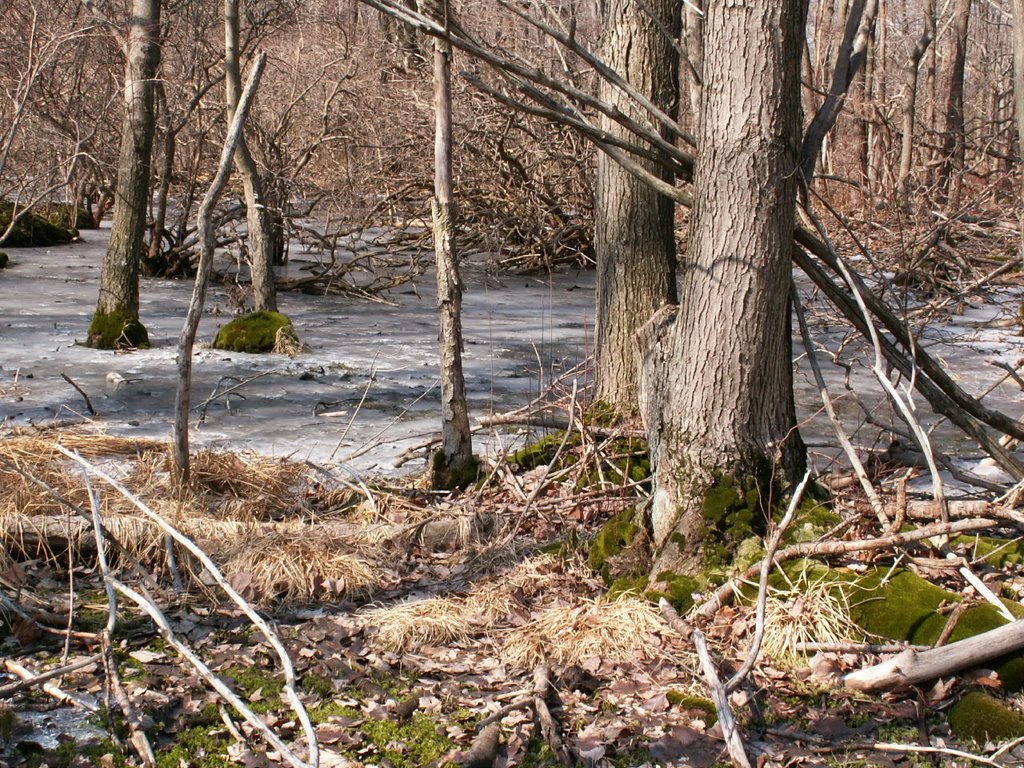


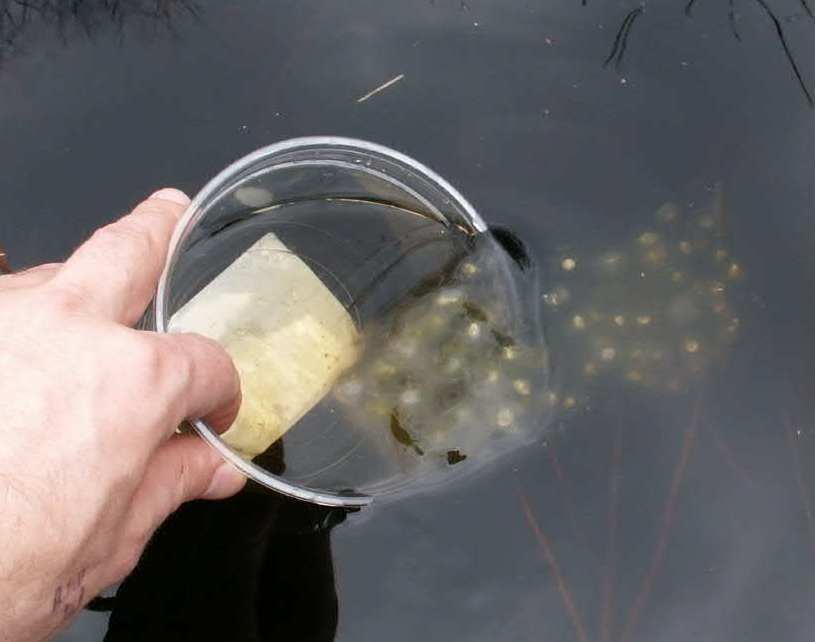
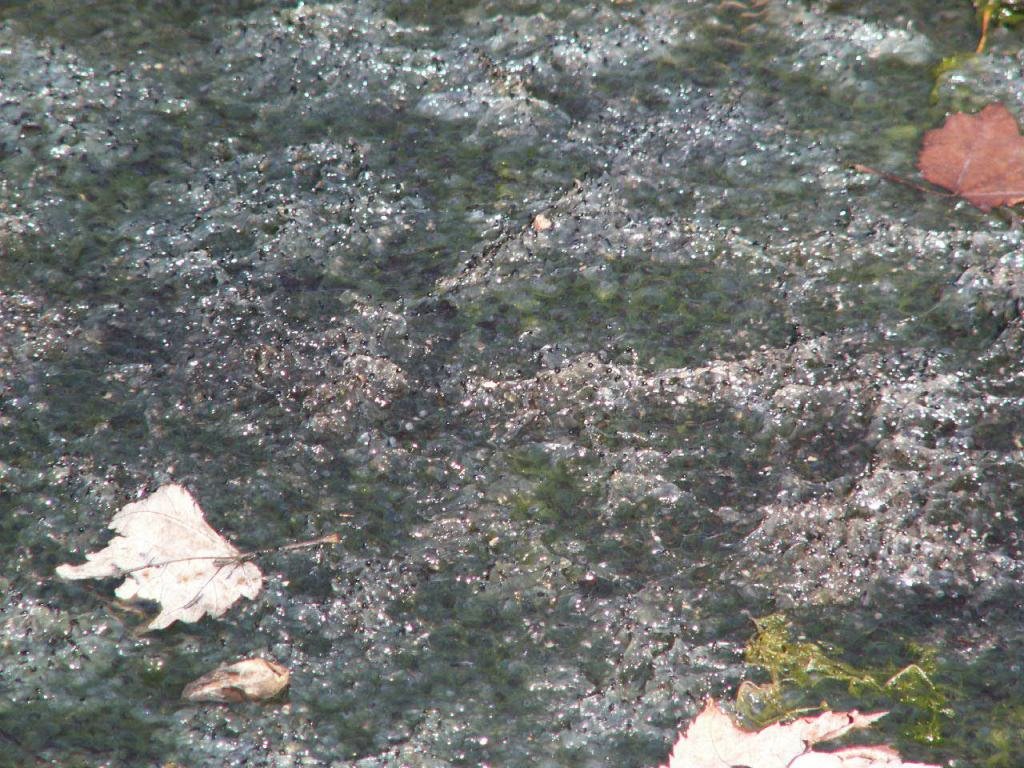
Now it was all thawed out and chock-full of egg masses:


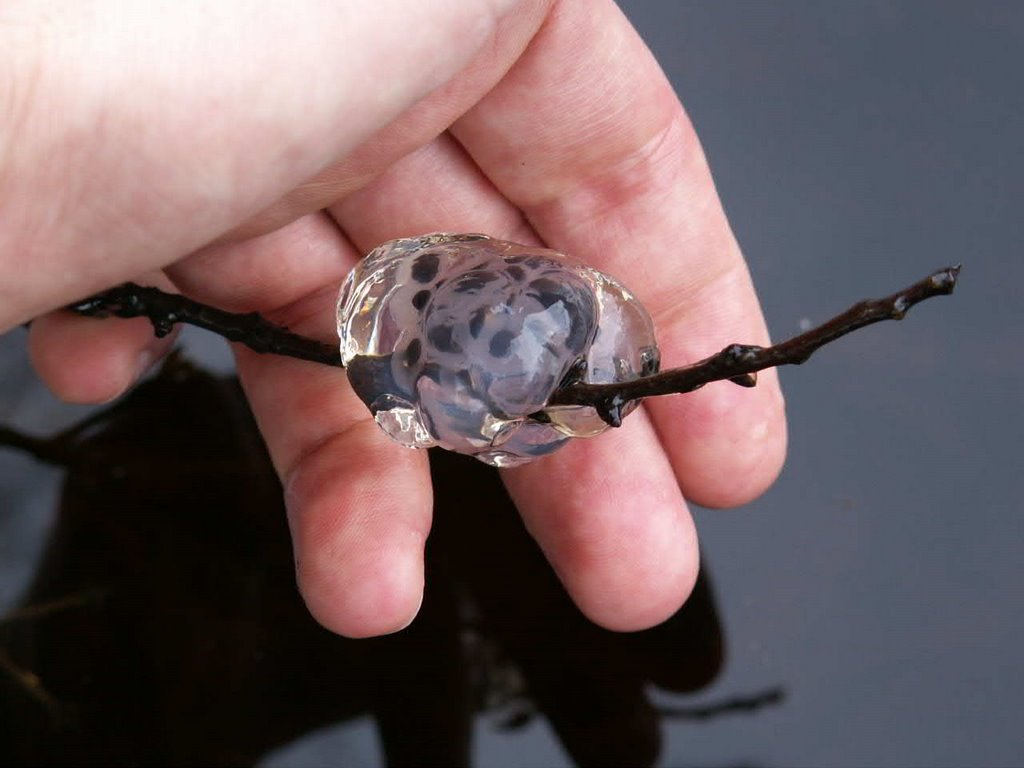
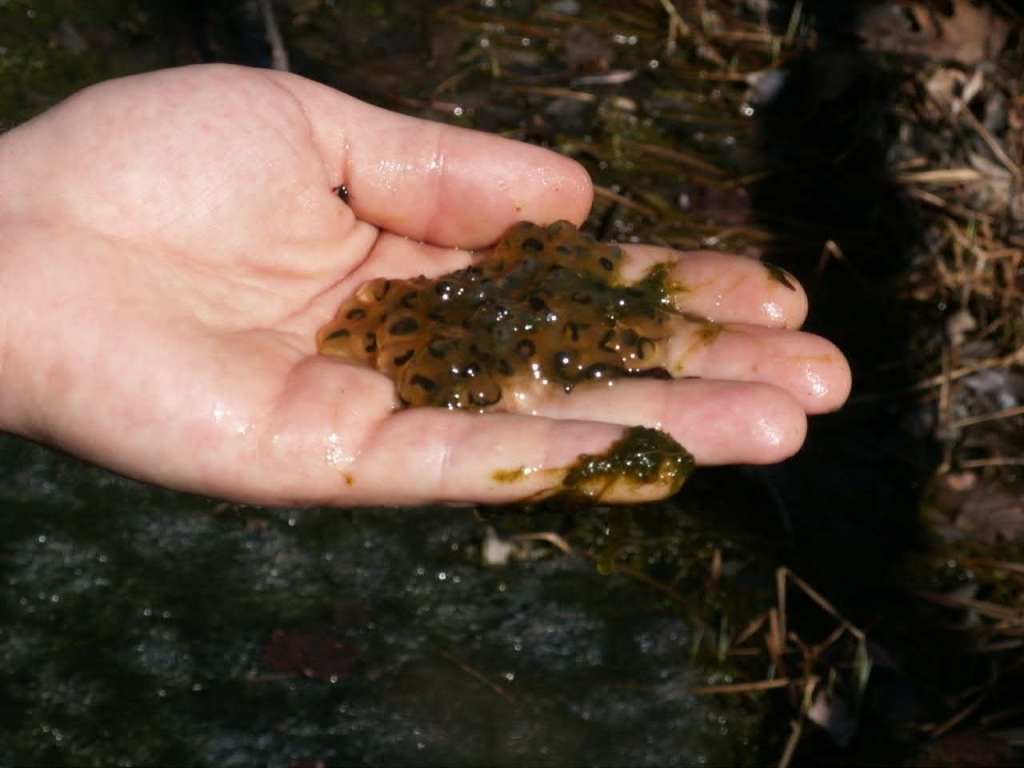
Here are some photos of the largest, likely deposited by wood frogs (Rana sylvatica). It had to be six feet across. I didn’t even spot it at first; for some reason it registered in my brain as moss until Scott shouted and knelt down to take a closer look.



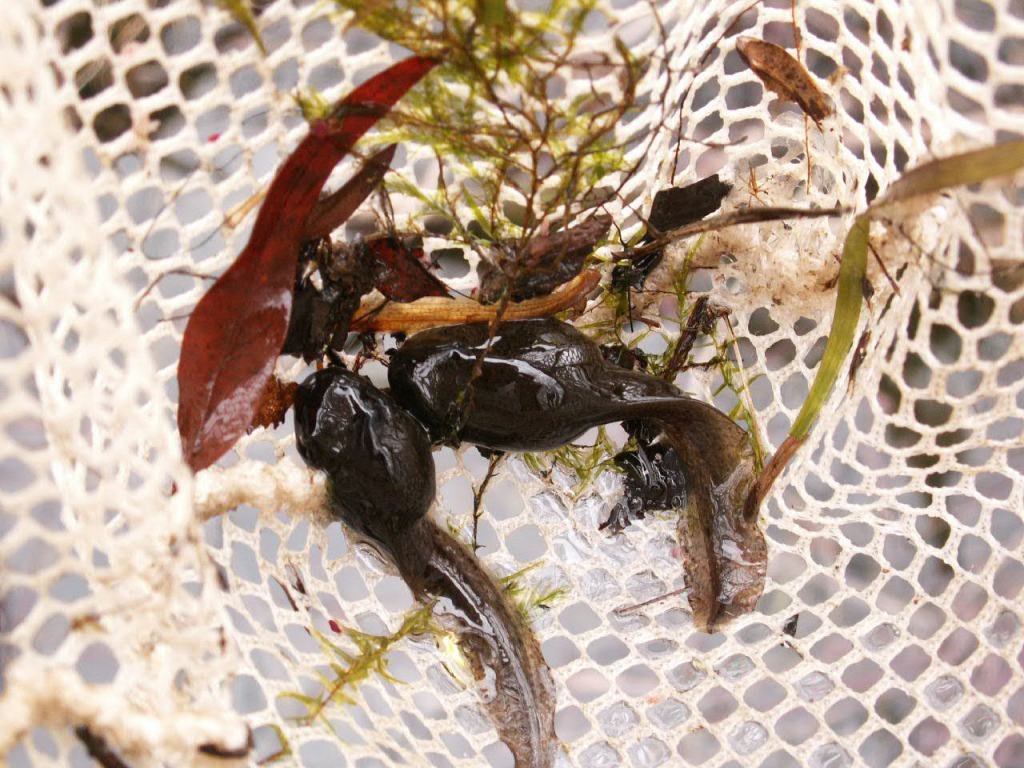
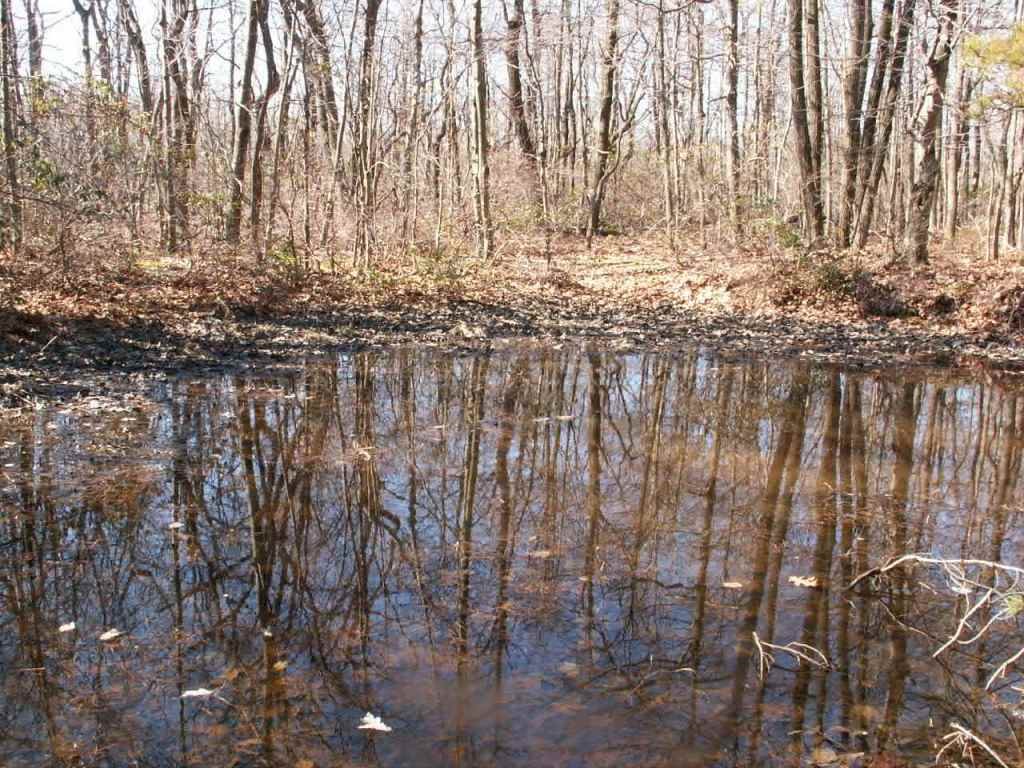
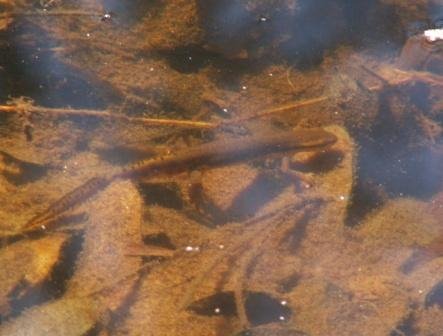
In this pond next to the bog, we found more egg masses, likely of spotted salamanders (Ambystoma maculatum), as well as some adult frogs we didn’t see well enough to identify, the head of a turtle we likewise could not identify, and a small army of newts (Nopthalmus viridiscens viridiscens) cavorting around the leaves at the bottom.


Newts love to eat the egg masses of other amphibians. Here is a photo of one of them in the water:


Here are a couple out of the water:
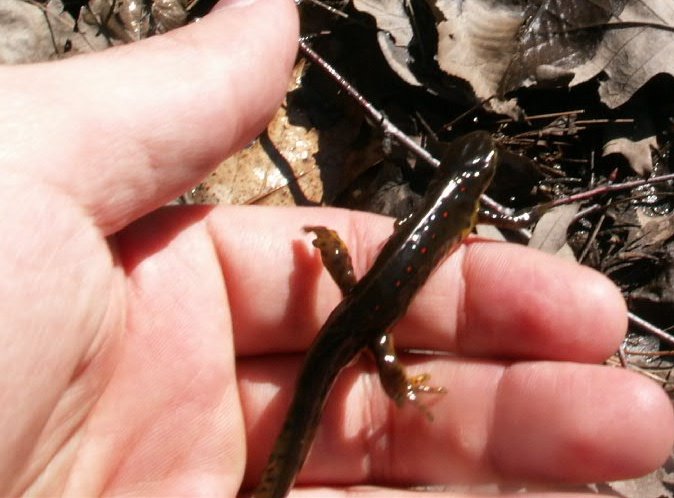


I love newts. They are pretty in their adult form (these are adults), and they are beautiful in their intermediate form, the ‘eft’ that leaves the water after its larval phase and is frequently seen marching around in wet weather. The red-spotted newt’s efts are bright orange with those same red spots that the adults have. Newts are poisonous. Few creatures eat them, and they move with the slow, steady confidence of an animal that does not have to worry about being attacked. These were a piece of cake to pluck out of the water.

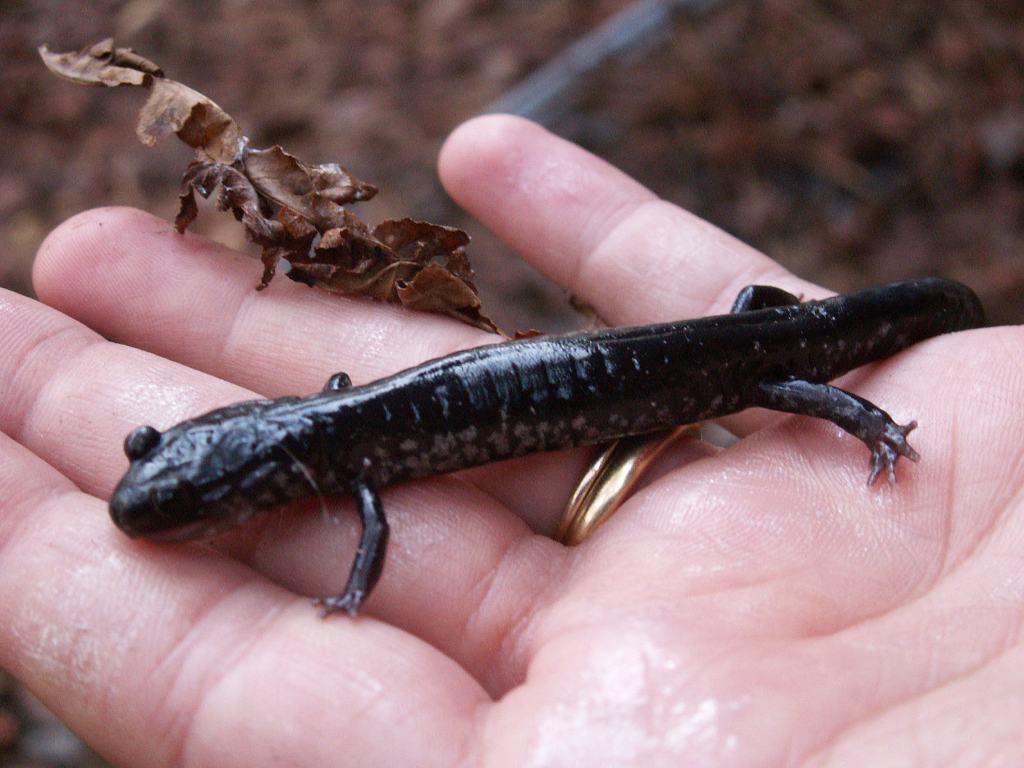
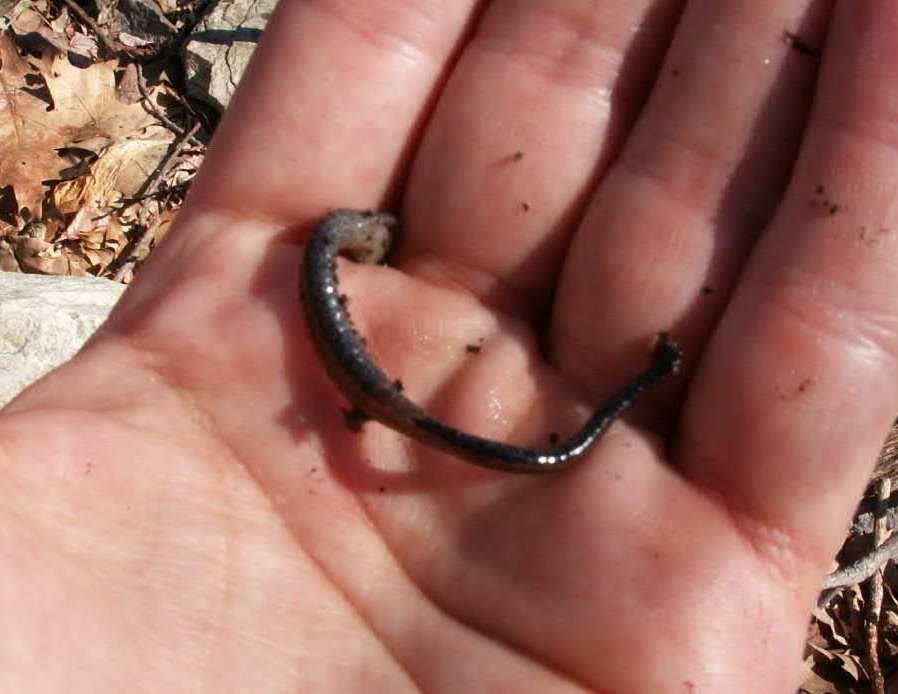
I also found some redback salamanders (Plethodon cinereus). Here’s a pair as I found them under a rock:


Here’s another trying with all its might to burrow through my hand:


After we felt we had sufficiently cased the mountain bog and pond, we headed on to some promising timber rattler habitat. After hiking for a few miles we made the decision to cut south and find some boulder fields and outcroppings. The decision to head downhill was based on a combination of impatience and my reading of my topographical map of the area (a Christmas gift from Susan Walker and Fernando Ornelas). I guess we guessed right, because soon we hit the edge. The gently sloping forest floor fell away into a steep slope of tumbled rocks and two-story outcroppings jutting out from the mountainside.
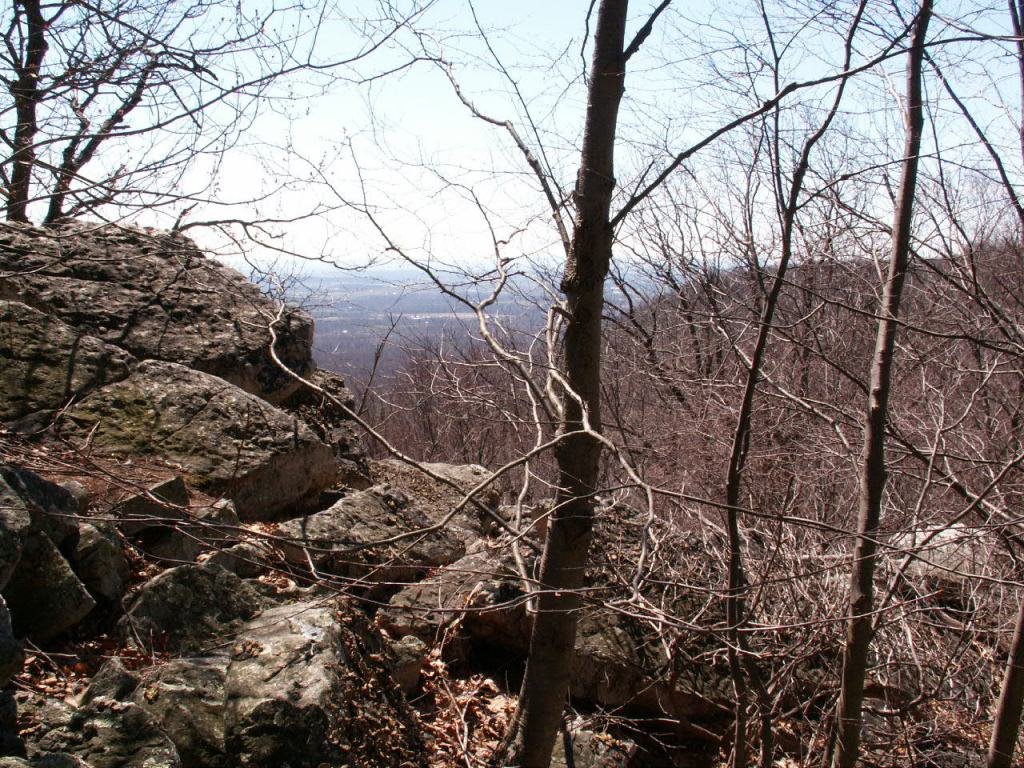
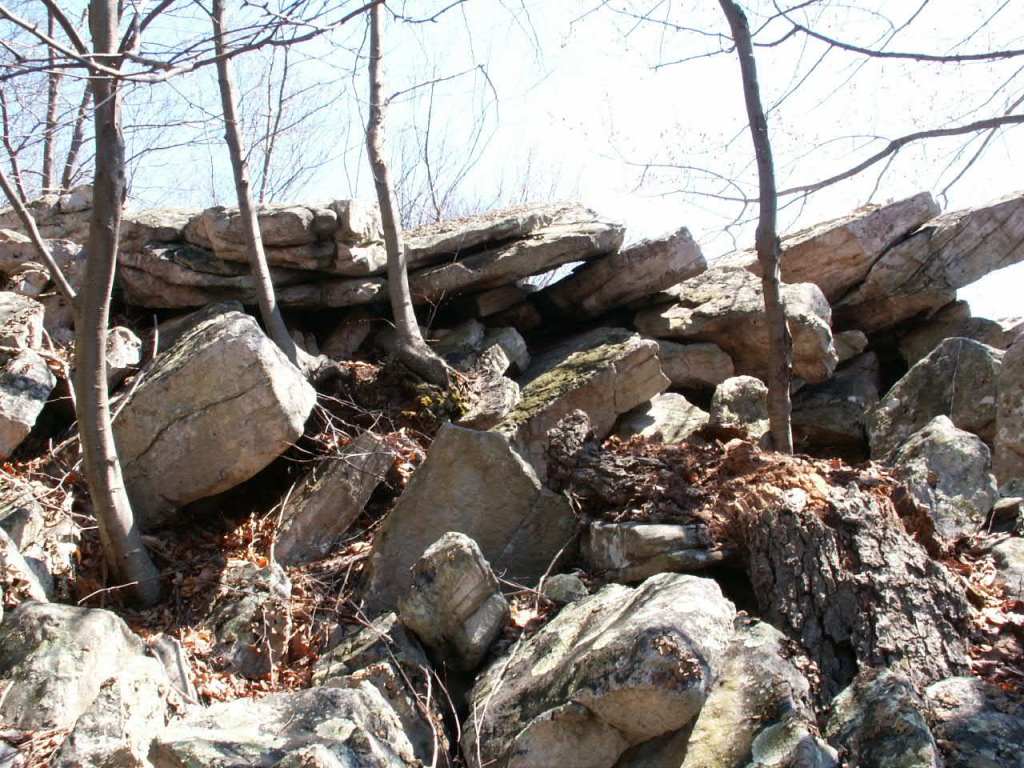


We worked our way back along this landscape, studying the slopes for snakes and peering into cracks and spaces between the rocks. We found nothing. We got a lot of exercise, but saw no snakes.

We made our way back to the car and tried a couple more spots after that. We found no snakes, but I did make a big find, for me at least.

I flipped what struck me as too small a log to house much, and I saw three redback salamanders (all the leadback phase, interestingly) and this brilliant little gem:

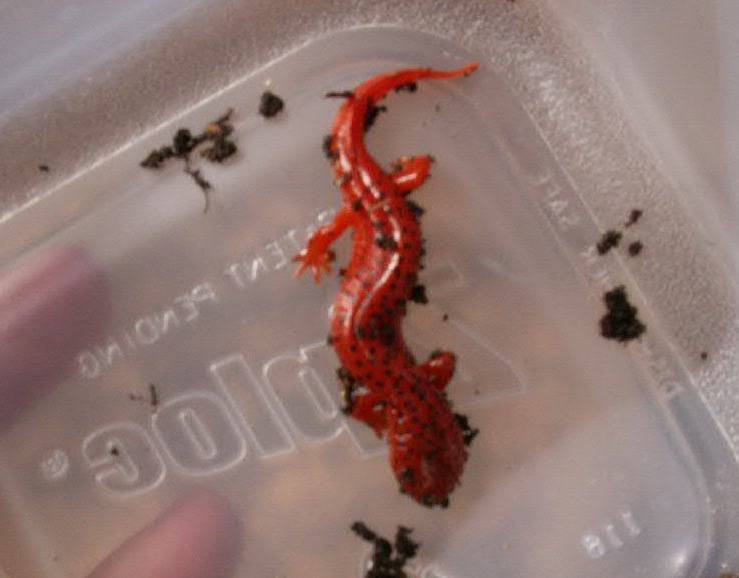


This is a red salamander (Pseudotron ruber). I had never caught one of these, and they have been on my short list of critters to find. I hope you can see why. Like the efts, they are painted a totally unnaturally bright color. They also have cartoonishly rounded features that give them an almost cuddly look. They may actually mimic the efts, gaining some protection from predators that have learned to avoid their poisonous look-alikes.

I also found a little (2 inches) slimy salamander (Plethodon glutinosis) under another log. I like how these little slimies have big, brassy spots on their backs, though the pictures did not turn out well:


Scott did some rock flipping at the bottom of the slope and found “thousands” of redback salamanders. He also flipped this itty-bitty two lined salamander (Eurycea bislineata) at the edge of a stream. In one of the cutest episodes so far this year, it tried to bite his hand:


Conditions were sunny and in the low 60s.

Totals:

Red spotted newts: 15+
Redback salamanders: 12+
Slimy salamanders: 1
Two-lined salamanders: 1
Red salamander: 1
Spotted salamander eggs: five or so egg masses
Wood frog eggs: absolutely mind blowing

Tuesday, April 04, 2006

This is the first of two egg mass posts. Egg masses are what connect my herping trips last weekend. I can’t think of anything else except that wherever I went I found eggmasses and amphibians hard at work at producing or eating egg masses.

Egg masses are kind of gross to look at. To prove that point, here are some photos of egg masses:

Wood frog (Rana sylvatica):


Spotted salamander (Ambystoma maculatum):


Tiger salamander (Ambystoma tigrinum):


I’ll point out here that the spotted and tiger salamanders are target species for me. I’ve never seen adults of either, and I’m pretty pissed off at myself for missing their respective breeding aggregations. Both come out in hordes on cold, rainy nights for a huge orgy (there’s no better word) of breeding and egg laying.

In New Jersey and Delaware the tiger salamanders tend to breed in December and January, while the spotted salamanders get it on in February and March. It was February that I learned that the tigers here breed in December and January, so I got to feel frustrated in retrospect. I knew darn well when the spotted salamanders were breeding (we only had so many rainy nights in March); I was out of town or otherwise occupied when they were doing their thing.

I’ve seen plenty of photographs of the breeding aggregations (the scientific term for an amphibian orgy), so I know what I was missing: hundreds or thousands of salamanders marching through meadows and forests, across roads and over hills to reach their little vernal pools in the woods. They then mill about in the water, the males dropping their spermatophores (little white balls o’sperm tethered to the bottom), and the females then picking them up with their cloacas and soon popping out gelatinous globes of clear eggs. It’s apparently quite an exciting thing to witness. I don’t have many plans that extend beyond the next few months, but it is a major goal of mine to catch them in the act next winter and spring.

It would be nice to see wood frogs too. I’ve caught plenty of the adults, but it would be cool to see them hopping about the frigid water and quacking to each other in an effort to hook up.

I went out to some Delmarva Bays in Delaware to see if I could catch the next breeders and maybe find some lingering salamanders under logs or artificial cover (a.k.a. trash). Those next breeders are all frogs: spring peepers (Pseudacris crucifer), New Jersey chorus frogs (Pseudacris triseriata kalmi), southern leopard frogs (Rana ultricularia), and pickerel frogs (Rana palustris).

I heard them all calling as I pulled on my hip-wader boots next to my car. I took my net in one hand, slung my camera around my neck, and marched off to the water.

Spring peepers are one of the most aptly named creatures on the planet. Every spring the males take up positions in low vegetation near water and start calling. They make a clear, high-pitched peep. You have heard spring peepers. You might not have known what they were when you heard them, but their choruses are one of the most common and distinctive sounds of spring just about anywhere in the eastern and central United States.

Chorus frogs make a different noise: kind of like a finger being pulled across the teeth of a comb, but maybe a little bit more musical than that. Pickerel frogs and southern leopard frogs both make a farting/snoring noise. The pickerel frogs do it in slower, longer notes; the southern leopard frogs make pretty much the same sound as a faster trill.

The Delmarva bay:


The spring peepers were calling from the bushes around the bay, while the chorus frogs seemed to be calling from the bushes growing out of the water, or, more specifically, out of the moss at the bases of these bushes.
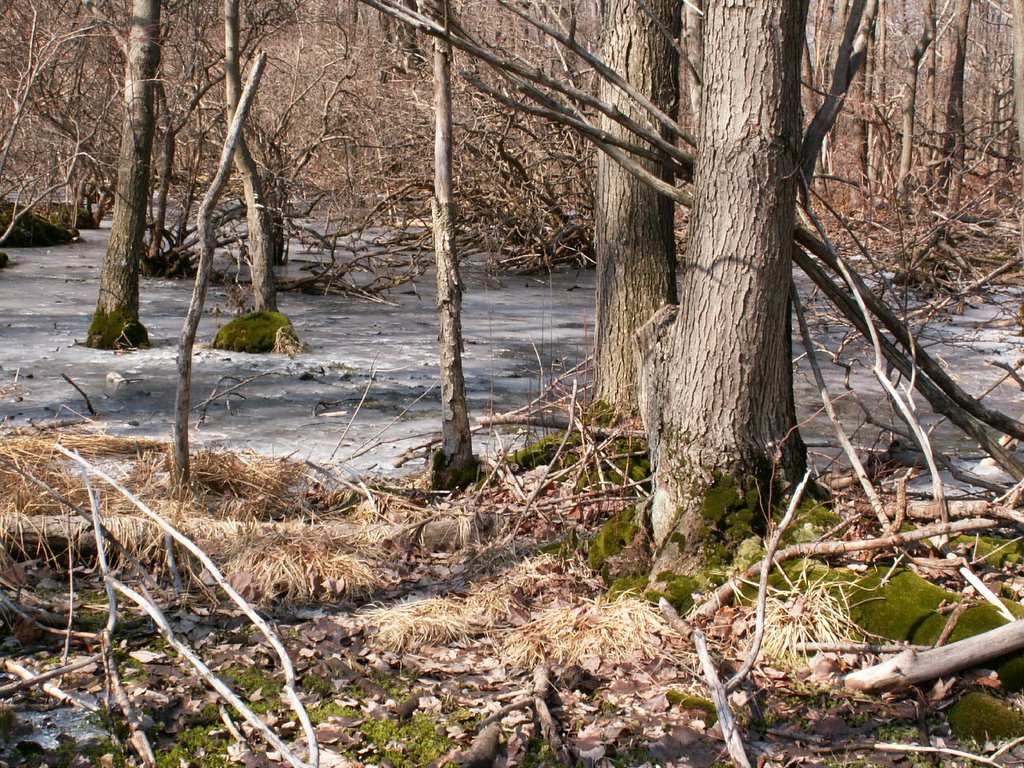


The chorus frogs and peepers were calling from all around me as I waded out among the bushes. There were a few pickerel and leopard frogs calling from the edges, but the little guys ruled that pond on Saturday. They called in waves. I would hear a couple peeps or chorus frog calls, then a few more would answer, and soon they were all yelling at each other from all directions. Then they would stop for a couple minutes.
I picked out one of the chorus frogs calling near me. I slogged a few yards over to triangulate, and then I headed slowly towards the bush that the little guy had claimed for his stage.

He shut up. The others were still calling, so I think he saw or heard me. I froze. Soon they whole chorus ceased. I waited with my eyes fixed in his direction. Soon, a chorus frog across the pond couldn’t take the silence anymore and started singing again. That frog's rivals couldn’t let that go without a challenge, and the wave swept towards me. My frog forgot about me, started singing too, and I took a few more steps. I kept staring, trying to spot that inch-long troubadour as he inflated his throat to sing. After twenty minutes of this I had reached the bush, but my frog was keeping his mouth shut. I looked all around the bush, I pulled apart some of the moss to peek inside, and I stuck my net underneath and shook hard to see if I couldn’t knock him out of there, but either he was holding on really tight or he had fled.

Undeterred, I picked out another bush (stopped for some egg mass photos) and repeated. I did this for almost two hours, and I did not see a single chorus frog or spring peeper. I tried sweeping my net around a small, emergent tree. I caught these large tadpoles, but no frogs.


I hiked around for another hour after I gave up on the bay. I tried turning over logs, but the ground was almost uniformly dry, and the only critter I saw was this little leadback-phase redback salamander (Plethodon cinereus).


On the upside, this trip confirmed the existence of tiger salamanders and spotted salamanders in this pond; now it’s just a question of waiting a year and watching the forecasts.

I will try frog stalking again sooner, next time at night. If I understand correctly, the frogs come out into the open a little more when it’s dark out. A couple people with flashlights standing a few yards apart can each point their beam at the sound of one frog calling and pretty reliably catch it in the act at the crux of the beams.

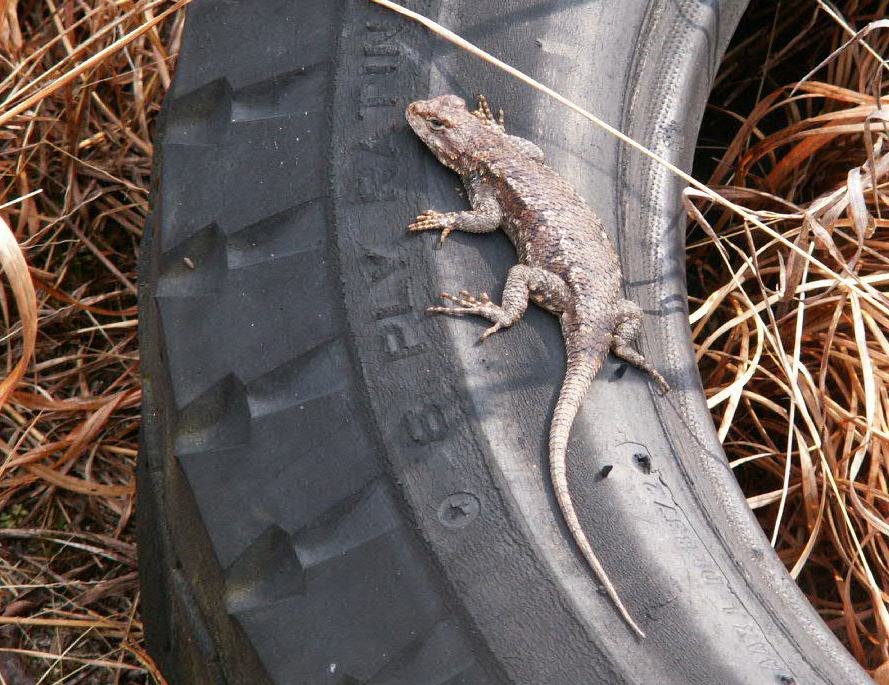
I visited some trash piles in western Atlantic County, New Jersey that afternoon. I didn’t find much. There were more frogs calling from a vernal wetland, and I got a good shot of this fence lizard (Sceloporus undulatus hyacinthinus). I was looking under tires a few yards away, and I got the feeling it was wondering what the hell I was doing.


Conditions were cloudy and humid with some rain in the morning and partly cloudy in the afternoon. Temperatures were in the high 60s.
Totals (excluding egg masses):

1 redback salamander
1 fence lizard
? Spring peepers heard
? New Jersey chorus frogs heard
? Pickerel frogs heard
? Southern leopard frogs heard

Monday, March 20, 2006


I had almost dug out the rat snake when I remembered the large tree trunk above me. I was breaking away chunks of rotting wood in an effort to uncover the rat snake that Jen had spotted with her amazing eye for herpetological detail.

We were in South Carolina, in the eastern section of Francis Marion National Forest. We were down for a wedding in Charleston, and we decided to drive down and make a little vacation of it once we realized how expensive it would have been to fly to Charleston directly.

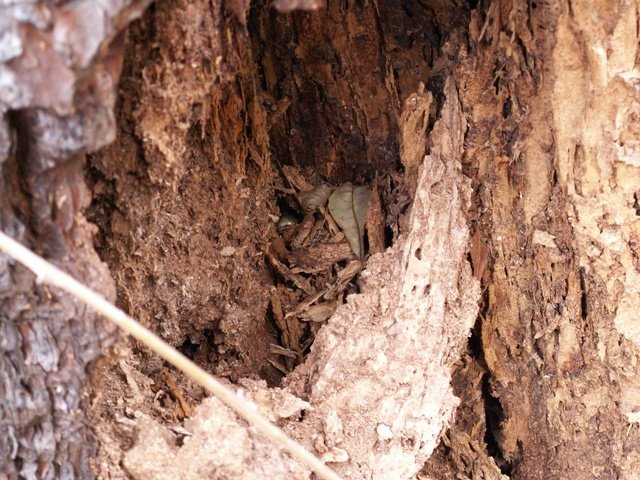
Anyhow, here is what Jen saw - the nose sticking out of this hole in the stump.


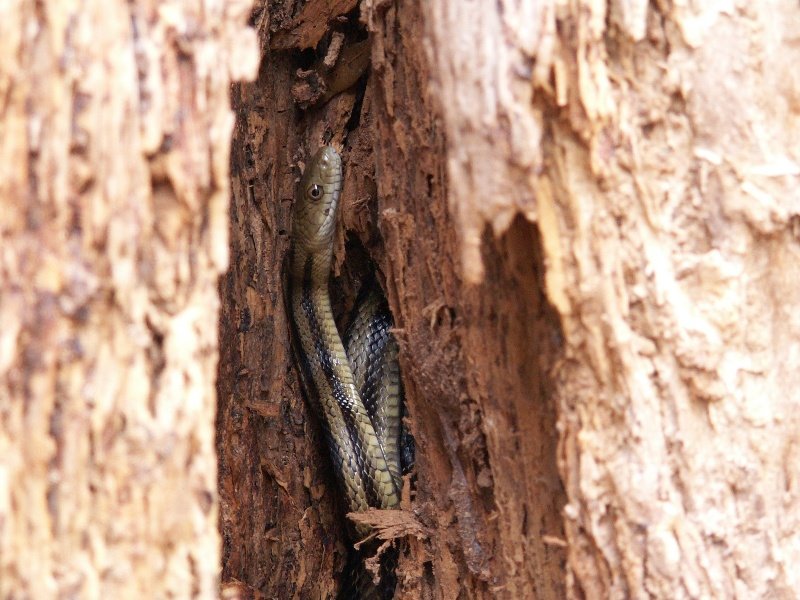
After some peering down in there, I decided it was a ‘greenish’ rat snake (Elaphe obsoleta obsoleta x quadrivittata), an intergrade between the black rat snakes (Elaphe o. obsoleta) that we have up here in the Northeast and the yellow rat snakes (Elaphe o. quadrivittata) that rule the southern coastal plain. The black rat snakes are usually solid black, the yellow rat snakes are yellow with black lines down their backs. When they mix in the wild the product is a dirty-green snake with thick black lines. These have a reputation for being ugly to look at and mean to handle.

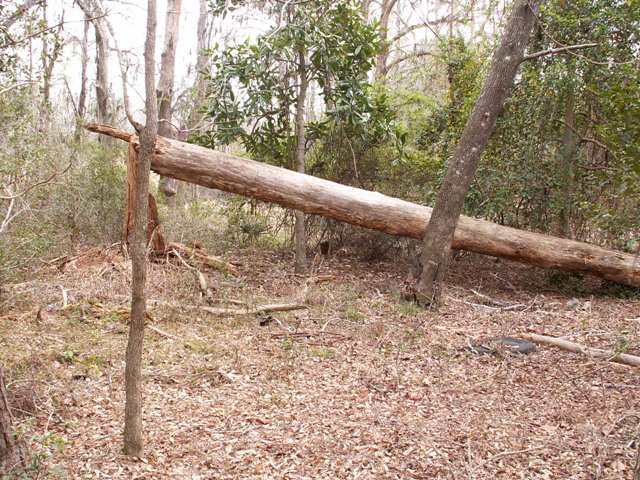
I wanted to see more than the nose of this snake, but when it occurred to me that I was tearing away at the vertical support for this tree trunk (please excuse the smaller tree I somehow managed to catch in the foreground), I stopped.


We decided to go look around elsewhere and come back when the snake had had some time to calm down and come back out to bask. This is the view we found when we returned.


Jen rates this find second only to the scarlet king snake (Lampropeltis triangulum elapsoides) she found in Alabama four years ago.

Here are some other highlights of the trip:

This is another of the ambystomid salamanders, a Mole salamander (Ambystoma talpoideum). These are usually deep underground, so I was surprised to find it under a log.


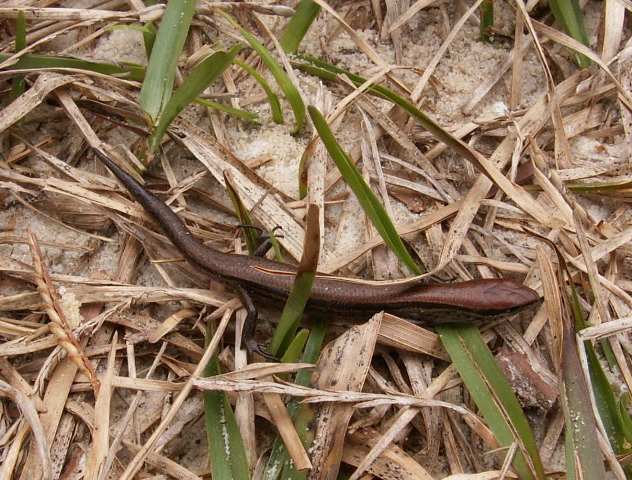
Here is a tiny ground skink (about three inches) we found elsewhere in the forest. These live in South Jersey too, but I’ve never found one there.


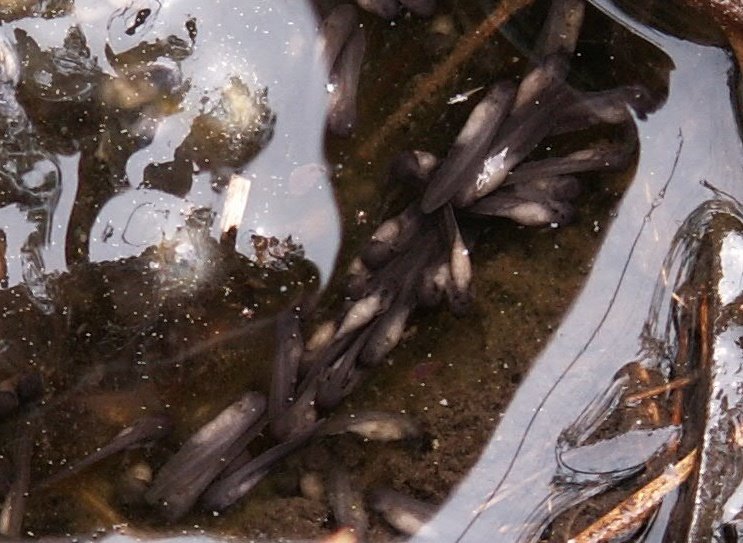
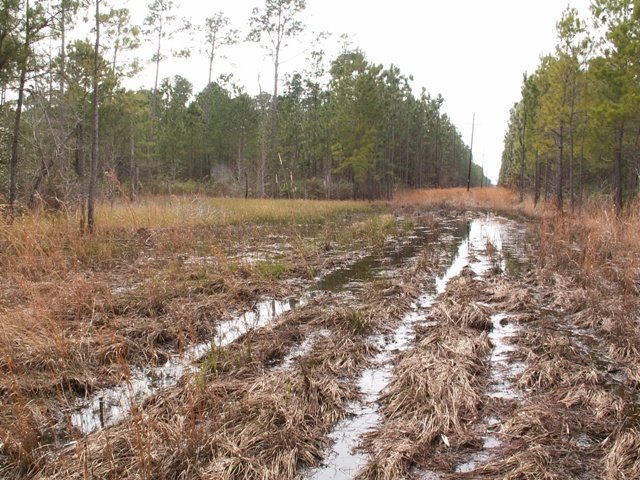
Here is a really special sight: a bunch of salamander larvae (each about 1/4 inch) hatching out of an egg mass in this wet spot in a right-of-way. These eggs were laid by some salamander (perhaps a mole salamander) a few nights before.


I scooped these tadpoles (each about one inch) out of one of those puddles. I don't know what kind of frog they'll grow into.


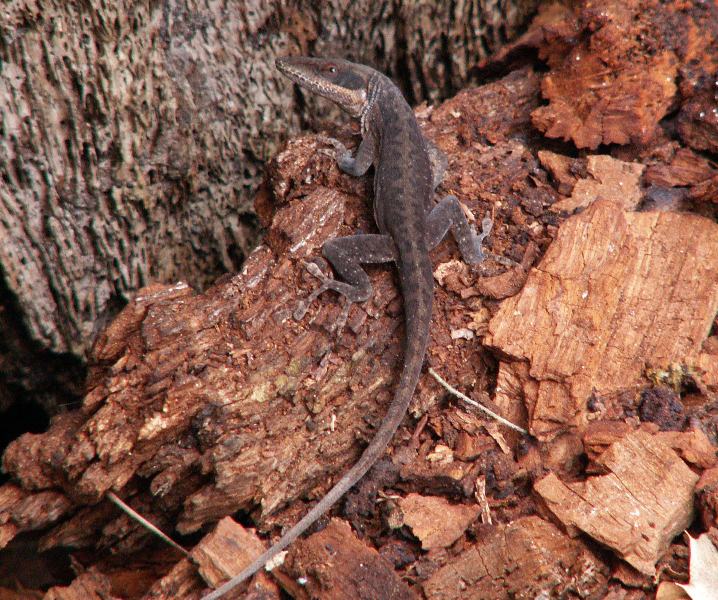
Last, here are some pictures of green anoles (Anolis carolinensis) that we found in the national forest. These guys are as common as the brown anoles (Anolis sagrei) are in Florida, and their abundance in a brown anole-free place makes me reconsider my thinking that the brown anoles are pretty benign in Florida. In Florida you only see the green anoles up in trees, while the broan anoles rule the ground and low vegetation. Since the green anoles were so common everywhere in South Carolina (they were coming out of the woodwork!), I have to conclude that the brown anoles are pushing them out of part of their natural habitat in Florida.


Here's an interesting anole behavior we saw close to Myrtle Beach. Anoles sleep on twigs at night, and here is one getting ready to go to sleep a little early (around 5:30 pm). It was still light out, but when I got close the little guy did not jump but just hugged tightly to his twig.


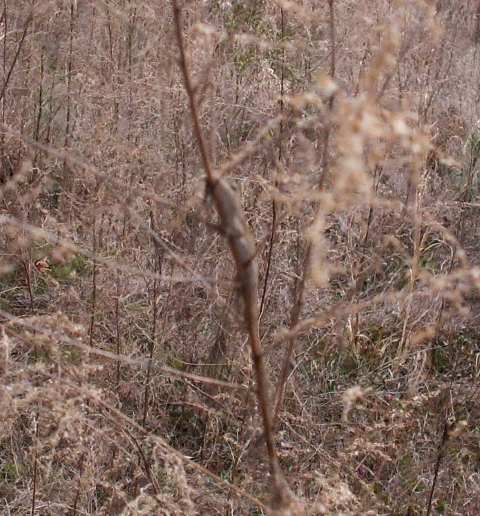
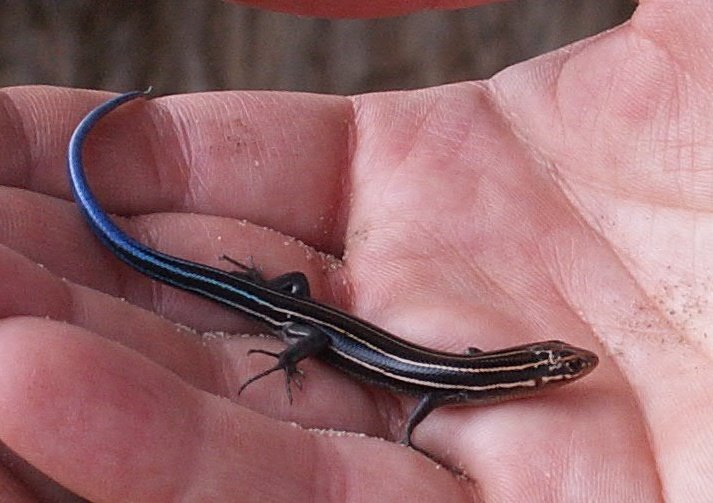
This is either a young southeastern five-lined skink (Eumeces inexpectatus) or broad-headed skink (Eumeces laticeps) that we found near Myrtle Beach. They look about the same, and this one was too small and squirmy for me to feel like counting scales to be sure of the identification.


Last, here is a slimy salamander (Plethodon glutinosis) that Jen nabbed.


We found the skink and the anole on the twig near Myrtle Beach on March 9. The temperature was about 65 degrees. It had been partly cloudy and relatively dry that day. In Francis Marion NF the temperatures were in the low 70s and the skies were partly cloudy.

Trip totals:

1 greenish rat snake
1 ? skink
>30 anoles
3 ground skinks
>20 basking turtles
>10 bronze frogs (Rana clamitans clamitans)
1 mole salamander
7 slimy salamanders
? spring peepers heard (Pseudoacris crucifer)
Last week this is all I found:


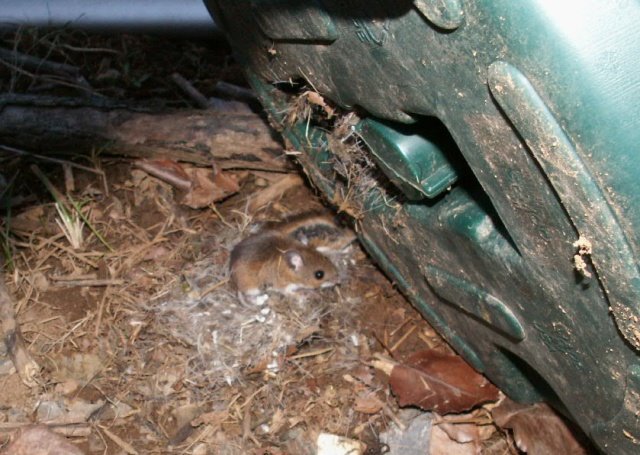
These were not herps, but they were pretty cute. This might be my greatest flaw as someone who loves snakes: that I am almost as enamored of their prey.

To be fair, I also found centipedes, beetles, roaches, and worms. I saw many robins, vultures, English sparrows, and even a red-tailed hawk. All these, though, are so common that to say that I “found” them would be like saying I found a telephone pole outside my apartment building on Spruce Street.

These mice, by contrast, are a special find. I lifted up this discarded base of something, and there they were, quivering and staring at me with those huge, liquid eyes.

I found them behind a hotel in State College where I was staying this week for a meeting. I had checked out the area on my Google Earth (my new best friend) and noticed some green space around the hotel, much of which turned out to be a few acres of marsh with a stream winding through. Unfortunately the weather had been dry and cold, and I was out poking around as the sun was going down and the temperature was falling.

I also went out scouting Saturday morning. Google Earth revealed to me just how over-grown the cemetery is south of Baltimore Ave. along Cobbs Creek, and that the creek would be worth exploring down there as well as around the Cobbs Creek Community Environmental Education Center, where I spend most of my time along the creek. Sure enough, this area looks like fun.

There are logs and trash galore, and I would expect the usual suspects there in the Spring.

I was, though, quite unsettled by the cemetery. I usually love cemeteries. In my senior year of college I lived next to the gorgeous Indian Hill cemetery, in Atlanta I spent a lot of time in the Oakland cemetery, and here in West Philly I have fallen in love with the Woodlands, the cemetery just south of where the trolleys go underground on Baltimore Ave. I have enjoyed these cemeteries' open grass shaded by well-spaced trees, many of them huge, majestic centenarians that radiate peace and calm. Few other people seem to like hanging out in cemeteries, making them fine places to jog, stroll, or bask without cars whizzing by or kids shouting. I like people, of course, but sometimes it’s nice if they all lie quietly and stay out of sight.

This Southwest Philly cemetery, however, was a mess. Many markers were off their bases, several sections have been taken over by weeds and tall grass, and people have even been dumping their trash in the cemetery. This took me quite aback. It’s one thing to dump trash in a vacant lot or out in the woods. That’s illegal, lazy, and gross. Dumping your old mattress or piles of boards on top of someone’s grandmother’s eternal resting place, however, strikes is a disgusting insult to the dead and those who remember them.

The problem with this cemetery, I guess, is that few people are remembered there. I will return there to look for critters and perhaps to jog, but I have made a decision to try to clean up a little each time I go back, to pull the trash from the graves and pile it neatly on the edges of the paths, if nothing else.

Sunday, March 05, 2006

We had one more shot to find some interesting critters in Brazil: our hike in the Tijuca National Park in Rio de Janeiro.

I had booked us two spots in a guided hike up to the top of Tijuca Peak. Guided hikes can be a lot of fun as hikes, but they are not often great for herping, since the group tends to want to keep moving rather than stop every twenty feet to look under logs. So while I was excited for the hike and for the beautiful views of Rio, finding herps was going to be a question of incidental sightings rather than intentional finds.

The Tijuca forest and park (some of the area is national forest, some is national park) date from 19th century. The land was originally used to grow coffee and sugar, but in mid-1800s the government decided to let it grow back as forest to protect Rio de Janeiro’s water supply. The result is a remarkably large and wild chunk of Mata Atlantica (Atlantic coastal forest) right next to a city of six million people.

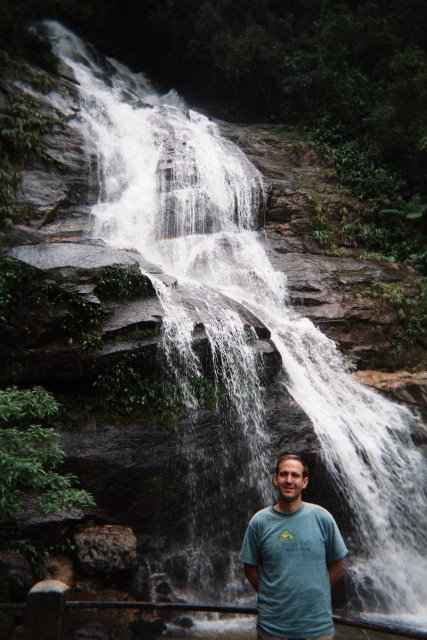
The views were beautiful, as expected. The weather was cool and damp, but it stayed nice enough to take some good pictures even with the crappy, backup, disposable cameras. Here I am at a waterfall relatively low down in the park.


Here we are at the “Vista Chinesa.”


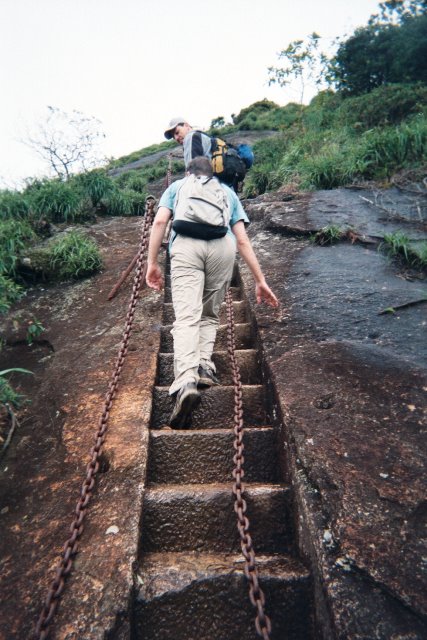
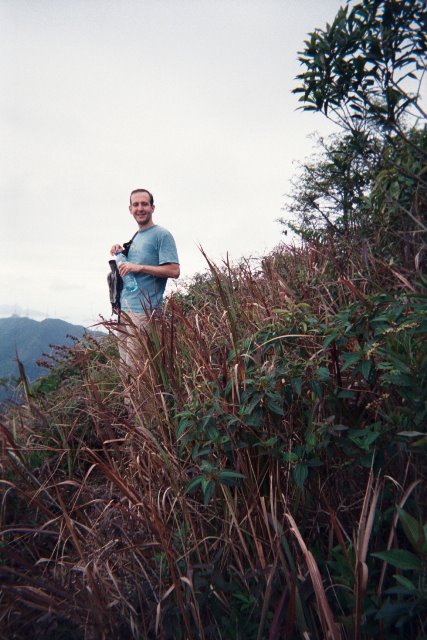
Last, here are some pictures of us ascending and then standing around the top of the peak. The dense forest gives way to low trees and then bushes and large tussocks of grass at the top.


We actually did spot some critters, or rather Jen spotted three and I saw the tail of one snake. They were all at the top of the peak, where we were graced by the only sunbeams that made it through the clouds during our entire stay in Rio.

Jen pointed out the first one, what looked like another Tropidurus torquatus, and then a skink basking on top of a large grass tussock (I love that word). I tried to get a photo of it, and this is what came out. I am pretty sure it is some species of Mabuya.


I had grilled our guide on the way up about the snakes he had seen, and they seemed to fall into two categories: a few species of pit vipers (Bothrops species) and something he said is called the cobra cipó, Portuguese for “air root snake." The first group are all venomous, some quite dangerously so. The latter, a long, thin, green snake, did not sound scary.

I saw the green tail of something slipping away into a heap of grass and I hesitated. I can’t remember if I was close enough to leap to grab it, but I did not. I have to guess at what I saw slip away, and I’m guessing it was the cobra cipó (Chironius bicarinatus), a fast, diurnal snake that is sort of a South American version of our racers and whipsnakes (Coluber and Masticophis species). Here is a link to a Portuguese-language web page about the cobra cipó: http://www.saudeanimal.com.br/cobra_cipo.htm

It feels kind of sad to finish the last post about my honeymoon. I had such high hopes, and we ended up finding so little. To write the final chapter feels like forgetting about even the aspirations; I’m shelving a fantasy. I don’t know if we’ll make it back to Brazil. We certainly intend to visit the Amazon some day, and the Pantanal still looks really attractive, but Bolivia makes a little more sense to me since I speak Spanish and know the country from having spent a couple months there back in 2000.
I’ve been intrigued for a long time by urban brown snakes (Storeria dekayi).

I remember reading about them living in Central Park in New York, and I was not surprised to see them dead, flattened, and dried out on roads near Grant Park in Atlanta or near the Wissahickon. I brought one of those rigid little snake chips inside once to look at it more closely and then put it away in my dresser and forgot about it, a slip of the memory that Jen still reminds me about; she was the one who found it several months later while digging around in my dresser for socks to borrow.

I live in West Philly, a landscape of rowhouses and old three-story duplexes. Some of these have little front gardens or yards, some don’t. A lot of blocks here have alleys and parking spaces running through the middle, some have little yards out back, but when you add it all up, there is not a lot of green space around here.

Thus I was kind of shocked when a friend who lives on the 4300 block of Locust showed me a snake that her cat had dragged in. It had actually dragged in a total of five, but this was the only one that was alive, and she was nursing it back to health. It was a northern brown snake (Storeria dekayi dekayi), and a big one at that – all of fifteen inches and as thick around as my pinkie finger.


I’ve heard more reports since then of northern brown snakes in unlikely (to me at least) places. One of Jen’s coworkers spotted one in her basement in East Falls. Friends reported seeing a small snake one night at 48th and Baltimore. Another Philly herper I recently started corresponding with reported seeing them in backyards in Germantown.

While I have been surprised at finding northern brown snakes in West and Northwest Philadelphia, I am ruling out Center City, where there is next to no green space and what green space can be found (Rittenhouse Square? Logan Square?) is intensively landscaped and isolated. Back yards in Germantown and West Philly are connected to other yards and separated by streets with relatively little car traffic. The yards are less likely to be doused with pesticides, and most of the time are left alone by humans.

I have thought of a few strategies to find northern brown snakes in Philadelphia:

· The first thing that came to my mind (and the riskiest), is to walk down the pavement between yards in the middle of relatively abandoned blocks in Southwest and North Philly and look under trash in the vacant yards.
· One slightly-safer, similar plan is to look under trash and debris in vacant lots – I still run the risk of getting shot for poking around someone’s stash, but at least I don’t run the risk of getting shot for jumping into someone’s back yard.
· The safest but least exciting plan is to look in parks. I’ve found live brown snakes in Cobbs Creek, and I know they live in the Wissahickon. I’d like to spend some time looking under logs in the wooded sections of Fairmont Park northwest of and across the river from the art museum.
· Coming in at safe but unseemly is herping cemeteries. There are great slightly-neglected cemeteries all around – in West Philadelphia, Southwest, North Philly, and so on.
· Safe and maybe the richest in terms of trash and debris are abandoned industrial spaces. I checked one such area out on Saturday, and here are some photos. I saw “No Dumping” signs, which of course mean that a lot of dumping goes on. This space is also supposed to be redeveloped in June, so I’ll look forward to relocating any snakes I find.


The weather will probably be getting warmer at the end of next week. With the days getting longer too, I’m looking forward to biking all over the city after work to see where I can uncover some brown snakes.


P.S. I looked around for critters in South Jersey in western Atlantic County and near Winslow. I found nothing.

Sunday, February 26, 2006

This blog is about my herping activities, about how I wander around (mostly in and near Philadelphia) looking for reptiles and amphibians.

There is another side of my hobby: I also keep snakes (in the past lizards and turtles too) as quasi-pets. I won’t write about keeping herps in this blog, tempting though it may be, but I thought I should explain what brought me to Hamburg, PA Saturday morning. I was there for the bimonthly reptile show. This is an event at which vendors set up tables to sell the critters they’ve bred and imported as well as to sell anything one could need to support captive herps: cages, bedding, water bowls, frozen rodents, fruit fly cultures, etc.

I am not a big fan of the captive herp industry (I prefer to buy from and sell to other hobbyists and to adopt unwanted herps), and as usual I left feeling a little nauseated and unsettled. I had the frozen rodents I had needed, and I headed for the hills for a cleansing hiking and scouting session.

There is a line of Pennsylvania state game lands (SGLs) and state forests on the ridges to the north of I-78 in Berks, Schuylkill, and Lehigh Counties. These are the closest mountains for Philadelphians, as far as I can tell. Several species of herps reach the edge of their range there. Others are more abundant than in the piedmont and coastal plain. Timber rattlesnakes (Crotalus horridus) live in those hills as well as redbellied snakes (Storeria), both of which are target species for me this year.

I scouted around those ridges on Saturday, and I had a great time. The forecast had been for a 50% chance of rain and snow, but the skies ended up blue and sunny, so that in spite of the 45 degree weather I did not need to bundle up.

I had brought a dip net in case I found some promising vernal pools. I found some great pools, but as you can see from this photo, there wasn’t much I could do with the net.


The ground was dry where it wasn’t frozen solid, and I blame the lack of moisture for my total failure to find any redback salamanders (Plethodon cinereus).

I also wonder how to herp the boulder fields on these hillsides. The south-facing sides of these ridges feature these steep slides of rocks and boulders.


These look perfect for timber rattlers, as well as ringneck snakes (Diadophis punctatus edwardsii) and copperheads (Agkistrodon contortrix) but how do I search for them when the rocks are too big for me to lift, and there’s nothing beneath them but more rocks and boulders when I can lift them? I pick one up, and all I see is all the gaps between the boulders underneath.

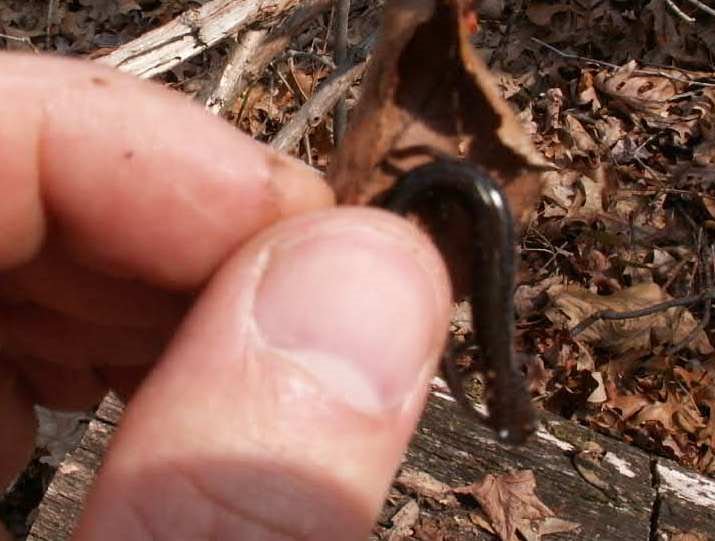
I only found one herp on my outing. I explored a new hillside in one of the SGLs and then tried a streambed. I picked up a streamside rock and saw a little tail wiggling in the water underneath. I gently scooped it up and put it in the container I had brought along. It was so tiny, about three quarters of an inch. Note the two parallel rows of little spots down the back – these mark it as a baby northern dusky salamander (Desmognathus fuscus).
We made one trip into the forest. Although we had seen rain inland on our original trip out to Corumbau, it was dry in the forest. We tried looking around in two areas: a cacao farm and the Monte Pascoal National Park.

The only things we saw at the cacao farm that remotely resembled herps were chickens. I don’t say that because chickens, like all birds, are more closely related to crocodilians than crocodilians are to any other reptiles, thus sort of rendering birds reptiles, but because they sound a hell of a lot like lizards when they’re kicking their way through underbrush.

At the cacao farm we started off moving through a cacao grove, looking under piles of leaves and flipping any logs we came across.


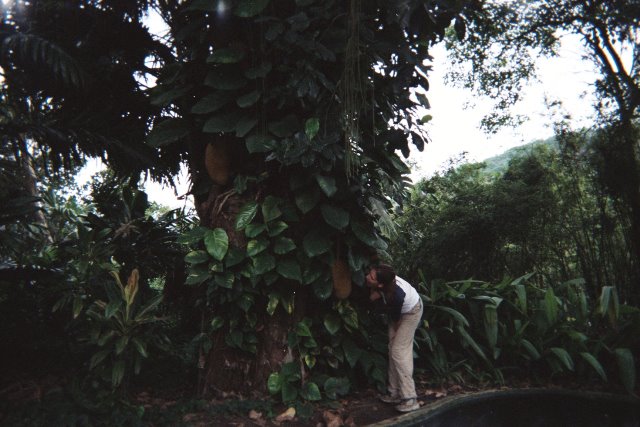
In this part of Brazil cacao has to be grown in the shade of larger trees to maintain the necessary high humidity. Many of these larger trees were jackfruit trees, which are pretty impressive if you’ve never seen one. The jackfruit look like huge spiky sacks and they grow straight from the trunks. Here’s Jen with a jackfruit tree in Rio.


We moved towards a creek and checked around and under rocks there. We found nothing. This was all so very disheartening because it seemed like such a great place for critters. The eco-resort worker, Jason, told us about all the snakes he had seen there a few months before.

We stopped by a pond at the edge of the woods and a pasture – another fine place to find critters. I found nothing, but Jen, who was poking around the trees, froze like she had noticed something important. I watched her turn her head to look around carefully, stare at something, and then crack up laughing.

“What?” I hollered. Jen was still laughing. Finally she pointed and shouted back, “Chickens!”
Sure enough there was a small group of scrawny chickens kicking its way through the underbrush. Jen at first had thought she had heard a large lizard – rustle, pause, rustle, pause – but then the noise had grown to sound like a group of lizards moving together (highly unlikely), until she could see them coming towards her. This is about when we figured out the digital camera wasn’t working; it would be cool to post a shot of those raggedy, little Bahian chickens.

So, in a slightly sour mood (I at least) we hopped back in the truck and headed towards the park. What’s supposed to happen when you get to the entrance is you walk through the gate, and you meet your guide – an Indian who will take you around for a tip of about ten dollars. When we showed up, though, the one adult Indian there was leaving to help fight a fire in the middle section of the park – another problem caused by the dry spell (not to say that my not finding herps is a problem on par with a forest fire).

The substitute guides were two boys, probably eight and six years old. I was dressed in boots, hiking pants, and a long sleeved shirt to keep away mosquitoes and biting flies; these guys were decked out in all of shorts and flip flops.

The air was dry and hot, and the leaves crunched underfoot as we walked. When I think of a rainforest, I think wet and muddy. Maybe the forest there is naturally drier than I expected, but the drought apparently had made things drier than they would have been otherwise. On our hike we saw some very large trees, some vines shaped like ladders that are called ‘monkey’s ladders,’ and some large leaves that when plucked and smacked hard on the base of the stem produced a loud thump like striking a drum.

We saw three types of herps while hiking around with our mini-guides. The first was a tiny toad (Proceratophrys appendiculata) that the guides spotted. It was about as big as a nickel and had a bizarre head – a sort of a triangular shape with a pointed nose. Do you want to see the photo I took of such an interesting and bizarre creature? There, there is it on the leaf. So much for using backup disposable cameras.


A few minutes later the guides perked up. “A tegu!” they whispered. I was maybe fifth in line, but Jen was closer. Her eyes followed the line of the guides’ pointing arms and gasped. It was, she said, a large lizard, black with red and gold markings. By the time I got up close to see, it (a Tupinambis species) was gone, but that was truly an exciting find. I used to see a lot of another species of tegu (Tupinambis marianae) in a park in Buenos Aires when I lived there. The biggest of them, maybe four feet long, looked like dragons as they basked on the trails. I remember one giant on the other side of the fence from the park as it inspected piles of junk, checking every crack and crevice for something to dig up and eat. Tegus resemble the large Asian and African monitor lizards (Veranus), but are more closely related to the ameiva (Ameiva ameiva?) we saw earlier and the race-runners (Cnemidophorus species) we’ve got here in the United States. Here are some links to tegu pictures and to shots of their smaller N. American cousins from a reptile dealer's website (http://markmlucas.com/Monitorgallery.htm).

We hiked to a streambed. It was about twenty feet wide, but what we saw dribbled downhill from one stagnant pool to another. I did see a group of fat, black tadpoles in one of these little pools. I did not get a good photo, and I have no idea what they were.

On our way back out we nearly ran over another tegu. Again, I totally missed it. Jen was leaning forward in her seat when it flashed by on the road (I was staring out the side window), and so managed to spot her second large tegu in just a couple hours.

We rode back via the more ‘interesting’ route – bumping along over rutted dirt roads through cattle ranches and admiring the view of the park to our left. We saw no more herps, but we did see caracaras (birds of prey that seem to walk around on the ground as much as fly to look for food), and a lot of zebu, the breed of choice for ranchers in that part of the country. While we did pass some subsitence farms, most of the land is owned and worked by wealthy ranchers or farmers who live in the big cities. Most of Brazil that gets any rain is cattle country, including much of what used to be rainforest. If I ever needed another reason to not eat beef, seeing how ranching destroys the environment is it.

I don’t want to end this on too sour a note. We had a great time on this trip, and we really got an impressive tour of the countryside just inland from our resort.

Here are some shots of the countryside. Note the smoke rising from the park in the first photo.


Here's Jen posing for a shot with Monte Pascoal.