Saturday, May 10, 2008

Update: Eitan posted his account of the trip here (see "Pennsylvania 05/08"). You'll see it wasn't just me going all loopy; the day was just that awesome!

I have dreams in which I'm finding more snakes than I know what to do with. They're usually species you can't find here like coral snakes or mountain kingsnakes, and they're often fanciful inventions of my imagination: half rat snake, half cobra or something similarly outlandish. I flip a board and find three more, five more crawl out from under a bush, and then they're everywhere; I'm simultaneously delighted and panicked that they'll get away because I can't catch that many snakes. I grab a handful (whether or not they're venomous) with one hand, then more with the other, but they keep crawling around me and I can't even get my camera out to start taking pictures. A little while ago Scott mentioned having roughly same dream, and I've started to wonder if this might be a universal dream for herpers, kind of like the not-having-studied-for-the-final dream (which I still occasionally have, even four years out of grad school) is universal for students.

On Tuesday (May 6th) that recurring snake dream came true for me.

After about a couple of hours driving and more than an hour of hiking (we found a few redback salamanders – Plethodon cinereus – and a leopard frog – Rana pipiens on the way), Eitan and I reached some rocky outcroppings I've been scouting and herping.

Simon and I had seen a couple timber rattlers (Crotalus horridus) and a black rat snake (Pantherophis obsoleta) there last year, and on a sunny spring day like Tuesday (highs in the low 70s in the mountains) I figured it was worth checking for more.

I'm a little nervous whenever I bring a fellow herper to one of my sites. Will the snakes show up or will they be inexplicably absent? Will I look like an idiot if nothing's out but birds and ants? It's like hearing about a party and bringing your friends along. You could turn out looking pretty cool if it's a good time, but if it's a bust everyone could blame you for the wasted evening. I know that all my herping buddies understand the fundamental unpredictability of herping and won't blame me for a skunked trip, but I still get a little anxious that things might not turn out.

We split up to start searching around the outcroppings and big slabs of sandstone. I headed for the coordinates of the snakes I'd seen last year, and Eitan searched above me on the slope. In five minutes it was clear I didn't have to worry about a thing; Eitan called me on the walkie talkie: he was looking at a black snake basking in the sun.

On his instructions I took a wide arc back to his location (to avoid walking too close to the snake), and together we stared at the tight black coil and plotted how to get closer for a photo without spooking it.

Here is a photo of Eitan making his approach,

and here is one of my photos of the snake.

Note that it looks kind of dirty. We're pretty sure it (and most of the other snakes we saw) had just come out of their dens after their long winter nap and haven't shed their skins yet. They'll look a lot shinier and prettier in a few weeks.

I headed downhill again while Eitan stayed to take a few more pictures. I don't think I'm very good at spotting critters (Jen's a natural, Chris supernatural), so I paused in front of a pile of boulders and looked around, forcing myself to stop moving and just observe.

Somehow that worked. I slowly panned to my left, and instead of just leaves, shrubs, and sandstone I saw the charcoal form of a rattler stretched out a few feet away.

This is a classic situation in herping: you and the snake (or turtle, frog, lizard, etc.) make eye contact, and you both freeze. The animal is hoping it hasn't actually been spotted but is ready to flee. Who moves first? You'd like to grab it or take a photo, but either action requires movement that could spook the animal. After a five second showdown I reached for my camera, and the rattler turned around and headed back for a space under a slab, buzzing a little as it retreated.

I was powerfully tempted to just reach out and grab it, but I obeyed the voice in my head reminding me not to get myself maimed or killed doing something that stupid. Rattlers are docile snakes, but they're not that docile. I took photos until I saw it stop, still in view under the rock.

I stood up, feeling quite pleased with myself, but then I heard buzzing coming from behind me. This time I didn't see the rattler, but I sure heard it buzzing away from beneath a slab to my left.

I was pretty excited at this point, and I called on the walkie talkie to Eitan to come right away. "Just a minute, Billy," he replied, "I just nearly stepped on another one. Over."

I figured my two weren't going anywhere, so I turned around, thinking to head uphill to see his second snake. I went about two steps before I stopped hard and froze again. There were two yellow rattlers right in front of me, and the bigger one was buzzing its tail off. I have no idea how I hadn't seen them on the way to my location; I must have passed them by about a yard. Apparently they'd been watching me the whole time and only decided to sound off when I looked like I was heading right towards them.

There are a few moments in herping I recall as among the happiest moments of my life, and this was one of them. I'm still feeling high as I think about it as I write this a few days later. At the time I was going a little nuts with glee, basically overloaded with not one, not two, not three, but four rattlesnakes to keep track of, and another one really close by. I pretty much spazzed out on the walkie talkie, shouting just-barely-coherently that I'd found TWO MORE! Eitan replied he'd be there in a minute, and I got down to taking pictures of the yellow pair.

Eitan soon showed up and was deep into photographing the yellow pair when I spotted the first rattler coming back out. Apparently this snake had somewhere to go, and it was not going to be deterred by the two humans standing a few yards away, just as long as they didn't move in its direction. This time I already had my camera out and the small motion of lifting it to my eye and pressing some buttons didn't spook it as it crawled towards and then under another slab.

I did calm down enough to follow Eitan back up top to see the one he'd almost stepped on. It was another solid black beauty of snake.

He spotted another black one not too far away, this time half under the shade of a slab. Unlike the other two black basking rattlers (neither of which had rattled), this one responded to our presence by making some noise. It didn't retreat however. Apparently it was enough to let us know it saw us as long as we kept our distance.

It was clear this was a den site. Timber rattlers spend the winter in communal dens (hibernacula) and then spread out for the summer. Den sites for mountain populations are usually in rocky outcroppings or cliffs on slopes facing south. The snakes can crawl back into crevices deep into the mountainsides to escape the frost, and the south orientation means the winter sun will keep the ground relatively warm. (in the Pine Barrens rattlers tend to winter in stream banks)

In theory finding rattlers is a question of locating these outcroppings on south-facing slopes. Of course most of Pennsylvania is mountains, and much of that is in the ‘Ridge and Valley Province,’ a landscape of long mountain ridges and deep valleys. Blue Mountain, for example, is one long ridge running for about 150 miles just north of I-78, and it’s chock full of rocky outcroppings facing south over the Piedmont. There’s another ridge to the north, then another, and then another, and so on. Once you get to the Allegheny Plateau, there are yet more south-facing hillsides with rocky cliffs.


At the beginning of European settlement there were likely dens in all of these suitable sites. We’ve been slaughtering the rattlers for 400 or so years, unfortunately, and now they’re just scattered here and there, meaning you need to check a lot of outcroppings (as I’ve been doing for the past three years) to find the active ones. The best time to look is late spring when the rattlers are getting ready to head out into the world again and early fall when they’re catching just a few more rays before the long sleep. If you know exactly which gap in the rock to check, you might even find them in winter warm spells sticking one or two coils into the open to soak up some sun in the afternoon.

I hope to locate another den site or two before the end of the spring, and I’m starting to fantasize about a fall or spring vacation, a week of hiking ridges and finding yet more new dens.

So, although we could have stayed there all day, searching out in a wider radius around the den, we struck off for another outcropping that I think might have an even bigger population. Storm clouds gathered as we hiked, unfortunately darkest in the direction we were heading. The wind whipped around us, and the temperature dropped by about ten degrees in a half hour (to the low 60s). With the first few drops we made the decision to turn around. We didn’t relish the prospect of getting caught on in the open at high elevation during a thunderstorm, so we backtracked towards the first den, and when it was clear the clouds were blowing by we checked to see if our friends were still out basking (it turned out that most were).

Eitan spotted the yellow pair right away, and he walked over (stepping on and over the slab that had hid the rattler I had heard but hadn’t seen) to take some pictures. Here are two of mine.

I followed him but I went around the slab. I quickly spotted this rattler (I think it was my crawler), which had been blocked from Eitan’s view by the edge of the slab when he stepped up onto it. It was only about a foot away from where he’d been standing.

I need to be clear that both of us had been very carefully watching where we were stepping; we knew the dangers of walking around a dense grouping of well-camouflaged venomous snakes. As careful as we were, however, it’s simply impossible to see every snake from any single vantage point on a rocky, brushy landscape; step a few feet in any direction and you can see better into some new gaps between rocks and around boulders that had been blocking your view.

This moment also highlighted the rattlers’ docility. Of course you shouldn’t mess with them, and a bite can be horribly painful if not lethal, but it seems like you have to step right on them or within some very close radius of personal space before they’ll strike. These aren’t horrible villains lying in wait to kill unsuspecting hikers; these are incredibly calm and confrontation-averse animals that just want to sit quietly and bask in the sun.

On a related theme, I’ve heard some evidence that rattlers sometimes abandon den sites if they’re harassed too much by researchers or amateur herpers. Since abandoning a good den site can mean death the next winter, this is a potentially serious problem. It’s hard to say what ‘too much’ is, but we made a special effort not to bother them. We did not pick any up, we didn’t yank any out from under rocks, and we did not prod them into defensive coils. We gently hooked one that had been in the open to detain it for a moment for a photo before we let it retreat back to its hole, and I’m wondering if even that might have been too much interaction. This is another good reason to keep your timber sites to yourself. Even if you trust no one will collect any, too many people visiting and handling the snakes can hurt the population.

In the ‘other finds’ category, I lifted a rock away a few dozen yards away from the den to find this very pretty slimy salamander (Plethodon glutinosis). I love the big, shiny spots.

It was late in the afternoon when we called it quits and hiked back to the car, cutting through a boggy area (I’ve noticed these on top of several ridges) that looked promising but produced nothing. We’d already had enough fun to be sure, but I couldn’t resist the urge to turn over the rocks and trash around the car.

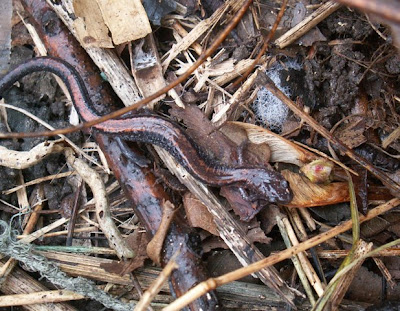
Under this rock, I found a redback salamander along with another small salamander that looked like a orange, wrinkly redback with a bigger than normal head.

It took me a second to realize I was looking at a four-toed salamander, (Hemidactylium scutatum).

Note the white belly with black spots (here’s a lame photo of this squirmy little guy) and the constriction at the base of the tail – the easiest way to tell these apart from the more common Plethodon species.

Four-toed salamanders like boggy areas with lots of sphagnum moss, and herpers look for females guarding eggs under mats of moss next to water. Their territory covers most of PA and NJ, but they can be hard to find, and this is my first.

Tuesday, April 29, 2008

Back last Monday I was fantasizing about a big herping trip upstate, maybe to Chester County, maybe to the mountains. I didn’t really care, as long as it was somewhere they’ve got black rat snakes (Pantherophis obsoleta). There is no finer snake in the Northeast: they can be so elegant in their jet black with white chins, and they’re often incredibly gentle in the face of a huge potential predator. Even when they rear up in that big zig-zag pose you know they don’t want to strike. Every now and then you’re lucky enough to find a really big one, a beast pushing seven feet and as thick as your forearm, looking almost clumsy until you see it glide up a tree trunk like it’s flat on the ground.

But there I go fantasizing again. This weekend the weather turned out to be cool, damp, and cloudy, and I called off any big trips in favor or some homework (I’ll see if I can take off a day with better weather) and a small trip into the Wissahickon Valley on Saturday (April 26th) afternoon in search of milk snakes (Lampropeltis triangulum).

A guy from New England on the Field Herp Forum (www.fieldherpforum.com) posted a couple months ago about finding milk snakes, and how he usually finds them on overcast, warm, humid days when he feels a storm coming. So after dropping Jen and my parents at the airport (Jen for a weekend trip, my parents on a big vacation), I took advantage of an overcast, humid day with a chance of rain (although not so warm) and started flipping rocks.

It almost goes without saying that I found no milk snakes – I would have led this post off with a long string of exclamation points – but I did get a workout. Scott and I were chatting about this a few weeks ago; we have to get back into herping shape, to be able to spend hours hiking steep slopes and bending over again and again to lift heavy rock after heavy rock.

I only found one red back salamander (Plethodon cinereus), which was very strange since I would have expected to find dozens. I did find a couple active mouse nests. This always makes me feel awful. I’m sure they recover and rebuild once I’m gone, but I always feel the need to apologize when I see the mother looking at me with those big, terrified, liquid eyes just before she runs away with her babies hanging off her.

However bad I feel about the whole incident, it’s actually a good thing for a milk snake hunter to find mice, since milk snakes make a living by eating mice and their cute little babies; at least I know there’s food.

Baby milk snakes actually specialize in eating babies of smaller snake species, and so the only snake find of the day was an auspicious one – this baby ring neck snake (Diadophis punctatus edwardsii). It was a lovely little find in its own right, of course, even if it didn’t want to pose for the camera. See below for the weedy terrain where I found it and a few pics – a couple of it pausing in awkward positions and one of it moving its head at just the wrong moment.


Tuesday, April 22, 2008

I don’t have much to report in this post. A lot of family was in town over the weekend for Passover and we only managed to get out a little late morning on Saturday (April 19th). The herping was a little disappointing; we hit the brown snake hot spots and some other prospective sites and we only found redback salamanders (Plethodon cinereus). I know, redbacks are beautiful salamanders, and I do like looking at them, but after a spring of finding them under every board and log, seeing more redbacks is kind of like finding robins on your front lawn.

The weather Saturday was particularly warm for this time of year, and maybe the snakes weren’t tempted to come close to the surface. Also there’s a chance the brown snakes (Storeria dekayi) haven’t made it very far from the winter dens yet. Last, the West Parkside Industrial Park hotspot is gone, so there’s no chance of getting close to the only big den I’ve located so far.

More interesting was that yesterday Scott and I got our venomous snake hunting licenses in the mail. The licenses entitle us to kill one timber rattler (Crotalus horridus) and one copperhead (Agkistrodon contortrix). Don’t worry, we’re not planning to kill anything, but we decided to get the licenses just the same. For one, they lend us some legitimacy out in the field. If we’re stopped by a conservation officer on a ridge somewhere upstate, we can demonstrate that we’re part of a legal process and that we’re not poachers. The other reason is that it makes us fees-paying members of the Fish and Boat Commission’s public. State game agencies are designed to serve hunters and fishers, people who pay for licenses and then follow rules and regulations while out in the field. Now we’re not just a couple guys flipping rocks; we’ve paid our share into the funds that maintain the natural resources we enjoy, and we can feel entitled to some respect from F&B. I don’t mean to imply that we anticipate getting harassed by conservation officers (I’ve only met one and it went well – in New Jersey), but we’re happy to have a little more standing with the bureaucracy that comes closest to managing herping.

Thursday, April 17, 2008

I found a brown snake (Storeria dekayi) in the Woodlands cemetery Saturday morning. Midway through my weekly run in the cemetery I checked the same board I’ve been checking for a few weeks now, and this time it wasn’t just worms, slugs, and centipedes. I’m leading off with the brown snake because out of all the herping I’ve done over the past week (and I’ve had a really good week of herping) it’s what’s gotten me the most excited. I checked my records and I found one DOR in the Wissahickon on April 18th 2004. This makes the 10.5 inch male in the Woodlands my earliest brown snake out of hibernation (in other words not including the big hibernating group of them we found in March last year).

It also makes it my first herp of the season within the limits of Philadelphia. (Of course I’ve been finding redback salamanders, Plethodon cinereus, but the more I think about them, the less they seem to obey the normal seasons.) I won’t be able to make any big trips this weekend, but I do hope to poke around the Cobbs Creek area to see if any more snakes are up in Philadelphia.

I did manage a big trip on Thursday along with Simon and Scott. After watching so many other good forecasts evaporating before our eyes, I couldn’t resist. So, on Tuesday, with a good day called for Thursday the 10th and a light and flexible schedule that week, I asked for Thursday off. Scott, Simon, and I headed out early and made for a large, privately-owned marsh in northern Chester County.

I wrote about the property on April 2nd, and again I’d like to state my appreciation to the owners for access. Our minds were blown yet again (Simon’s for the first time) by the scale of it as well as the beautiful marsh habitats – I use the plural because I’ve been impressed by the range: there’s the cattail marsh sections, the expanses of rose shrub, sedge marsh, flooded forest. This discussion really makes me self-conscious of my ignorance of wetland geology and hydrology, but there’s a lot in there to explore.

We spent from around 9:30am to around 2:30pm taking one sucking, slogging step at a time through the muck and deep, wet mats of vegetation as we covered just a little more of the 2,500 acres.

We heard the American toads (Bufo americanus) calling their little heads off as we drove in, and they were hopping all around us almost everywhere we went. One of the lovely things about toads is that they have none of the fears and inhibitions of peepers and other little calling frogs. Toads just sit out there and dare you to grab them.


The easiest to grab are the ones in amplexus, the grip of love in which males wrap their front legs (feet complete with rough ‘nuptial pads’ to help them hold on) around females’ backs and don’t let go even if a 170 pound monster reaches down, for all they know to eat them. Male toads always put sex before life. The pickerel frogs (Rana palustris) stayed out of sight, but we heard their snarling calls most of the morning. We heard a couple peepers (Pseudacris crucifer) calling, but nothing like the choruses from a few weeks ago.

Here’s the first snake of the season (outside Philadelphia, at least), a skinny, scruffy garter snake (Thamnophis sirtalis). Snakes always look their worst right out of hibernation. They’re underweight, they’ve often got blisters or other skin problems, and they’re always filthy.

We were walking towards the embankment around a pond when I noticed a mossy, muddy looking rock plodding up the embankment towards the pond.


It was a male stinkpot (Sternotherus oderatus) and we found three others making the same trip over the embankment to the pond. I always have fun with the stinkpots. Some stay tight in their shells, and some adopt this adorable pose until you put them back down (we did them the favor of placing them at the edge of the pond, where they were headed). As cute as they are, always hold them towards the back of the shell since they bite and can reach further back than you think.


Hibernation ended none too soon for this one, disturbingly skinny and in need of a few good meals.


As a contrast, I’ve included a photo of Jen’s stinkpot (we adopted two last year), which is admittedly on the chunky side (it has started a diet).


We saw some painted turtles (Chrysemys picta) make splashy getaways, and Scott snagged this little one.


Out in a relatively open section of marsh I thought I could see something big moving under the water a few yards in front of me. After another moment I saw a bit of the shell surface, and I knew what it was. I took another photo with each step I took until I was nearly on top of it.


I was impressed with how little this monster of a snapper (Chelydra serpentina) seemed to care about my being there. It kept walking around slowly with its head extended until I was only a couple feet away. I hollered for Scott and Simon, and we quickly talked ourselves into picking it up. Here are a couple photos: one of Scott holding it by the tail and back of the plastron (contrary to popular opinion, a snapper should be supported by more than the tail when picked up) as it gives an angry warning snap, and another of Simon giving it a shot.


The last critter I’ll post is the first northern water snake (Nerodia sipedon) of the season, a beautiful little girl, showing that crimson and grey contrast you sometimes see in them. Most impressive was that Simon got away without getting nipped.


At the end of our trip, as we enjoyed our celebratory Dairy Queen Blizzards, Simon made a passing reference to the “one time a snake has bitten me.” Scott and I stared in shock and then made Simon repeat that. Did he really mean he’s only been bitten once by a snake, any snake? Including water snakes? Including racers? Simon’s spent years working in herpetological field research and many more years working with snakes as a hobbyist both in the field and captive settings. I lost count of how many times snakes (all harmless) have bitten me a decade ago, and the same goes for Scott. We look forward to throwing more water snakes and some racers (Coluber constrictor) at Simon to see if his bizarre luck can hold up.

We visited one more marsh on our way home. It was pretty unremarkable, but we did see lots of spotted salamander (Ambystoma maculatum) egg masses, and a few of them had clouds of larvae hanging around. It’s hard to imagine, but in a few years one of two of these half-inch squigglies will be a spotted salamander like one of the ones we saw back in March.


Monday, April 07, 2008

By now we should know better than to get our hopes up about the weekend any earlier than Friday. A forecast any longer than two days out is pretty much worthless in Philadelphia, as was plainly demonstrated at the end of March. Still, our optimism and hunger for herping sometimes gets the better of us, and late on Wednesday we were planning another grand turtle outing for Sunday (April 6th), which was predicted to be sunny and in the mid 60s.

Of course we were setting ourselves up for disappointment, and on Thursday the forecast wasn’t looking quite as good for Sunday. By Friday it was obvious the day was a wash.

Any writer of fiction knows that simple success is rarely as interesting or compelling as failure, and that you must make your characters suffer in the interest of a good story. This is a harder principle for an autobiographical blogger to accept; I’d gladly trade the reader’s good experience for mine (sorry). Unfortunately reality sometimes works out a better narrative than I’d like.

The first cruel plot twist (actually the gentler of the two) here is that Saturday ended up the far better day for herping, but on Saturday I couldn’t go out. The big event I couldn’t get out of was the Philly Cleanup. Mayor Nutter decided that the City could use a good sprucing up (he’s right), and Jen and I volunteered to do our part in the Cobbs Creek section of Fairmont Park.

Saturday morning, as Jen and I were getting ready to go, I checked to see where exactly the cleanup would be. I entered the corner of Whitby and Cobbs Creek Parkway into Google Maps and gasped when the program displayed the map. We would be cleaning up around two large overgrown fields I scouted about a month ago (See the February 25th entry). At the time I had been happy to see some old boards and other nice debris scattered around the fields. I had even spread one pile of old boards out to make good cover for black racers (Coluber constrictor).

So, on a day I wanted to go herping, the day before when we’d planned to go herping but no longer could thanks to a change in the weather, we would be working to ruin a spot I had plans to work in a few weeks.

Of course on principle the cleanup project is a good thing. People shouldn’t dump trash in public parks, and it is good to clean up public parks, but part of me wishes they could have saved that little section for later.

Still we managed to show up smiling and ready to work. The first person we met was Mark Focht, the head of Fairmont Park. I also had the pleasure of seeing Joe Caesar again; Joe leads volunteer cleanup in Cobbs Creek for Fairmont Park. He is one of the several hard-working, charismatic, truly-dedicated Fairmont Park employees I’ve had the pleasure to volunteer for over the past few years. These guys work 6 or 7 days per week improving our parks and helping others do the same, and have volunteer management down to a science.

Joe put us to work cleaning up a dump site in the woods at the bottom of a steep slope (so at least I was spared the sight of my boards in the fields being taken away), and Jen and I both had a good time. She filled bags with trash and I ran them up the hill to the sidewalk – great exercise. We even got to meet Mayor Nutter. His entourage pulled up, we all took a picture with him, and when he thanked us individually for volunteering. Jen, without skipping a beat, thanked him for being our mayor.

We wrapped up at two, and since we were so close to the Mt. Moriah Cemetery, we decided to check to see if the brown snakes have started moving yet. We determined that they’re probably still hanging back in their hibernaculum (they certainly weren’t out anywhere we looked). Maybe they’re too scared of the redback salamanders (Plethodon cinereus) to come out – we found about twenty of those. Here are the photos:

Here's Jen studying a catch:


This might be the smallest redback I've seen at under an inch. It's probably one of last year's babies.


Here's a female stuffed like a sausage with next year's babies, or at least the eggs that will be next year's babies:


Last, this one's a little out of focus, but the scene (not posed) was too cute not to post:


Better luck next week?

Wednesday, April 02, 2008


On Thursday Scott sent me a pretty harsh email about the weather forecast. I'll spare you the specifics, we were both swearing blue streaks after watching the forecast for Sunday change from high 50s and sunny to high 40s and partly cloudy. High 50s and sunny means spotted turtles (Clemmys guttata – our original target species for Sunday) would be out sunning themselves, eating, getting their swerve on, and otherwise having a good time. In the high 40s with sun here and there, we might find a few basking, but then the sun might spend a few hours behind the clouds and our turtles would decide to take the day off.


So, by Friday afternoon we had changed plans. Instead of a trip to a spotted turtle hot spot on Sunday, we'd scout wetlands on Saturday. Scott, who had the choice of working that weekend or next weekend, picked a Sunday all-day shift and a Saturday morning shift. Jen and I started the day with a trip to a sporting goods store to get her a pair of hip waders, and around noon picked Scott up outside HUP (it wasn't hard to spot the guy in scrubs and hip waders walking around University City).


We headed west into Chester County to visit a gigantic, privately-owned wetland basin. Here are a couple pictures.


The non-herpers out there are probably not impressed by all the water and mud, but this is the kind of thing we live for. The wetlands are wonderful for frogs, turtles, and our semi-aquatic snakes, and then there are the corn fields and patches of forest – perfect territory for my beloved milk snakes (Lampropeltis triangulum), black rat snakes (Elaphe obsoleta), and box turtles (Terrepene carolina).


The property is accessible by invitation only. Last week I was delighted and honored to get access. We had seen the marsh from I-76 and thought we had some idea of what it looked like, but we were still blown away as we drove in over the access road and parked the car. We're so used to herping small patches of this kind of marsh habitat here and there; looking at thousands of acres of it, we didn't know where to start.

So we pulled on our waders and started wading around. This is a little cumbersome in deep muck. The mud sucks back on your foot with each step, and after almost three hours we were pretty tired (I'll emphasize that after three hours we had only covered a small portion of the marsh).


What did we do for three hours? We kept our eyes open for any turtles we might see. It was chilly (high of about 48 degrees) and windy, but the sun was out, giving us a small shot at seeing our chelonian friends. Scott saw one head, and I caught this young painted turtle (Chrysemys picta) in a pond on the property.


We also chased frogs around. The spring peeper (Pseudacris crucifer) choruses were almost deafening, and there were a few wood frogs (Rana sylvatica) mixed in there too (Jen also observed several wood frog egg masses). A few times I could swear I heard other species (maybe western chorus frogs – Pseudacris triseriata – and maybe, maybe cricket frogs – Acris crepitans), but it's hard to pick softer calls out of a full choir of peepers.


The frustrating part about all calling frogs, but peepers especially, is that they're really hard to see, let alone catch. We're not the only things looking for frogs, and they do their best to hide themselves from herons, foxes, and snakes while making themselves known to their peers and crushes. Peepers are about the size of a thumbnail, and during the day call from inside bushes, clumps of grass or weeds, or somewhere else you can't see them. As soon as you get close to them they clam up. If you really want to see peepers, you hunt them at night when they come a little more out in the open. That said, Jen managed the impressive task of catching this little guy (see, they really do exist!).


She also snapped a picture of this tadpole – probably a bull frog (Rana catesbeiana) or green frog (Rana clamitans melanota).


We look forward to visiting this marsh a few more times through the season to experience its full herpetological diversity. That's a pretty dry way of saying we can't wait to go back. Here’s to a great spring.

Friday, March 21, 2008

Wednesday (March 19th) it rained almost all day and looked like it could rain off and on all night: perfect for a frog calling survey. Of course you don’t want it raining so hard you can’t hear the frogs calling, but wet weather is just right for loving and singing if you're a frog.

A couple weeks ago I signed up with NJ’s Calling Amphibian Monitoring Program (CAMP), which is part of the national North American Amphibian Monitoring Program (NAAMP). A lot of herpers (myself included) are impressed with national ornithology data collection projects such as the Christmas Bird Count, and the NAAMP might be the closest thing we’ve got: a national program in which amateurs can contribute important information to a national conservation effort. The individual data points we collect might not tell us much (it’s not earthshaking to hear peepers calling on a rainy spring night), but over decades and over lots and lots of data collectors we’re making it possible to track population trends and identify declines before they’ve gone too far. It’s still not too late to get involved this spring, so please let me know if you’re interested and I’ll put you in touch with the organizers.

My route is in Gloucester and Camden Counties in South Jersey. It’s basically a straight shot along one of the many county routes running through farms, patches of woods, old small towns, and new subdivisions. I stop at ten pre-determined sites and listen for five minutes. The stops are at places where the road crosses wetlands, so if the resident frogs are calling, I should hear them. I write down what I’m hearing along with weather conditions, and then at home enter the data on the NAAMP’s website.

I’m saying “I” but this is a hard task to pull off alone. Jen was my invaluable partner for the first run. The observations have to start a half hour after sunset, but we started early so we could check out the route in day light and make sure we wouldn’t waste time trying to find a seemingly random point along a two lane road in the woods in the dark. We ended up hearing a lot of peepers (Pseudacris crucifer) calling in choruses. On two stops I heard a few lonely wood frogs (Rana sylvatica) that I think might have missed their party a couple weeks ago.

So what do spring peepers and wood frogs sound like?

Last weekend (March 15th) I was up in New York City for my sister’s birthday. She and some friends were going to a day spa, and I chauffeured, driving a fifteen passenger van from the Lower East Side of Manhattan into Queens. As much as I like hot tubs and saunas, I’d rather be in the woods (Jen chose the spa), so I took the afternoon to check out a wooded park in Queens for frogs and salamanders. The temperature was in the low 50s, and the park had a few small ponds that looked good for spring amphibians.

I turned over a lot of logs and rocks, and I scanned all the water I saw for egg masses, but I found no salamanders (not even red backs – Plethodon cinereus). I did hear a lot of frogs calling – peepers and wood frogs. I was in my sneakers (although trust me that I did consider bringing my bulky hip waders on the Chinatown bus up to NYC) so I didn’t go wading in after them, but I did try out the video feature on my camera.

So, without much further ado, here is the first video file on Phillyherping. You’ll note that there’s not much going on in the image; it’s just a pond with emergent brush, but the peepers and wood frogs are rocking out on the soundtrack. The peepers are the ones peeping (no big suprise there), and the wood frogs are doing the chuckles. I don't know about you, but hearing this spring music makes me smile every time.

Sunday, March 09, 2008

The wind almost blew me away last night. It was blowing at what had to be thirty miles per hour at least as we crisscrossed the shopping center parking lot, refueling on junk food after our fabulous amphibian herping outing on Sunday (March 8th). It helped that I was feeling particularly buoyant after the spotted salamanders (Ambystoma maculatum) we found at the end of the trip. They were such cool little creatures, and to find them at the end of a night and afternoon of not finding them was a perfect way to start the season; all the tension built up over the cabin-fevered winter months of scouting, researching, and fantasizing snapped in me, and I felt high the rest of the night.


We’ll start at the beginning with Cobbs Creek. I’ve written a lot lately about my plans for herping Cobbs Creek this year, and this past week I had a long conversation with a naturalist who spends a lot of time in our wild frontier with Delaware County. I learned a lot about what lives in the creek, what has lived in the creek, and the restoration work that has vastly improved the creek from how it was before I moved to Philly.


In particular I learned the history of the small marsh basin just south of the Environmental Education Center. This was first planned to be several small pools, but was then dug out into its current single basin. It was stocked with American toads (Bufo americanus – remember me wondering why there are no American toads in there? I guess I was wrong.) and spring peepers (Pseudacris crucifer). So, around three in the afternoon Jen and I headed over to the mini-marsh. The heavy rain had just stopped and the wind was picking up. The temps were still high (low 60s), and I was optimistic that we might hear something calling.


I was wrong on that count, but we did flip five redback salamanders (Plethodon cinereus) around the edge of the marsh.


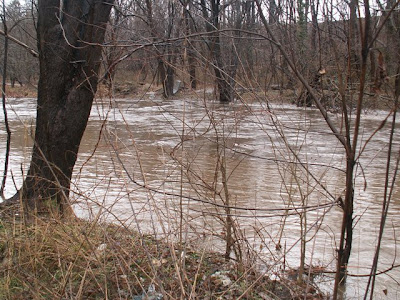
The creek was high and in fact had breached the basin, filling it up. Here's a shot of how high the water was in the creek.


Hearing no frogs and seeing no frogs, we hopped in the car and called Scott. He had called me in the morning coming off an overnight shift. At that time he was a little incoherent. I caught about half of what he was mumbling before he hopped into bed, but one thing was clear: he wanted to go herping. So, figuring he had caught up on sleep, we called him and after a couple persuasive minutes on the phone with Jen (I was driving), he pulled his waders on and got ready to go.
The plan was to herp the woods and marshes in the mixed farm/exurban landscape of Chester, Berks, and Lancaster Counties. After about an hour we pulled off the Interstate and started picking our way through two-lane country roads.


The spring peepers greeted us at our first stop. It is certainly a thrill to hear them for the first time in the spring. Even if they were named something else (‘Mini Peepers’?) their choruses of sweet, high chirping would be the official theme music for the opening of the season. With the whistling and rushing of the wind around us as we walked into the woods, it was hard to make them out at first; from far away it’s the kind of sound you think you could be imagining, but they only grew louder as we started wading into the flooded portion of the forest.


I should stop here to make clear they were not greeting us. However beautiful I find their singing, and even though I interpret it as the announcement that spring is back, these frogs are calling out of acute lust and hard headed territorialism. Each frog is announcing his availability to females and claiming his wad of dry grass against the encroachments of his neighbors.


These guys are dead set on love and war, but they still pay enough attention to predators to shut up when they hear you coming. This can make for some pretty frustrating herping. You hear a peeper, you’re pretty sure he’s right over there about ten feet away, but just as you’re about to really fix on him, he shuts up. Locating individual calling frogs is best done with fellow herpers so that you can triangulate on the calling location, but I have yet to dedicate the time and effort to do this successfully (this will always be my excuse for failing to photograph peepers, no matter how much time and effort I dedicate.). The way to do it is to freeze and wait until he figures you’re an inanimate object and resumes calling. Then you all point at where you hear the noise, and the intersection of the lines to where each person is pointing is the location of the frog. We actually did try to pinpoint one peeper, but we lost patience at the freezing step in the plan. It was getting darker, we hadn’t seen any salamanders or evidence of salamanders in an hour of wading around, and we had two more locations to check.


Location number two was a bust. None of us had been there before, and although we could hear peepers, we couldn’t figure out where to park, so we skipped on to the third destination.


At this point I can’t say I held out much hope for finding spotted salamanders. This didn’t ruin my mood; I was feeling pretty warm and fuzzy about the spring peepers calling, but I figured this was yet another noble but relatively fruitless herping effort.


Have I mentioned how windy it was Saturday evening? When I was gassing up the car I was a little worried a gust would take my credit card out of my hand before I could swipe it. It proved windy enough to knock a tree across the road we planned on taking. Some locals were already hard at work on it with chainsaws, but we decided not to wait and circled around another way.


Finally we parked and headed downhill into the woods. Only Scott knew where he was going, and the darkness combined with the low temperatures (38 degrees – the temps didn’t drop; they plunged) and the brambles we couldn’t see until they tore into our arms and thighs (Jen got the worst of it since only Scott and I had hip waders) made for a grumpy, albeit short, hike to the pool.


Scott called out the first spotted salamander before I stepped into the water. It disappeared into the leaf litter at the bottom of the pond before I got a good look at it, but I saw my first a moment later.


I think sometimes we regard the animals we hunt too much as static objects, frightened creatures frozen in our hands. We snatch them up as soon as we see them because we’re afraid they’ll hide themselves before we can get a good look, but sometimes it’s worth the risk to watch our animals move around on their own, even in escape from us. Last summer I was awestruck by the grace of a garter snake swimming away from me across Cobbs Creek, undulating curves of black and yellow lines, a gliding crease in the surface tension of the water. On Saturday I was impressed by the slower fluidity of the salamanders. They don’t use their legs much in the water, but seem to get around by slowly bending back and forth in gentle sine curves through the leaves at the bottom of the pool.


Of course the low temperatures contributed something to that slow grace that impressed me so much. Cold blooded animals don’t move very fast at 38 degrees. In this way Jen enjoyed the cold temperatures more than Scott or I did. She’s always chasing after frogs and almost never actually catching them. There were wood frogs in that pool, and they were just too cold to get away. Jen could reach out and grab them, and they were still there when her hand hit the water.


My camera has a hard time focusing in the dark, but note the frog floating in the flashlight's circle on the water.


Here's a wood frog Scott caught. It was complaining the whole time he had it in his hand - chuckling out a soft version of their usual call.


Here are some salamander pictures. Note the swollen area at the base of the tail; males' cloacas swell up in the breeding season.


This one looked particularly wrinkly.


Eventually we figured we’d examined our share of salamanders and frogs. Our hands were in a lot of pain by that point. Somehow I left the net in the car, and it is not easy to keep your hand in near-freezing water, even if you’re grubbing around for a much-coveted salamander.

The drive back is a bit of a blur to me. Both Scott and Jen fell asleep (I was driving), but I was buoyed by the salamander high all the way back home. The season has begun.