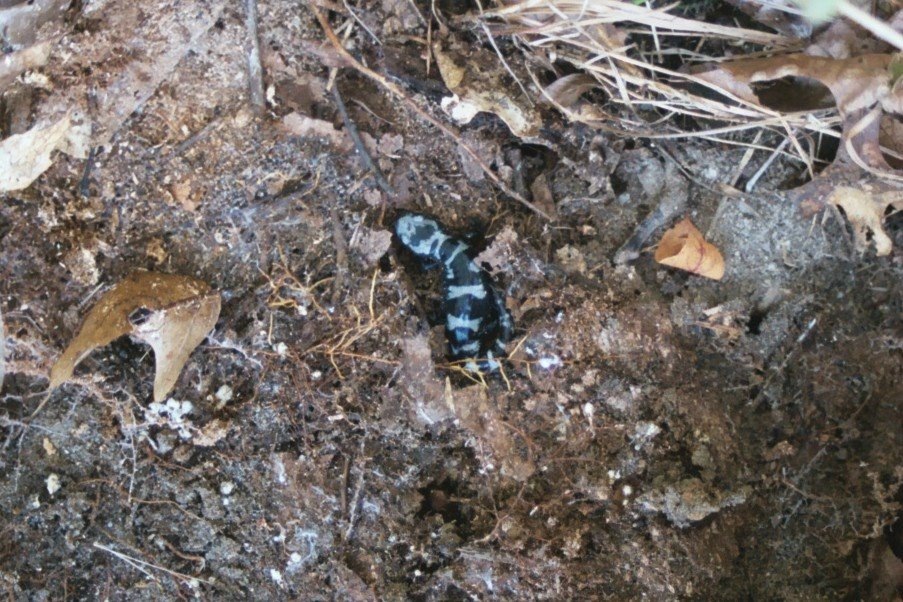
I have been late posting this week because I have little to post about.
I went again to the Pine Barrens, and I found even less than the week before. I saw one fence lizard (Sceloporus undulatus hyacinthinus) and found a pond with lots of calling green frogs (Rana clamitans melanota) and southern leopard frogs (Rana ultricularia).
That’s not much for four or five hours of herping. These Pine Barrens feel a little like hitting my head against the wall. I research where the herps certainly are, I get my hopes up, and then I walk around for several hours finding none of them.
I’d feel really pathetic if other herpers I know weren’t also striking out in the Pine Barrens. It seems that no one else is finding much besides racers (Coluber constrictor constrictor), worm snakes (Carphophis amoenus), fence lizards, and turtles.
I am ready to give up on daytime herping in the Pine Barrens for the summer. I won’t give up on the Pine Barrens entirely; I think I’ll shift my attention to the hills and urban Philly until it gets really hot and then get into road cruising at night.
Totals for May 14, morning and early afternoon (sunny sky, temps rose low 60s to low 70s):
- 1 fence lizard
- 10+ green frogs
- 5+ southern leopard frogs
Wednesday, May 17, 2006


Monday, May 08, 2006
"Voices of the Night: Calls of the Frogs and Toads of Eastern North America" saved my trip to the Pine Barrens yesterday.
I had had yet another trip to the Pine Barrens that started with visions of beautiful pine snakes (Pituophis melanoleucus melanoleucus), cute spotted turtles (Clemmys guttata), and majestic timber rattle snakes (Crotalus horridus) and ended with the frustration of a few fence lizards (Sceloporus undulatus hyacinthinus), a squirmy worm snake (Carphophis amoenus), and frog calls.
It turned out in the end that those frog calls made the trip, but I had to get home and figure out what they were before I knew it.
I had headed towards some reputed pine snake dens in southwestern Atlantic County and adjacent Burlington County. I spent four hours walking sand roads and firebreaks, flipping every piece of trash or log I could find, and stopping to locate whatever kept running away into the leaves to get away from me.
Most of the time it was birds; robins and sparrows rustle leaves in the stops and starts that make me think ‘lizard!’ There were some actual lizards in there too, though.

I usually think of myself as really bad at catching lizards. I’m slow and too worried about squashing them to grab for them fast enough. On Sunday, though, I was doing something right. I think it was the blind grab: fence lizards like to keep a tree trunk or a log in between themselves and whatever at that moment is trying to catch them. When you hear that startled rustle of leaves and see the lizard dash off, as likely as not it has ended up on the other side of a tree trunk or log. If you move into its field of vision, it will move around the trunk or log to the other side.
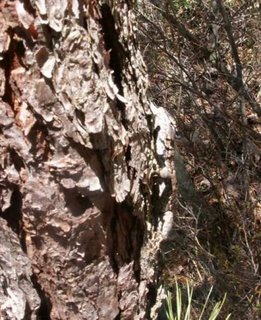
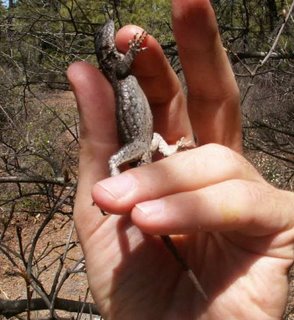
Thus the best way to catch the lizard is to keep most of you hidden on that other side and then, as fast as you can, grab for where you think it is. Here's a female I caught; the male would have bright blue patches on its chest and under its throat.
I found one hot spot in my trip: a stream that had been partially dammed by the path and had spread out, shallow and boggy.

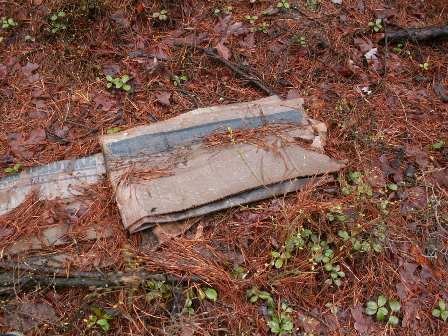
I heard a calamitous splashing as I got close – turtles that must have seen me before I had seen them and had jumped from their basking spots. I heard one green frog (Rana clamitans melanota) twanging from the edge, and I saw some really promising tar paper and other debris scattered on the ground near the water. I’m not sure if the debris had been left out to lure herps, since it looked like a great spot for eastern kingsnakes (Lampropeltis getula getula), but I did find a worm snake that produced a lot more feces and musk than I expect from such a little snake. It just would not stop squirming for long enough for me to get a good photo (or I was not patient enough to wait long enough for it to calm down).
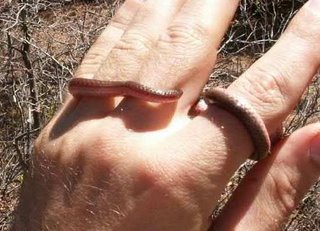

I checked this stream again after a few hours of fruitless wandering. I was hoping to sneak up on those turtles, but I didn’t even hear them trying to get away this time – there were just quiet, empty stumps and logs when I got there. After I had quietly stalking around for a few minutes, though, the frogs started up again. At first it was just a couple green frogs with their classic loose-banjo-string call, but then something else started honking in a middle/high pitch. Another few similar-sounding frogs joined in, and suddenly there were four or five of them going at it in a vociferous shouting match that just as suddenly stopped, leaving no noise but the wind.
I didn’t think much of it at the time – just that I needed to look up whatever those other frogs were on my frog calls CD. The tree frogs are at the beginning of the disk, and after I had eliminated other, more common, species, I tried the hard-to-find (indeed listed as threatened by the state of New Jersey) Pine Barrens tree frog (Hyla andersonii), and that was it! I tried the other possible candidates, but nothing else fit.
The temperatures on Sunday 05/07/06 ranged from the 50s in the morning to around 70 by mid-day. It was sunny throughout the day.
Trip Totals:
4 fence lizards
1 worm snake
2-3 green frogs (heard)
4-5 Pine Barrens tree frogs (heard)
? turtles (heard)
I had had yet another trip to the Pine Barrens that started with visions of beautiful pine snakes (Pituophis melanoleucus melanoleucus), cute spotted turtles (Clemmys guttata), and majestic timber rattle snakes (Crotalus horridus) and ended with the frustration of a few fence lizards (Sceloporus undulatus hyacinthinus), a squirmy worm snake (Carphophis amoenus), and frog calls.
It turned out in the end that those frog calls made the trip, but I had to get home and figure out what they were before I knew it.
I had headed towards some reputed pine snake dens in southwestern Atlantic County and adjacent Burlington County. I spent four hours walking sand roads and firebreaks, flipping every piece of trash or log I could find, and stopping to locate whatever kept running away into the leaves to get away from me.
Most of the time it was birds; robins and sparrows rustle leaves in the stops and starts that make me think ‘lizard!’ There were some actual lizards in there too, though.

I usually think of myself as really bad at catching lizards. I’m slow and too worried about squashing them to grab for them fast enough. On Sunday, though, I was doing something right. I think it was the blind grab: fence lizards like to keep a tree trunk or a log in between themselves and whatever at that moment is trying to catch them. When you hear that startled rustle of leaves and see the lizard dash off, as likely as not it has ended up on the other side of a tree trunk or log. If you move into its field of vision, it will move around the trunk or log to the other side.

Thus the best way to catch the lizard is to keep most of you hidden on that other side and then, as fast as you can, grab for where you think it is. Here's a female I caught; the male would have bright blue patches on its chest and under its throat.

I found one hot spot in my trip: a stream that had been partially dammed by the path and had spread out, shallow and boggy.

I heard a calamitous splashing as I got close – turtles that must have seen me before I had seen them and had jumped from their basking spots. I heard one green frog (Rana clamitans melanota) twanging from the edge, and I saw some really promising tar paper and other debris scattered on the ground near the water. I’m not sure if the debris had been left out to lure herps, since it looked like a great spot for eastern kingsnakes (Lampropeltis getula getula), but I did find a worm snake that produced a lot more feces and musk than I expect from such a little snake. It just would not stop squirming for long enough for me to get a good photo (or I was not patient enough to wait long enough for it to calm down).


I checked this stream again after a few hours of fruitless wandering. I was hoping to sneak up on those turtles, but I didn’t even hear them trying to get away this time – there were just quiet, empty stumps and logs when I got there. After I had quietly stalking around for a few minutes, though, the frogs started up again. At first it was just a couple green frogs with their classic loose-banjo-string call, but then something else started honking in a middle/high pitch. Another few similar-sounding frogs joined in, and suddenly there were four or five of them going at it in a vociferous shouting match that just as suddenly stopped, leaving no noise but the wind.
I didn’t think much of it at the time – just that I needed to look up whatever those other frogs were on my frog calls CD. The tree frogs are at the beginning of the disk, and after I had eliminated other, more common, species, I tried the hard-to-find (indeed listed as threatened by the state of New Jersey) Pine Barrens tree frog (Hyla andersonii), and that was it! I tried the other possible candidates, but nothing else fit.
The temperatures on Sunday 05/07/06 ranged from the 50s in the morning to around 70 by mid-day. It was sunny throughout the day.
Trip Totals:
4 fence lizards
1 worm snake
2-3 green frogs (heard)
4-5 Pine Barrens tree frogs (heard)
? turtles (heard)
Sunday, April 30, 2006
I’d like to find a spotted turtle. Even more, I’d like Jen to find a spotted turtle (Clemmys guttata). They are the cutest turtles out there, cuter yet than their smaller relative the bog turtle (Clemmys muhlenbergii). Spotteds are small black turtles with one or a few bright yellow polka dots on each scute. You’re not likely to see spotted turtles at big lakes or rivers; these guys like shallow water in the woods.
I’ve never seen one in the wild, but another herper reported seeing them at a park in Bucks County, and I decided to head out that way with Jen. It was late in the day on Saturday, which was a problem, because spotted turtles are most active in the morning.
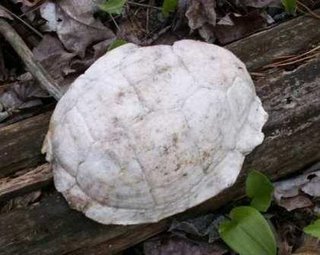
We didn’t see any live turtles (I think this shell was once a box turtle - Terrepene carolina):
We did have a great time with salamanders. The redbacks (Plethodon cinereus) I expected to find, but the spotted salamanders (Ambystoma maculatum) were a surprise.
I have been close to tears over the nights of perfect spotted-salamander-breeding weather that I have missed out of town or otherwise incapacitated. I know they sometimes turn up under cover, but I’ve turned over a lot of logs and never seen one.
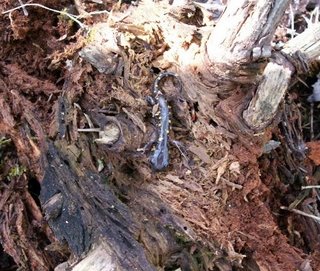
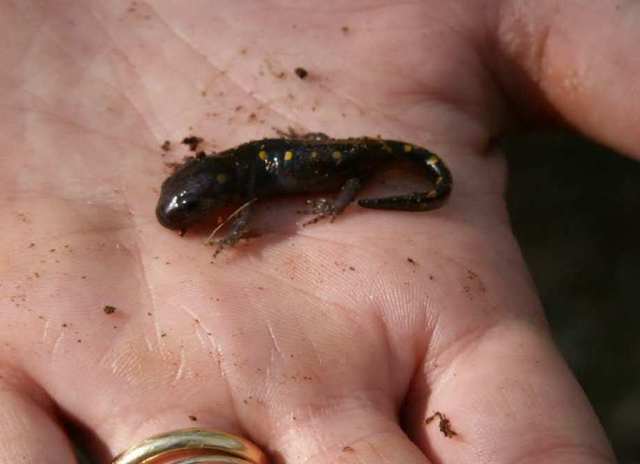
Jen found three. Two were little, about two inches long; she was scandalized by the size of the third, a hefty adult of about seven inches. Unlike the squirmy redbacks, they just sit there limp if you handle them gently, making them really easy to photograph:




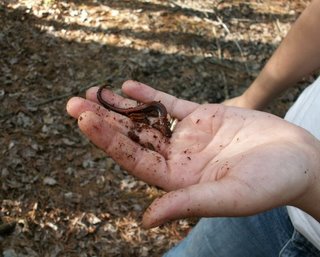
My pen broke, so I was unable to record the details of the eighth through forty-fourth redback salamanders Jen found. On cool spring days when the ground is damp to wet, we’ll find redbacks under almost half the logs or rocks we check. Here are a few of the little guys. I almost wonder what the point is of photographing them. Maybe now that I have gotten past simply recording their presence I can work on finding the perfect redback salamander and taking the perfect photograph of it. I’m not there yet.

I’ll end with this wood frog (Rana sylvatica). I didn’t catch it, and I didn’t try very hard once I got the photograph. Am I lazy to think that frogs are too much trouble to catch once you know what they are?

I’ve never seen one in the wild, but another herper reported seeing them at a park in Bucks County, and I decided to head out that way with Jen. It was late in the day on Saturday, which was a problem, because spotted turtles are most active in the morning.
We didn’t see any live turtles (I think this shell was once a box turtle - Terrepene carolina):

We did have a great time with salamanders. The redbacks (Plethodon cinereus) I expected to find, but the spotted salamanders (Ambystoma maculatum) were a surprise.
I have been close to tears over the nights of perfect spotted-salamander-breeding weather that I have missed out of town or otherwise incapacitated. I know they sometimes turn up under cover, but I’ve turned over a lot of logs and never seen one.
Jen found three. Two were little, about two inches long; she was scandalized by the size of the third, a hefty adult of about seven inches. Unlike the squirmy redbacks, they just sit there limp if you handle them gently, making them really easy to photograph:


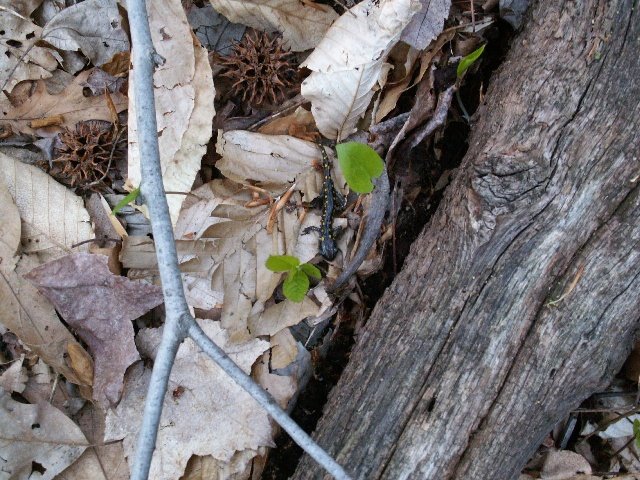
My pen broke, so I was unable to record the details of the eighth through forty-fourth redback salamanders Jen found. On cool spring days when the ground is damp to wet, we’ll find redbacks under almost half the logs or rocks we check. Here are a few of the little guys. I almost wonder what the point is of photographing them. Maybe now that I have gotten past simply recording their presence I can work on finding the perfect redback salamander and taking the perfect photograph of it. I’m not there yet.
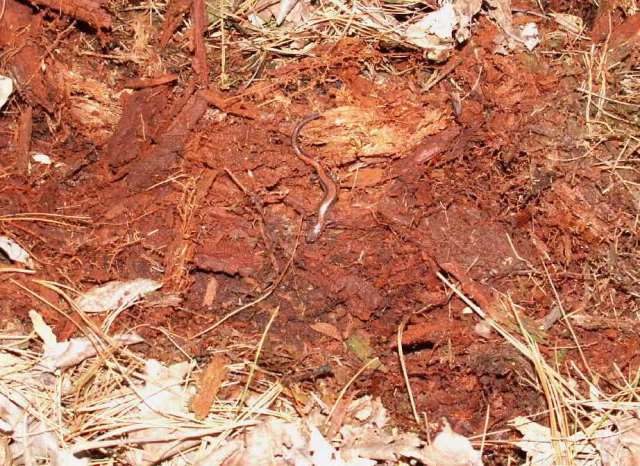

I’ll end with this wood frog (Rana sylvatica). I didn’t catch it, and I didn’t try very hard once I got the photograph. Am I lazy to think that frogs are too much trouble to catch once you know what they are?

Thursday, April 27, 2006
I’m finding snakes again around Philadelphia. They were probably out earlier in the season, but I haven’t been out enough myself.
Winter and early spring are dominated by the amphibians – the salamanders that breed on cold rainy nights and the tiny, hard to photograph frogs that make such a racket around ponds as the weather starts to warm up.
That said, the snakes do come out earlier than you might think – I’ve read plenty of reports of them sunning outside hibernation dens even in near-freezing temperatures – but right about now they’re really moving.
The weather is not too hot to be uncomfortable, some are moving from hibernation dens into their summer habitat, many are cruising around looking for love, and all of them are hunting and feeding to make up the weight they lost over the winter.
Once the temperatures get up into the 80s, many of them will switch to a more nocturnal lifestyle and stay underground during the day to avoid the heat, and I won’t be able to find them by looking under logs, rocks, and trash like I can now.
I found the first in Cobbs Creek Park on April 20 (75 and partly cloudy at 6:30pm). I was out looking for worms, and I decided to check my favorite logs. I was shocked to find that someone had rolled them over and had not rolled them back. In herping, this is the worst of all sins: not replacing cover. Garter snakes (Thamnophis sirtalis sirtalis) (and worms, for that matter) like those logs to hide under because of the cool, damp soil beneath. Now the logs are resting on dry grass, and the ground they had been protecting is all dusty and bare.
So, I found the garter snake under this piece of concrete instead of under my reliable logs. I'm not sure that ruining those logs as cover hurts the snakes, but it does make finding them harder.

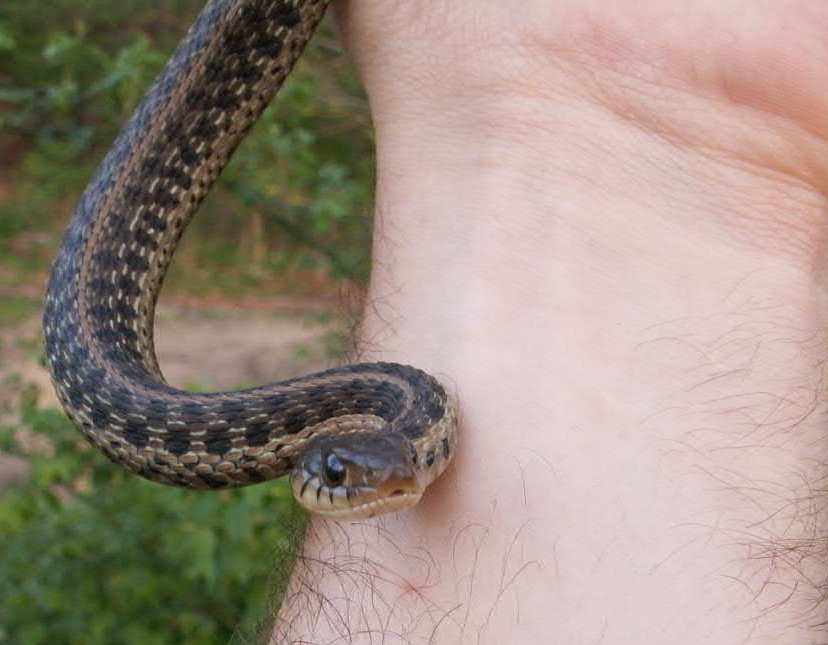
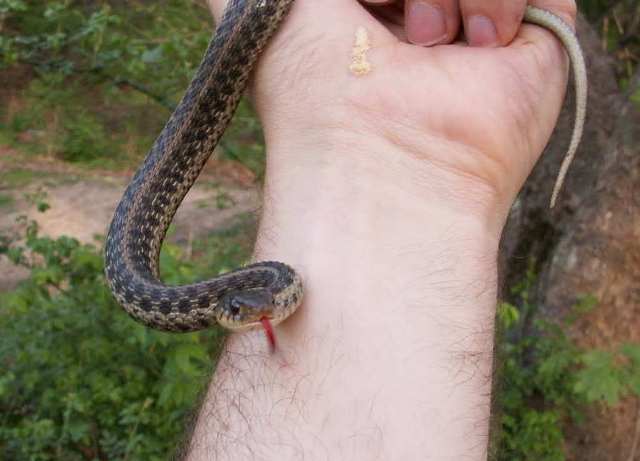
I like how garter snakes look when they’re studying the camera. It knows something’s going on inside that box but it's not sure if biting it is a good idea.


Here’s snake number two, a worm snake (Carphophis amoenus) I found under an old, soggy shirt in Winslow WMA on April 23. It was small, even for a worm snake, and I had trouble getting a good photo of the squirmly little thing.
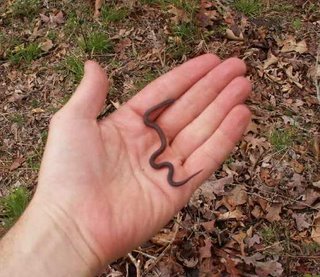
Here it is burrowing back under. I thought it was a throw-away shot, but the more I looked at it the more I liked how it showed the urgency with which these little, vulnerable snakes thrust themselves underground.

I also found some redbacks (Plethodon cinereus) at Winslow:
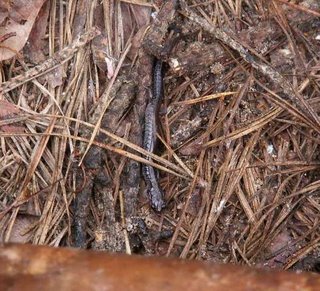
I found three under this piece of cardboard:

The most exciting salamander of the day was this marbled salamander (Ambystoma opacum) I found under a board in this dumpsite:
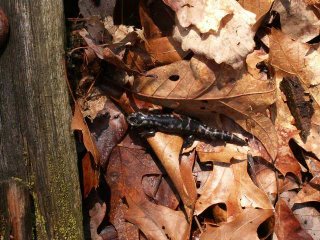

Notice how much darker it is than the one I found in October a few hundred yards away:
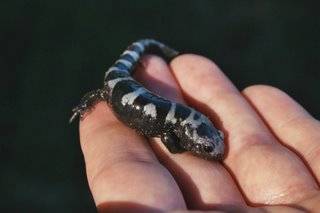
Marbled salamander males are more brightly colored than the females, so I’m assuming the one I just found is a girl, while the one in October was a boy.
Totals:
April 20, 2006
1 garter snake
April 23, 2006 (generally damp and in the low 60s in the morning and early afternoon)
4 redback salamanders
1 worm snake
1 marbled salamander
Winter and early spring are dominated by the amphibians – the salamanders that breed on cold rainy nights and the tiny, hard to photograph frogs that make such a racket around ponds as the weather starts to warm up.
That said, the snakes do come out earlier than you might think – I’ve read plenty of reports of them sunning outside hibernation dens even in near-freezing temperatures – but right about now they’re really moving.
The weather is not too hot to be uncomfortable, some are moving from hibernation dens into their summer habitat, many are cruising around looking for love, and all of them are hunting and feeding to make up the weight they lost over the winter.
Once the temperatures get up into the 80s, many of them will switch to a more nocturnal lifestyle and stay underground during the day to avoid the heat, and I won’t be able to find them by looking under logs, rocks, and trash like I can now.
I found the first in Cobbs Creek Park on April 20 (75 and partly cloudy at 6:30pm). I was out looking for worms, and I decided to check my favorite logs. I was shocked to find that someone had rolled them over and had not rolled them back. In herping, this is the worst of all sins: not replacing cover. Garter snakes (Thamnophis sirtalis sirtalis) (and worms, for that matter) like those logs to hide under because of the cool, damp soil beneath. Now the logs are resting on dry grass, and the ground they had been protecting is all dusty and bare.
So, I found the garter snake under this piece of concrete instead of under my reliable logs. I'm not sure that ruining those logs as cover hurts the snakes, but it does make finding them harder.
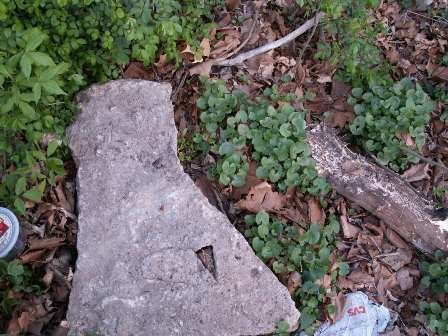
I like how garter snakes look when they’re studying the camera. It knows something’s going on inside that box but it's not sure if biting it is a good idea.
Here’s snake number two, a worm snake (Carphophis amoenus) I found under an old, soggy shirt in Winslow WMA on April 23. It was small, even for a worm snake, and I had trouble getting a good photo of the squirmly little thing.

Here it is burrowing back under. I thought it was a throw-away shot, but the more I looked at it the more I liked how it showed the urgency with which these little, vulnerable snakes thrust themselves underground.

I also found some redbacks (Plethodon cinereus) at Winslow:

I found three under this piece of cardboard:
The most exciting salamander of the day was this marbled salamander (Ambystoma opacum) I found under a board in this dumpsite:


Notice how much darker it is than the one I found in October a few hundred yards away:

Marbled salamander males are more brightly colored than the females, so I’m assuming the one I just found is a girl, while the one in October was a boy.
Totals:
April 20, 2006
1 garter snake
April 23, 2006 (generally damp and in the low 60s in the morning and early afternoon)
4 redback salamanders
1 worm snake
1 marbled salamander
Monday, April 17, 2006
A couple weekends ago (April 8th through 10th) I played hide and seek with a group of northern water snakes (Nerodia sipedon sipedon) in Virginia. Whack A Mole might be a better description, but I don’t want to give the impression that I was whacking them.
A couple we’re friends with (Marc and Katherine) invited us down to Marc's aunt’s house on the water at the tip of Virginia’s Northern Neck. This is the tiny peninsula that sticks out and forms the southern corner of the Potomac’s mouth into the Chesapeake. The landscape there was flat farms with the occasional patch of forest, all edged by new vacation houses on the water.

We arrived on Saturday, and we mostly sat inside watching the rain fall. Marc reported that he had seen a snake crawl across the dock outside. I perked right up, but he’s terrified of snakes so I couldn’t get any good details out of him – he had just turned and walked away.
I figured that he had seen a northern water snake. These are heavy-bodied snakes patterned in dark gray and dark reddish-brown bands. They lose the pattern a little as they age, and big ones, especially big ones that are covered in a layer of mud, can look a muddy gray. These are really common snakes, and you can often spot them basking next to water (rivers, streams, lakes, ponds). They’ll plop right in as soon as they see you. Be careful if you decide to catch them; they're harmless but are notorious for being mean and stinky – they bite and spray feces and musk to the point that I usually just let them sit there. This time I guess I was bored with the rest of the herping opportunities, so I made it my mission to catch one.
The next day I spotted at least two of the snakes. They were basking among the rocks along the water. I’d spot them, they’d spot me, and they’d quickly head deeper into the rocks where I couldn’t grab them. This happened over and over again. There was one little, more strongly patterned one whose position I thought I had memorized. I fixed the location and then an hour later crawled up and quickly popped up and grabbed at where he should have been. I did that twice, but each time he was one or two rocks over from where I had remembered him.
Monday was our last day. I missed my little guy again, and as I gave up on my mission I walked further along the rocks to see if there were any others. Oh! One more, a big one too, but I missed it. I took another few steps, and this time I didn’t think, I just lunged and grabbed the third snake as it dove into the rocks.
After a brief tugging match (steady, gently pulling) I had my snake. It was pretty cool to the touch, and I credit its early morning torpor with its unusually placid response to my grabbing it. All it did was flatten its head and sit there for a minute - no biting, no spraying musk and feces.
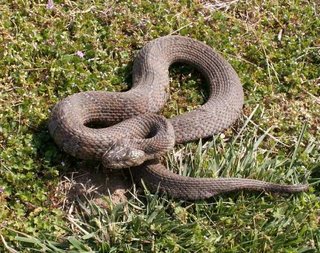
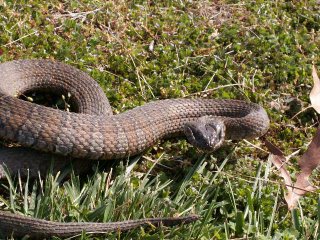
Here’s another picture showing a little of its belly pattern.
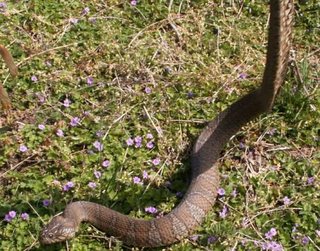
Here’s its release shot. I hope you can see the normal shape of the head here.

After I let this one go, Jen and I spotted the little one I had been stalking. It was swimming out away from the rocks on an angle towards the dock. We watched it for a moment as it swam along with perfect grace, its head out of the water and its body rippling through curve after curve to propel it along. I ran up the dock and dove flat onto the wood planks, whipping my arm down over the edge to grab for it. I missed by a few inches and it dove for the bottom. Jen scolded me for ruining a beautiful image by trying to catch something. Wasn't it enough to watch it? She has a point, but how cool would it have been if I had caught it?
One thing that confuses me about these water snakes is that the water right there is brackish, and I didn’t realize that northern water snakes lived in anything but fresh water.
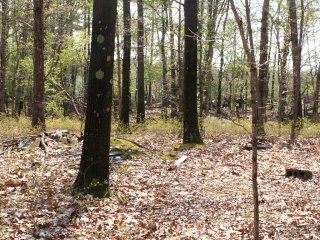
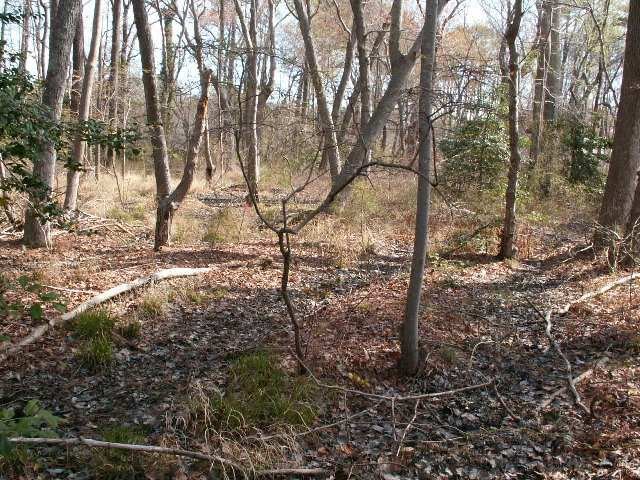
I did look around a little beyond the house, but only found one critter. I tried a patch of forest and found that it was a really dry wetlands (see the depressions in this photo with the dark leaves?).

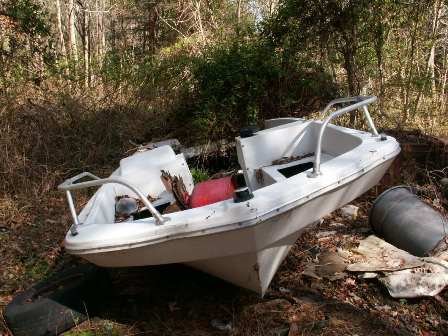
The forest had a dump site, which featured a couple boats:

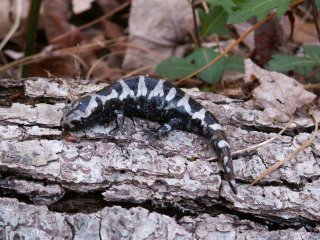
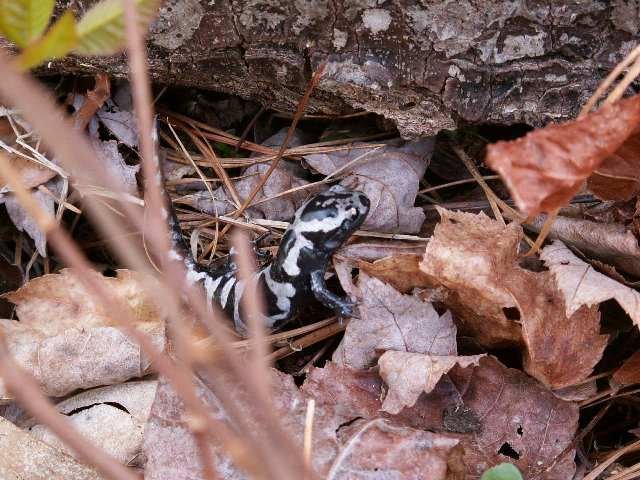
Under a log I found a marbled salamander (Ambystoma opacum).
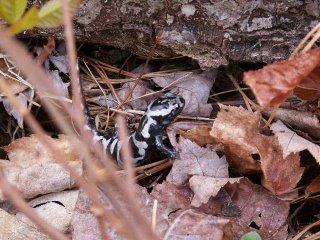
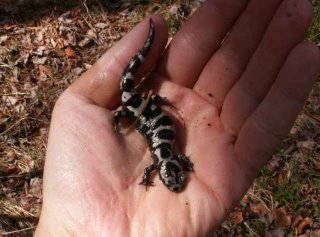
Last, I’ll leave you with a shot of a couple of the neighbors.

Conditions were wet and in the 50s the first day, sunny and windy in the 60s the next two days.
Totals:
3 northern water snakes (seen repeatedly)
1 marbled salamander
A couple we’re friends with (Marc and Katherine) invited us down to Marc's aunt’s house on the water at the tip of Virginia’s Northern Neck. This is the tiny peninsula that sticks out and forms the southern corner of the Potomac’s mouth into the Chesapeake. The landscape there was flat farms with the occasional patch of forest, all edged by new vacation houses on the water.

We arrived on Saturday, and we mostly sat inside watching the rain fall. Marc reported that he had seen a snake crawl across the dock outside. I perked right up, but he’s terrified of snakes so I couldn’t get any good details out of him – he had just turned and walked away.
I figured that he had seen a northern water snake. These are heavy-bodied snakes patterned in dark gray and dark reddish-brown bands. They lose the pattern a little as they age, and big ones, especially big ones that are covered in a layer of mud, can look a muddy gray. These are really common snakes, and you can often spot them basking next to water (rivers, streams, lakes, ponds). They’ll plop right in as soon as they see you. Be careful if you decide to catch them; they're harmless but are notorious for being mean and stinky – they bite and spray feces and musk to the point that I usually just let them sit there. This time I guess I was bored with the rest of the herping opportunities, so I made it my mission to catch one.
The next day I spotted at least two of the snakes. They were basking among the rocks along the water. I’d spot them, they’d spot me, and they’d quickly head deeper into the rocks where I couldn’t grab them. This happened over and over again. There was one little, more strongly patterned one whose position I thought I had memorized. I fixed the location and then an hour later crawled up and quickly popped up and grabbed at where he should have been. I did that twice, but each time he was one or two rocks over from where I had remembered him.
Monday was our last day. I missed my little guy again, and as I gave up on my mission I walked further along the rocks to see if there were any others. Oh! One more, a big one too, but I missed it. I took another few steps, and this time I didn’t think, I just lunged and grabbed the third snake as it dove into the rocks.
After a brief tugging match (steady, gently pulling) I had my snake. It was pretty cool to the touch, and I credit its early morning torpor with its unusually placid response to my grabbing it. All it did was flatten its head and sit there for a minute - no biting, no spraying musk and feces.

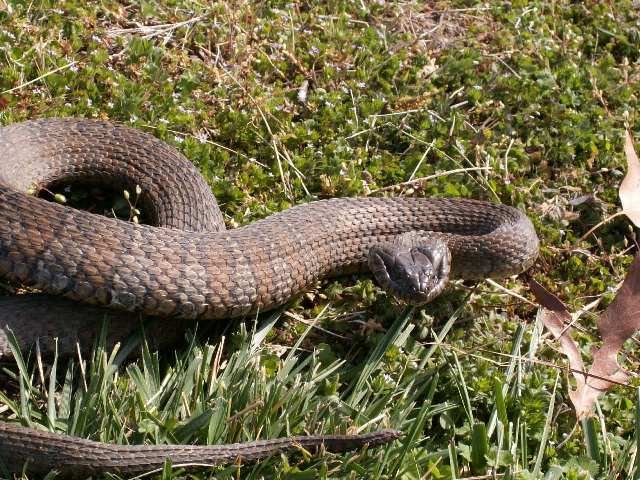
Here’s another picture showing a little of its belly pattern.
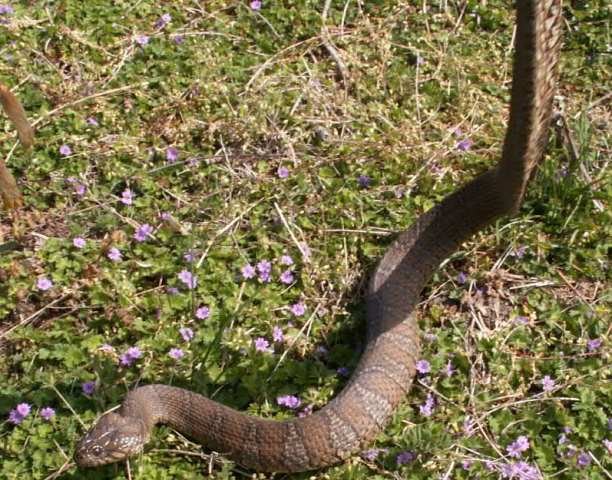
Here’s its release shot. I hope you can see the normal shape of the head here.
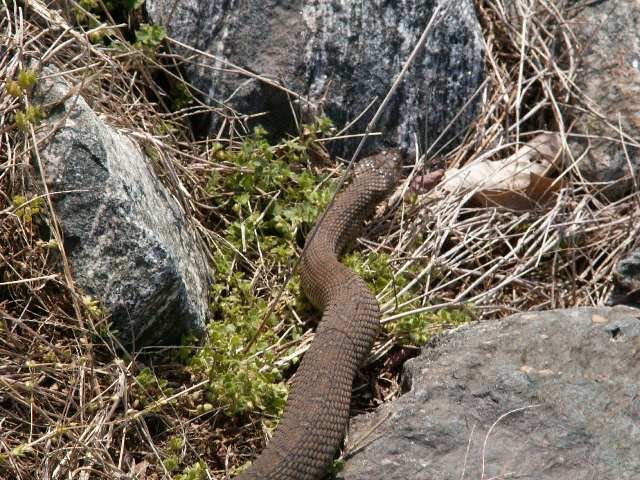
After I let this one go, Jen and I spotted the little one I had been stalking. It was swimming out away from the rocks on an angle towards the dock. We watched it for a moment as it swam along with perfect grace, its head out of the water and its body rippling through curve after curve to propel it along. I ran up the dock and dove flat onto the wood planks, whipping my arm down over the edge to grab for it. I missed by a few inches and it dove for the bottom. Jen scolded me for ruining a beautiful image by trying to catch something. Wasn't it enough to watch it? She has a point, but how cool would it have been if I had caught it?
One thing that confuses me about these water snakes is that the water right there is brackish, and I didn’t realize that northern water snakes lived in anything but fresh water.
I did look around a little beyond the house, but only found one critter. I tried a patch of forest and found that it was a really dry wetlands (see the depressions in this photo with the dark leaves?).
The forest had a dump site, which featured a couple boats:
Under a log I found a marbled salamander (Ambystoma opacum).
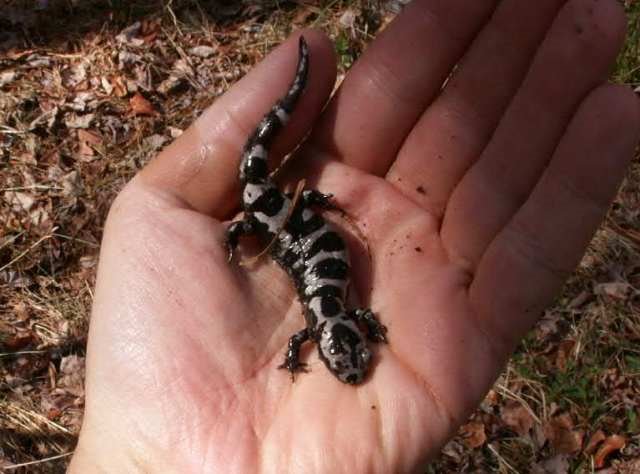
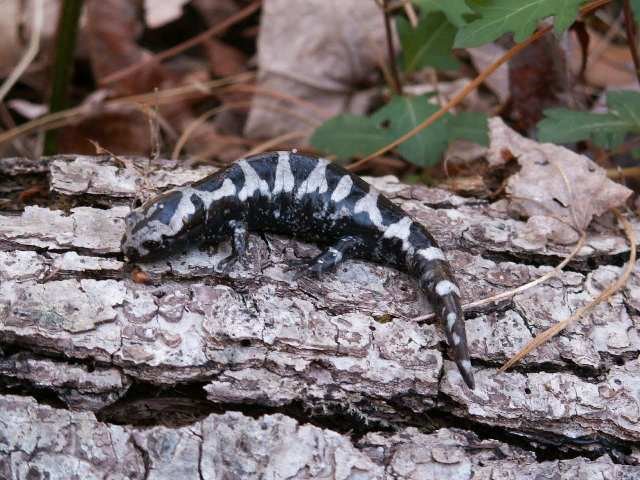
Last, I’ll leave you with a shot of a couple of the neighbors.

Conditions were wet and in the 50s the first day, sunny and windy in the 60s the next two days.
Totals:
3 northern water snakes (seen repeatedly)
1 marbled salamander
Wednesday, April 05, 2006
Egg Masses II:
My trip on Sunday was supposed to be a snake trip. I have been scouting the ridgeline just north of I-78 at the border of Berks and Schuylkill Counties for rocky outcroppings on south-facing slopes. These are classic timber rattlesnake (Crotalus horridus) den habitat. Timber rattlesnakes hibernate together in cracks and cavities deep in such hillsides. In the spring they tend to hang out around the outcroppings before dispersing. The return in the fall, catch some rays at their den site before things get too cold, and then hibernate.
I have found some great den sites, but I know that not all of them are occupied. Timber rattlesnakes live on this ridgeline, but they are not common, and so the challenge will be figuring out which of the hundreds of potential den sites over a few dozen miles of ridgeline are occupied.
Timber rattlesnake dens are a delicate topic in PA herping. Timber rattlers are rare and, in my opinion as well as that of most herpers I talk to, should be given greater protection than they are currently given under state law. Since rattlers from several square miles hibernate together in communal dens, it is really easy to extirpate them from an area. All one has to do is find the den and show up in the spring or fall with a shotgun or with a few pillowcases and a snake stick. That happens more often than you might think.
So, I was somewhere on that ridgeline (covered by several state game lands and at least one state forest) on Sunday with Scott, who is a third-generation Philly herper who knows the region a lot better than I do. He’s also an intern in emergency medicine, which struck me as a valuable characteristic in a herping companion as I we scrambled over ankle-twisting rocky outcroppings and slopes of loose boulders in search of venomous snakes. We made it out without breaking any limbs, but without finding any snakes either.
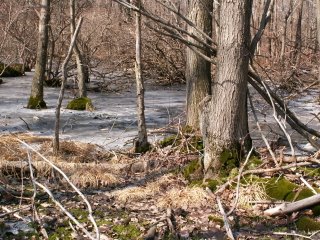
The big find was all the action going on at the ridge top. I had found this mountain bog a few weeks ago when it looked like this:
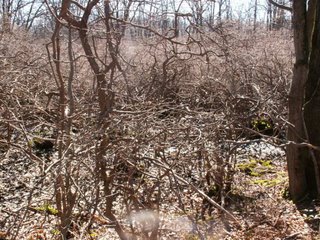
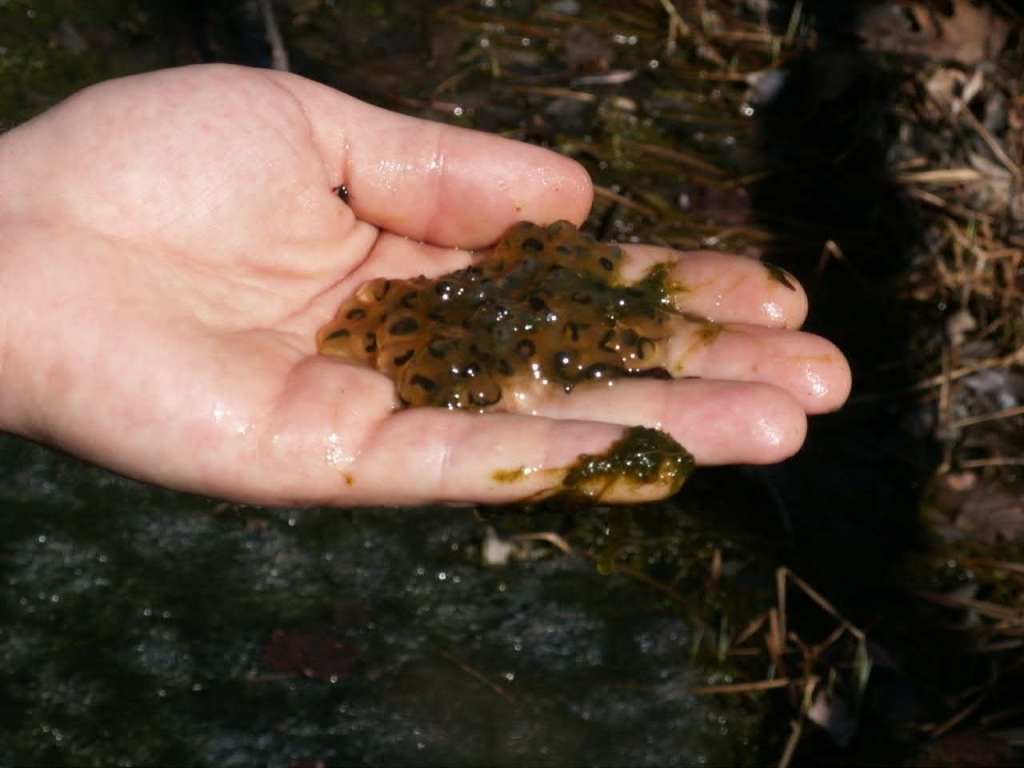
Now it was all thawed out and chock-full of egg masses:
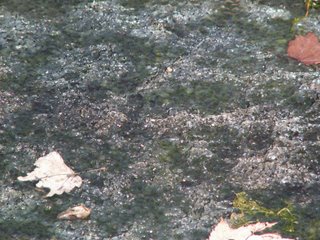
Here are some photos of the largest, likely deposited by wood frogs (Rana sylvatica). It had to be six feet across. I didn’t even spot it at first; for some reason it registered in my brain as moss until Scott shouted and knelt down to take a closer look.
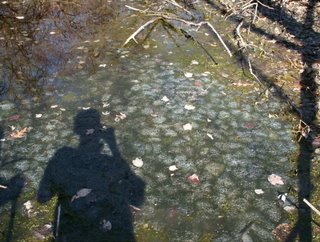
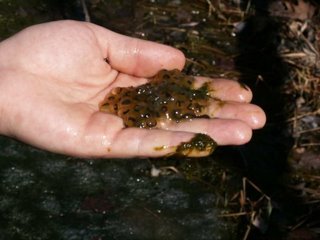
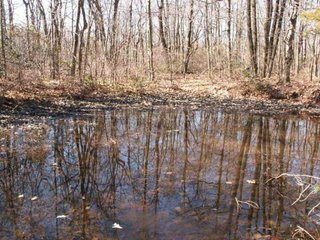
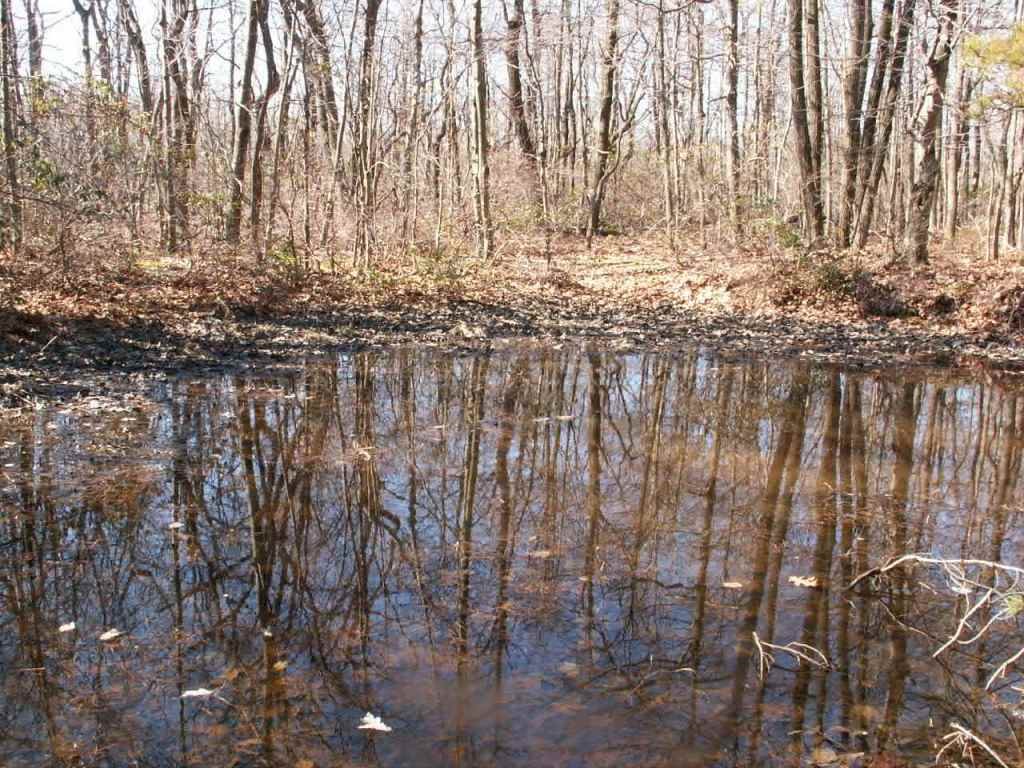
In this pond next to the bog, we found more egg masses, likely of spotted salamanders (Ambystoma maculatum), as well as some adult frogs we didn’t see well enough to identify, the head of a turtle we likewise could not identify, and a small army of newts (Nopthalmus viridiscens viridiscens) cavorting around the leaves at the bottom.
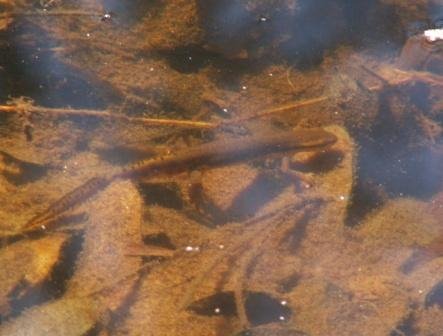
Newts love to eat the egg masses of other amphibians. Here is a photo of one of them in the water:
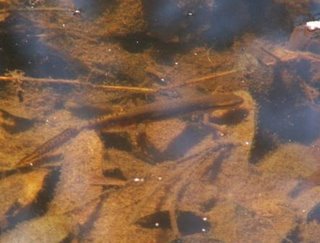
Here are a couple out of the water:
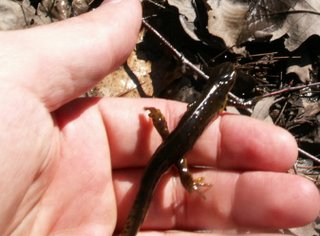
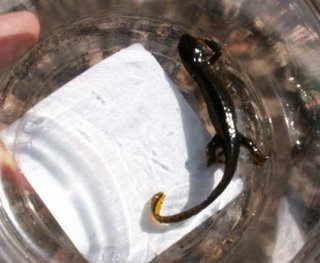
I love newts. They are pretty in their adult form (these are adults), and they are beautiful in their intermediate form, the ‘eft’ that leaves the water after its larval phase and is frequently seen marching around in wet weather. The red-spotted newt’s efts are bright orange with those same red spots that the adults have. Newts are poisonous. Few creatures eat them, and they move with the slow, steady confidence of an animal that does not have to worry about being attacked. These were a piece of cake to pluck out of the water.
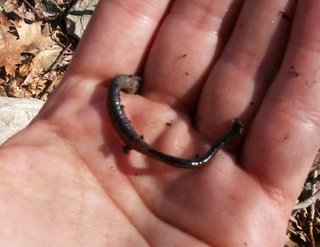
I also found some redback salamanders (Plethodon cinereus). Here’s a pair as I found them under a rock:
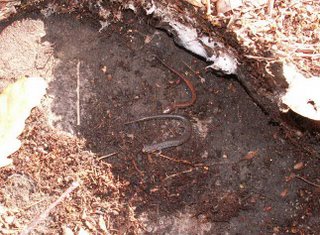
Here’s another trying with all its might to burrow through my hand:
After we felt we had sufficiently cased the mountain bog and pond, we headed on to some promising timber rattler habitat. After hiking for a few miles we made the decision to cut south and find some boulder fields and outcroppings. The decision to head downhill was based on a combination of impatience and my reading of my topographical map of the area (a Christmas gift from Susan Walker and Fernando Ornelas). I guess we guessed right, because soon we hit the edge. The gently sloping forest floor fell away into a steep slope of tumbled rocks and two-story outcroppings jutting out from the mountainside.
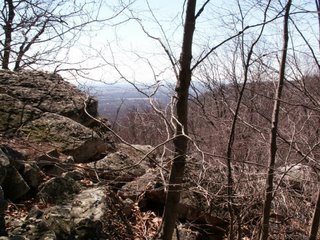
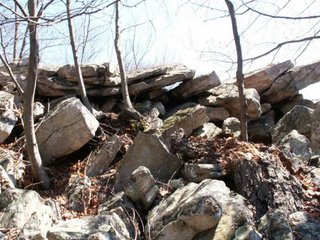
We worked our way back along this landscape, studying the slopes for snakes and peering into cracks and spaces between the rocks. We found nothing. We got a lot of exercise, but saw no snakes.
We made our way back to the car and tried a couple more spots after that. We found no snakes, but I did make a big find, for me at least.
I flipped what struck me as too small a log to house much, and I saw three redback salamanders (all the leadback phase, interestingly) and this brilliant little gem:
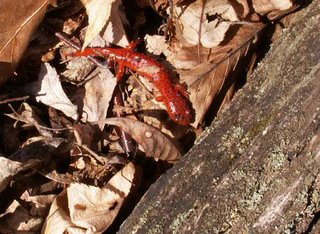
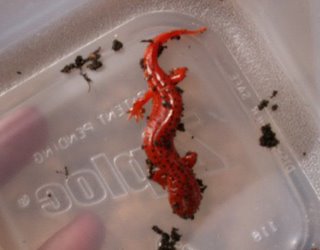
This is a red salamander (Pseudotron ruber). I had never caught one of these, and they have been on my short list of critters to find. I hope you can see why. Like the efts, they are painted a totally unnaturally bright color. They also have cartoonishly rounded features that give them an almost cuddly look. They may actually mimic the efts, gaining some protection from predators that have learned to avoid their poisonous look-alikes.
I also found a little (2 inches) slimy salamander (Plethodon glutinosis) under another log. I like how these little slimies have big, brassy spots on their backs, though the pictures did not turn out well:

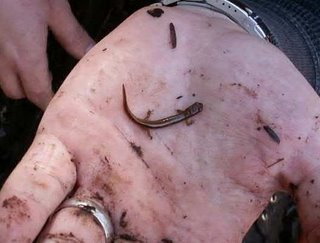
Scott did some rock flipping at the bottom of the slope and found “thousands” of redback salamanders. He also flipped this itty-bitty two lined salamander (Eurycea bislineata) at the edge of a stream. In one of the cutest episodes so far this year, it tried to bite his hand:
Conditions were sunny and in the low 60s.
Totals:
Red spotted newts: 15+
Redback salamanders: 12+
Slimy salamanders: 1
Two-lined salamanders: 1
Red salamander: 1
Spotted salamander eggs: five or so egg masses
Wood frog eggs: absolutely mind blowing
My trip on Sunday was supposed to be a snake trip. I have been scouting the ridgeline just north of I-78 at the border of Berks and Schuylkill Counties for rocky outcroppings on south-facing slopes. These are classic timber rattlesnake (Crotalus horridus) den habitat. Timber rattlesnakes hibernate together in cracks and cavities deep in such hillsides. In the spring they tend to hang out around the outcroppings before dispersing. The return in the fall, catch some rays at their den site before things get too cold, and then hibernate.
I have found some great den sites, but I know that not all of them are occupied. Timber rattlesnakes live on this ridgeline, but they are not common, and so the challenge will be figuring out which of the hundreds of potential den sites over a few dozen miles of ridgeline are occupied.
Timber rattlesnake dens are a delicate topic in PA herping. Timber rattlers are rare and, in my opinion as well as that of most herpers I talk to, should be given greater protection than they are currently given under state law. Since rattlers from several square miles hibernate together in communal dens, it is really easy to extirpate them from an area. All one has to do is find the den and show up in the spring or fall with a shotgun or with a few pillowcases and a snake stick. That happens more often than you might think.
So, I was somewhere on that ridgeline (covered by several state game lands and at least one state forest) on Sunday with Scott, who is a third-generation Philly herper who knows the region a lot better than I do. He’s also an intern in emergency medicine, which struck me as a valuable characteristic in a herping companion as I we scrambled over ankle-twisting rocky outcroppings and slopes of loose boulders in search of venomous snakes. We made it out without breaking any limbs, but without finding any snakes either.
The big find was all the action going on at the ridge top. I had found this mountain bog a few weeks ago when it looked like this:
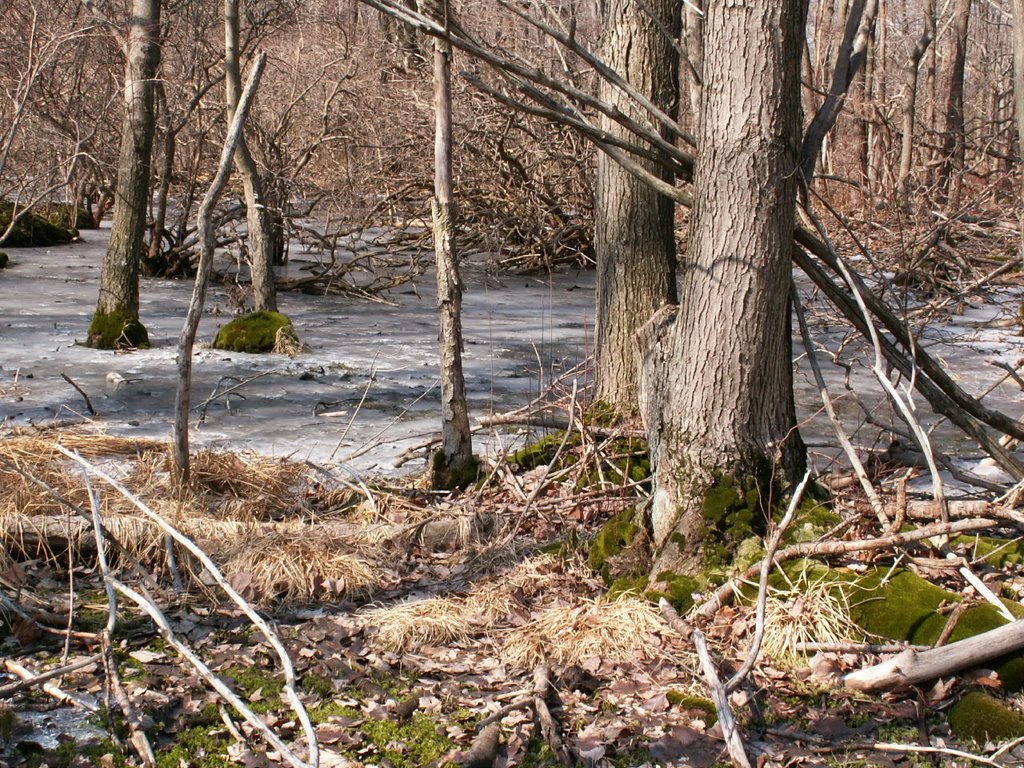
Now it was all thawed out and chock-full of egg masses:
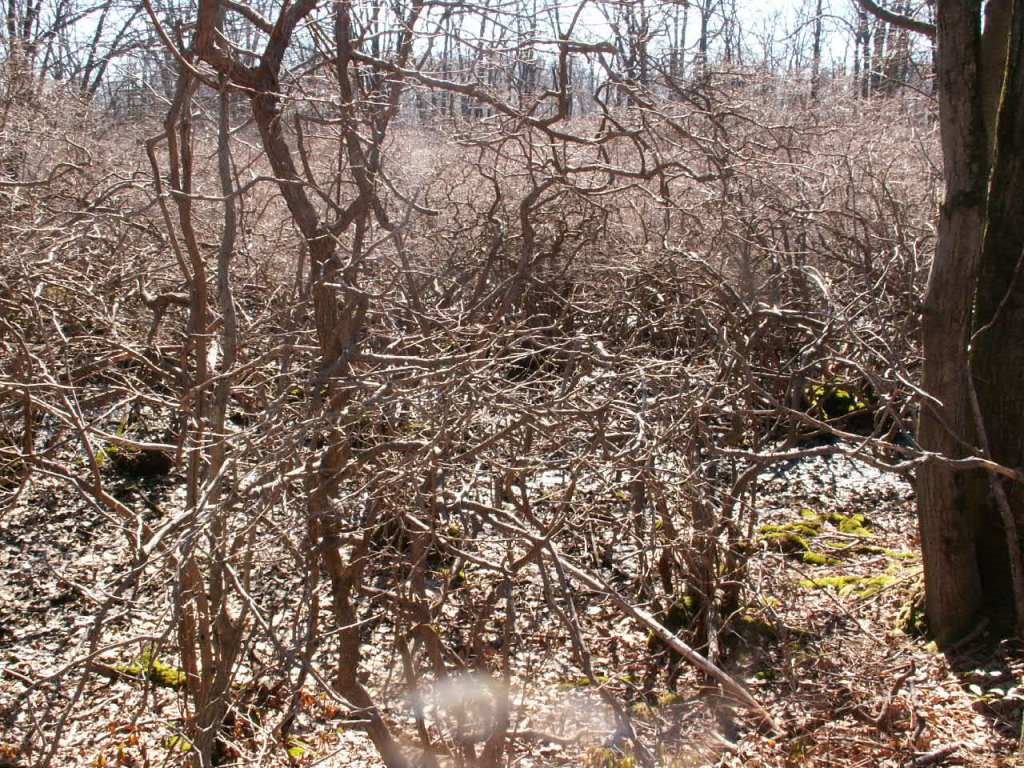
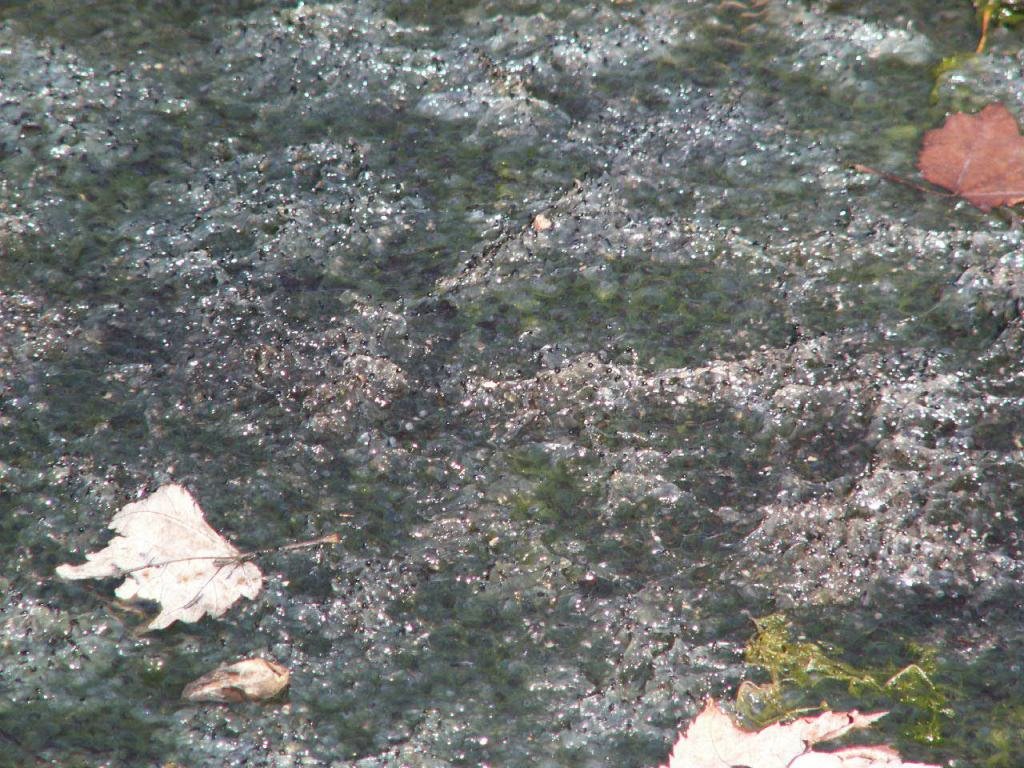
Here are some photos of the largest, likely deposited by wood frogs (Rana sylvatica). It had to be six feet across. I didn’t even spot it at first; for some reason it registered in my brain as moss until Scott shouted and knelt down to take a closer look.

In this pond next to the bog, we found more egg masses, likely of spotted salamanders (Ambystoma maculatum), as well as some adult frogs we didn’t see well enough to identify, the head of a turtle we likewise could not identify, and a small army of newts (Nopthalmus viridiscens viridiscens) cavorting around the leaves at the bottom.
Newts love to eat the egg masses of other amphibians. Here is a photo of one of them in the water:
Here are a couple out of the water:
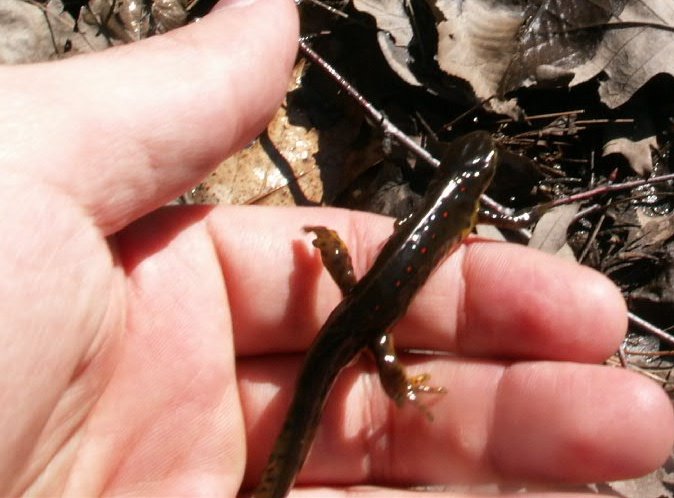

I love newts. They are pretty in their adult form (these are adults), and they are beautiful in their intermediate form, the ‘eft’ that leaves the water after its larval phase and is frequently seen marching around in wet weather. The red-spotted newt’s efts are bright orange with those same red spots that the adults have. Newts are poisonous. Few creatures eat them, and they move with the slow, steady confidence of an animal that does not have to worry about being attacked. These were a piece of cake to pluck out of the water.
I also found some redback salamanders (Plethodon cinereus). Here’s a pair as I found them under a rock:

Here’s another trying with all its might to burrow through my hand:
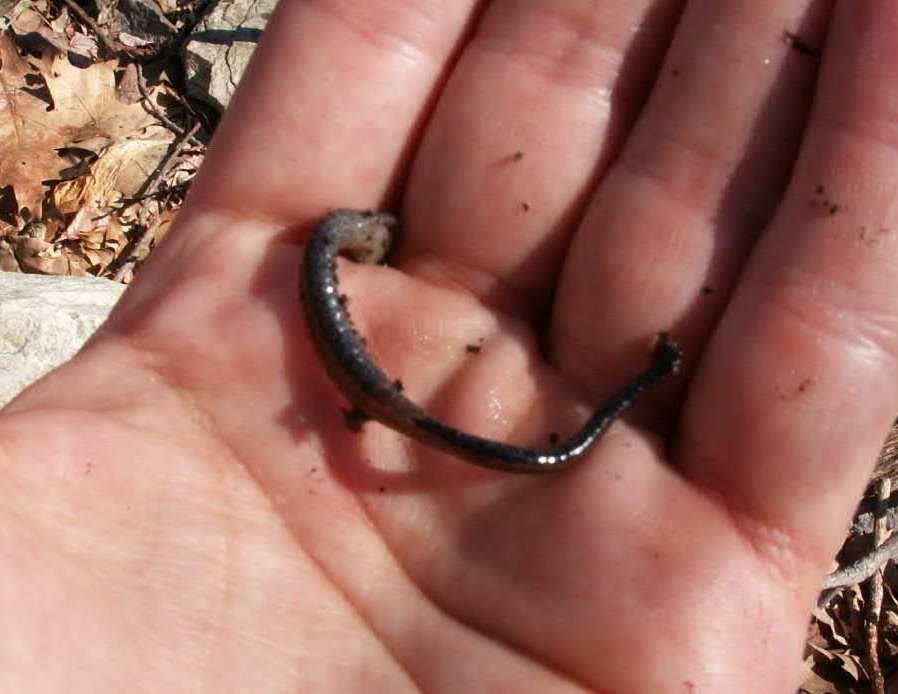
After we felt we had sufficiently cased the mountain bog and pond, we headed on to some promising timber rattler habitat. After hiking for a few miles we made the decision to cut south and find some boulder fields and outcroppings. The decision to head downhill was based on a combination of impatience and my reading of my topographical map of the area (a Christmas gift from Susan Walker and Fernando Ornelas). I guess we guessed right, because soon we hit the edge. The gently sloping forest floor fell away into a steep slope of tumbled rocks and two-story outcroppings jutting out from the mountainside.
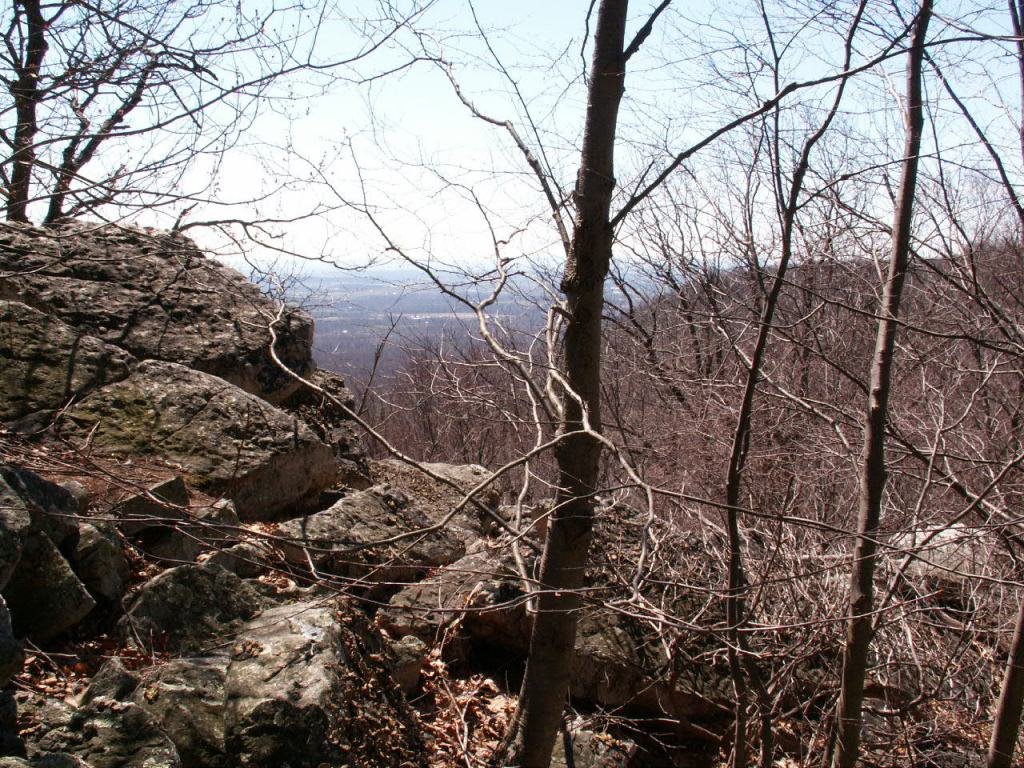
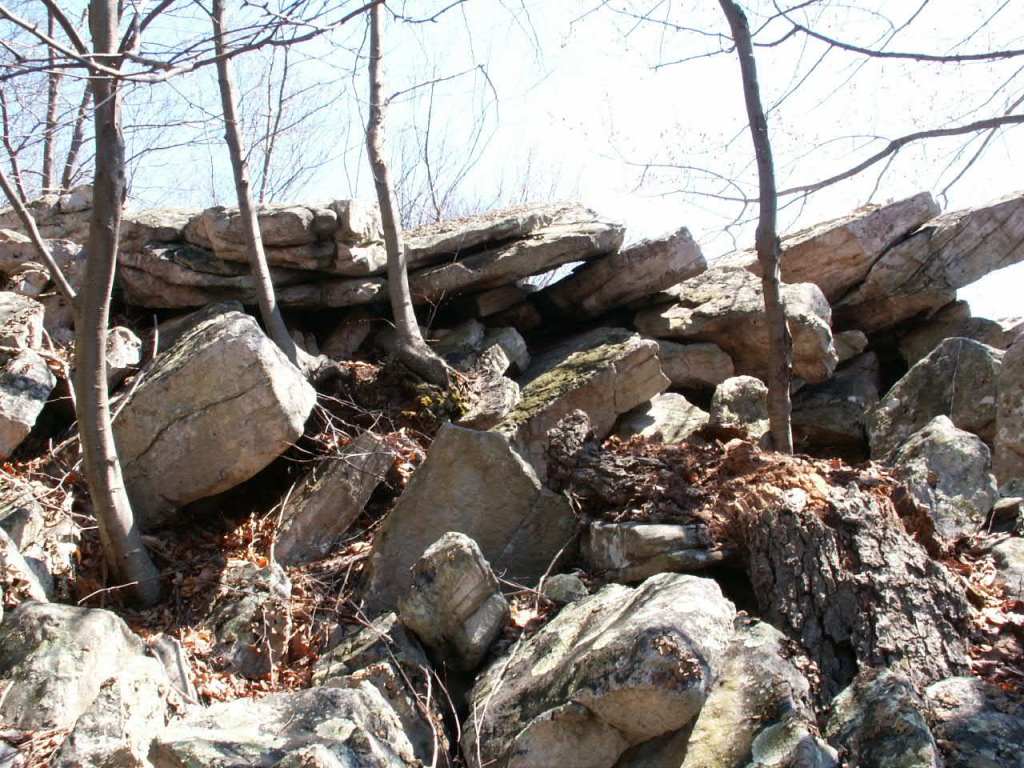
We worked our way back along this landscape, studying the slopes for snakes and peering into cracks and spaces between the rocks. We found nothing. We got a lot of exercise, but saw no snakes.
We made our way back to the car and tried a couple more spots after that. We found no snakes, but I did make a big find, for me at least.
I flipped what struck me as too small a log to house much, and I saw three redback salamanders (all the leadback phase, interestingly) and this brilliant little gem:

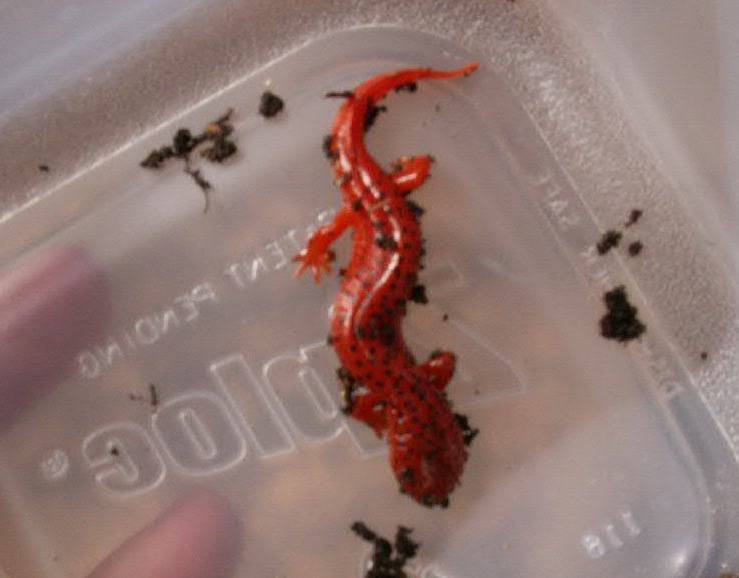
This is a red salamander (Pseudotron ruber). I had never caught one of these, and they have been on my short list of critters to find. I hope you can see why. Like the efts, they are painted a totally unnaturally bright color. They also have cartoonishly rounded features that give them an almost cuddly look. They may actually mimic the efts, gaining some protection from predators that have learned to avoid their poisonous look-alikes.
I also found a little (2 inches) slimy salamander (Plethodon glutinosis) under another log. I like how these little slimies have big, brassy spots on their backs, though the pictures did not turn out well:

Scott did some rock flipping at the bottom of the slope and found “thousands” of redback salamanders. He also flipped this itty-bitty two lined salamander (Eurycea bislineata) at the edge of a stream. In one of the cutest episodes so far this year, it tried to bite his hand:

Conditions were sunny and in the low 60s.
Totals:
Red spotted newts: 15+
Redback salamanders: 12+
Slimy salamanders: 1
Two-lined salamanders: 1
Red salamander: 1
Spotted salamander eggs: five or so egg masses
Wood frog eggs: absolutely mind blowing
Subscribe to:
Posts (Atom)