Wednesday, January 31, 2007

One of the reasons I like my job is the traveling. I don’t travel more than a couple times a month – any more than that I think I’d get sick of, but I do get to see a lot of the beautiful state of Pennsylvania. My more cynical friends would say I don’t like the traveling; I like the opportunistic herping. I can’t say that I don’t, but I also enjoy driving out in the hills. Take I-80, for example, especially just west of the middle of the state where the mountains to either side give the impression of a green, leafy ocean thrown up all around you in great waves of forest.

A little ways past that point I got off 80 and headed north into Elk County. As the name implies, they used to have elk. They were hunted to local extinction, but in the early 1900s they were reintroduced. There are now elk herds in Elk County, McKean County to the north, and Cameron County to the east, and maybe in other neighboring counties, for all I know.

I didn’t see any elk on my late-May, 2006 trip to Elk, Cameron, and McKean counties, but I did see evidence of them – in the mud impressions of hooves that were definitely bigger than those of the deer I’m used to seeing everywhere.

On May 30th I did see another mammal for the first time – a porcupine. I saw others on the trip, all DOR (I guess they’re about as good at crossing roads as possums), but this one was alive. I was walking on a trail in Allegheny National forest, trying to resist the temptation to go so deep into the woods that nightfall would catch me there – I did have to work, of course, and I was catching my herping/hiking time late in the afternoon (doesn’t it seem amazing how late the sun stayed up in May, now that we’re mired in the middle of winter?). I heard a noise off in the trees to one side, and instead of a squirrel I saw this guy:


Isn't it adorable? It looked like it was having trouble getting up the tree, and I wanted to reach in and either help it up or let it down, but, of course, it was a porcupine.

I saw some herps too. Here’s a garter snake (Thamnophis s. sirtalis) I found under a rock.


A ringneck (Diadophis punctatus edwardsii) snake got away from me before I could take a photo of it, as did a wood frog (Rana sylvatica). The redback salamander (Plethodon cinereus) would have posed for a picture, but sometimes I just don’t feel like getting the camera out for another redback.

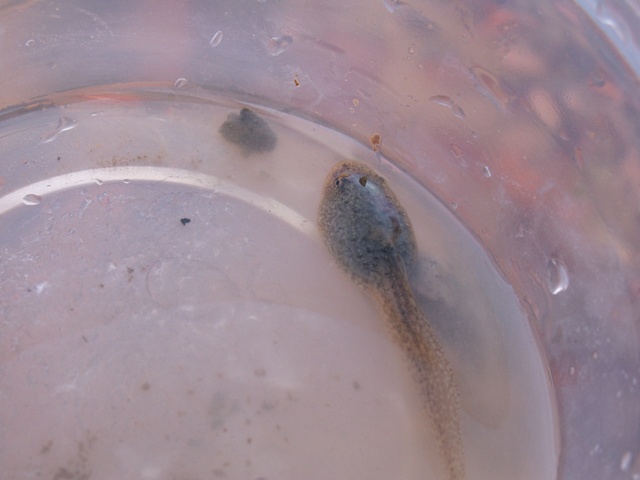
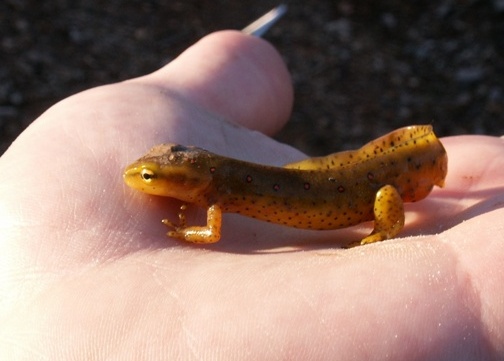
The most beautiful part of the hike was around this lake. I didn’t see anything really crazy up there – a bullfrog (Rana catesbeiana), a newt (Nopthalmus v. viridescens), and some tadpoles.


The picture of this lake, though, was what got me thinking about the landscapes I get to drive across for work and hike across if I’m lucky enough to have a little time left over.


From around 5pm to 7pm the temperatures were in the low 80s, the sky partly cloudy, and the air was humid.

Totals:

1 wood frog

1 garter snake

1 ringneck snake

1 redback salamander

1 bullfrog

1 red spotted newt

100+ mystery tadpoles

15+ calling green frogs (Rana clamitans melanota)

Tuesday, January 23, 2007

Isaac, the five-year-old, asked me whether the Gabon viper (Bitis gabonicus) was the one that could eat a pig. Gabon vipers are impressive snakes, with chunky bodies and brutish heads the size of your fist, but even with their two-inch fangs they can’t hoark down a pig. I pointed out the reticulated python (Python reticulatus) and the anaconda (Eumeces murinus) around the corner; those are the ones that could down a pig.

While they’ve got pythons and maybe even anacondas in Florida, we don’t even have racers (Coluber c. constrictor) right now (though this December was a little weird) in Pennsylvania. These were all indoors snakes.

Last weekend we took three of Jen’s friend’s kids to the zoo. We had a good time throughout the zoo, but of course for this post I’ll be focusing on the reptile and amphibian house.

More than one person has complained that I’m no fun in a reptile/amphibian house. I get annoyed when I see mislabeled animals, and I can be a little dismissive of animals that are easy to find in the pet trade; if I can see it at the Hamburg reptile show, why do I want to pay to see it at a zoo? Of course most people don’t go to the Hamburg show (and, in my opinion, they probably shouldn’t – very sketchy show), and zoos are for most people, not for know-it-all herp snobs like me. Last, I’m consistently annoyed that reptile/amphibian houses aren’t bigger. Of course I would want larger reptile/amphibian houses – I’d love to see a whole zoo of just herps – but I think I’ve got a good argument for reptile/amphibian house expansion: herps are cheap and easy.

1) How often and how much do you have to feed birds and mammals? A lot and often! Cold-blooded herps, by contrast, need less food to fuel their slower metabolisms and they need it less often. 2) How often does a zoo keeper have to interact with a lion or a zebra? These animals take daily attention from multiple people, while herps generally don’t – at most a daily misting for the moisture-loving critters, so you can have more critters served by fewer people. 3) I imagine the liability costs are also lower for herps, as long as they’re not venomous. I’m sure zoos have to carry some pretty hefty workers comp policies for the potentially-lethal hoof stock and carnivores. Another reptile/amphibian house’s worth of chameleons, racers, toads, and water turtles, however, has to be pretty-near insurance-neutral.

Anyhow, until I run the world or have millions of dollars to donate to zoos to have my own reptile/amphibian houses built, I’ll have to keep my mouth shut and let my friends enjoy the critters.

I had the best time with Isaac and his sister Mary (Jen had to take Owen outside – all the crocodiles and pythons scared him) when we got to the native species corner. Of course I would have loved to have every species native to Pennsylvania and the Delaware Valley represented, but it was still cool to look at the timber rattlers (Crotalus horridus), copperheads (Agkistrodon contortrix), the northern water snakes (Nerodia s. sipedon – I told Isaac we might be able to catch one of those this summer), and one rather gimpy-looking box turtle (Terrepene c. carolina).

What excited me most, for reasons I still don’t understand, were the Pine Barrens tree frogs (Hyla andersonii). These are adorable little frogs, green with black stripes along the sides and across their eyes, and I nearly giggled to see all of them sitting around, stuck to the sides of the terrarium. Follow this link (http://www.cnah.org/detail.asp?id=1108) to see one. Isn’t that the cutest thing you’ve ever seen?

By coincidence, I also got a new ringtone for my cell phone – of calling Pine Barrens tree frogs. If you want to hear little Hyla andersonii each time you get a call, check out (http://rareearthtones.org/ringtones/) for the download.

Wednesday, January 10, 2007

The day before I ran into that bear in Clearfield County I spent some time in a State Game Land in Northeast Pennsylvania.

I had finished with some morning meetings in Scranton, and all I had to do the rest of the day was drive over to Dubois. That left time for a herping stop near Scranton.

I had hoped to find some redbelly snakes (Storeria occipitomaculata) or even timber rattlesnakes (Crotalus horridus) up in them hills, but it was a day for the salamanders. I’m not upset; I had a fun, productive time that afternoon (May 2nd, 65 degrees and sunny), but I’m still hoping for more snake trips this year.

I started off walking up a dirt road with a dribble of a stream seeping down the middle. On a whim I looked under a few rocks in a particularly wet section and found a couple northern dusky salamanders (Desmognathus fuscus fuscus). I’ve got to work on taking better pictures of duskies. Many are drably true to their name, but some, like this guy, are marked in a deep purple and red pattern that looks great in real life but brown in photos.


I continued up the road into some clearings – the basic SGL clearings with big, thorny hedgerow

s running through the middle of it. I found a redback salamander under a soggy log, and then I zeroed in on a pond in one corner of the clearing that spilled over one bank to form a long, marshy strip of grass in the field.


I had apparently just missed the spotted salamander (Ambystoma maculatum) orgy, since the pond was full of egg masses. I saw one green frog (Rana clamitans melanota) hop in before I could snap a photo, and then in the water I saw the dark shape of a newt (Nopthalmus v. viridiscens) dive for the bottom.


I smiled. Wherever there are newts there’s fun. They’re pretty, they’re active in all kinds of weather, and they’re slow and easy to catch. I didn’t go for any in the pond, but I found a bunch in the water seeping out from the pond into the marshy area. There it was a simple matter of reaching down and grabbing them.


At least some of them were mating, since I found one with its rear legs locked around another’s neck. This might not sound like foreplay to you, but apparently this is what male newts do to get female newts in the mood: they put them in a leg lock with their hind legs around the shoulders and hang on for a while, culminating in bouts of violent shaking until the female decides she would like to mate with him.


And then the mating isn’t quite what you’d imagine either. Once the male has seduced the female, he walks in front of her and deposits a packet of sperm (which comes complete with a stalk to balance on) from his cloaca on the bottom of the pond, and she then plucks it from the stalk with her cloaca to fertilize her eggs.

Totals:

5 mystery frogs
1 green frog
10+ newts
1 redback salamander
3 northern dusky salamanders
60+ spotted salamander egg masses


Tuesday, January 02, 2007

A few days before New Year’s Day I got excited about the weather forecast. They were calling for rain starting New Year’s Eve and continuing through New Year’s Day. Maybe this was my chance for finding a tiger salamander (Ambystoma tigrinum), the largest of our terrestrial salamanders and one of the hardest to find.

Tiger salamanders spend almost their entire lives out of sight. They mostly stay under ground, and if they come out it’s at night. Once a year, though, they crawl out of their burrows and trek over hills, through fields and forests, to the right breeding pool to mate and lay eggs. These are truly epic journeys – hundreds of yards is quite a migration for a salamander.

I know of one supposedly reliable tiger salamander spot and it’s in Delaware (tigers don’t live in PA, are considered extremely rare by the state of Delaware, and are endangered in NJ). It’s a bit of a drive, but an interesting place with several Delmarva Bays, small seasonal ponds (a.k.a. vernal pools) that are amphibian hot spots in the spring.


Tiger salamanders in South Jersey and Delaware supposedly breed in December, but I didn’t notice much precipitation when I looked back at the weather history for December, so I figured they might be getting out to get it on over New Year’s Eve or the night of New Year’s Day.

The coolest way to herp breeding aggregations of ambystomid salamanders (tiger salamanders, like spotted salamanders, Ambystoma maculatum, and marbled salamanders, Ambystoma opacum, are part of the Ambystoma family, the ‘mole’ salamanders) is to head out at night and cruise the roads around the breeding pond or walk around the edges of the pond. Do that in the right spot at the right time and you can see hordes of these usually-secretive critters, all of them looking for love and some of them finding it.

You can still get lucky the next day, after all the salamanders have gotten lucky and a few are still hanging around the pool. You flip logs and other cover in soggy areas, keep an eye out for anyone hiding in the water, and maybe uncover a critter before it starts the long hike back home. You can also see egg masses in the water, the products of all that crazy amphibious sex.

I guess I was wrong about my timing, since I didn’t see anything besides tadpoles in the Bays. I looked under a lot of cover, got my socks plenty wet (extra fun when it’s 49 degrees out; at least it was sunny today), and didn’t even see any egg masses.

This wasn’t the greatest start to my 2007 herping year, but it did sort of validate some of my herping resolutions. So what have I resolved for herping 2007?

- First, I’m going to stay as local as possible and as urban as possible. I have as much fun finding common species in unlikely places nearby as I do finding rarer species after a miles and miles of driving. I would have had a lot more fun today finding long-tailed salamanders (Plethodon longicauda) in the Wissahickon

- When I do go far away – to the Pine Barrens, to the mountains, I would like to team up with other herpers as much as possible. Striking out with other people is more fun than striking out on your own, and more eyes and ideas make finding something after the long drives more likely.

- I’d like to get more involved with herping with kids. This fall and winter I’ve gotten requests from cousins, friends, and even someone who volunteers with local urban school kids to take children herping with me. I’d love to turn more kids on to the hobby, but more importantly I’d like to teach kids with limited access to Nature how to get their hands dirty and find wonder where they can find it.

- More turtling: I need to work on catching turtles, something that I can practice relatively locally and can combine with hot-weather activities such as canoeing and tubing. I'd like to master several techniques, including noodling, fruit baiting, netting, and leaping from shore.


That’s it: no species targets, no specific locales to hit – all that is secondary. Have a happy and herpy New Year!

Wednesday, December 27, 2006

I’ve been kicking around the idea of an ode to the redback salamander (Plethodon cinereus). It’s the herp I find most often, it’s a strikingly beautiful little critter that even normal people can find cute and appealing, and if you’re counting by numbers, it’s the dominant vertebrate predator in the Northeast.

Ever since I moved from Atlanta to Baltimore, the redback has for sure dominated my herping, but before then, when I was living in Atlanta, I didn’t see any. Of course I was herping mainly in the range of the redback’s close relative, the southern redback salamander (Plethodon serratus), but these are very closely related species (they used to be considered the same species), and to this day I’m a little miffed I hadn’t found any serratus while I lived in Atlanta.

The problem was that the southern redbacks like summer even less than ours do, and back than I was still thinking of herping as something I did in the summer while out hiking. That was great for finding streambed salamanders like the duskies (Desmognathus species), but really bad for finding redbacks, which spend the summer deep underground.

I’d almost forgotten that southern redbacks existed when Jen and I decided to look around her parents’ house the day after Christmas. It was a foul day, misty and thirty-eight degrees when we headed outside and into the wooded ravine behind the house at around four in the afternoon. We focused on the stream that runs through the ravine, and I’m proud to say we checked every rock that looked good, even though the icy water completely numbed our fingers.

I found one southern two-lined salamander (Eurycea bislineata cirrigera) that way, and I was ready to head back inside, but Jen was stubbornly turning over rocks on our way back. I really couldn’t head back inside without her, and it was a good thing I didn’t, since after a minute she shouted that she’d found something.

My camera’s batteries had died, so I didn’t get any photos, but what she had in her hand looked exactly like one of our redbacks, maybe a little more slender. I checked the range maps again, and although it’s close, I’m pretty sure it was a southern redback – my very first, and not a bad Christmas present.

I have one other find to report: on the 23rd we headed to Calloway Gardens in Troup County, GA. They have a big Christmas lights show, but we got there in the afternoon to enjoy the grounds in daylight too. It was a beautiful sunny day in the low 60s, and I spotted a stinkpot (musk turtle - Sternotherus oderatus) crawling around the bottom of one of the ponds. If I hadn’t had to get back into the van with the rest of the family I would have jumped in after it.


Totals:

December 23rd:

- 1 stinkpot


December 26th:

- 1 southern two-line salamander
- 1 southern redback salamander

Sunday, December 17, 2006

"The other day I saw a bear, a great big bear, oh way out there, the other day I saw a bear, a great big bear oh way out there! He said to me, why don’t you run because you ain't got any gun…”

It wasn’t exactly the other day, but the 'way out there' part sure was true; I had a meeting starting in Dubois, Clearfield County, at 10 in the morning on May 3rd, and I managed to get out of my hotel room around 6:30am to spend some time in a nearby State Game Land.

The bear might have been saying to me “why don’t you run,” since I sure didn’t have any gun, I didn't even have my cultivator, but I don’t speak bear. I didn’t even know it was a bear that I was hearing at first.

You’d think a bear would make some kind of deep growling or roaring noise, but what I heard as I was walking through the field sounded more like a pig – a kind of grating, squealing noise. If I were the bear I'd be a little embarrassed. I figured it was probably raccoons or possums tussling back in the woods, and I didn’t think much of it.

A lot of these fields in State Game Lands are cut up by long hedge rows, and this long field had several of them running crosswise. I rounded the end of one of them a few minutes after I’d heard all that squealing, and I looked across the field to see a black bear looking right back at me.

The sun was just burning through the morning mist, and the air had a bright, hazy quality to it that stretched that instant out, so I recall it now as a long, mutual contemplation, even though it probably only lasted one second.

I thought to get my camera out as the bear was dashing off into the woods, and of course I missed capturing that absolutely amazing image. The woods were close, and no matter how big and clumsy bears look, they can haul ass when they want to.

That bear’s speed made very clear to me that bears do not make a habit of attacking people. I’ve seen black bears before, and I know they almost never attack humans, but man, if they wanted to eat people we’d have no chance at all of getting away from them.

I had been planning to head just where that bear had headed, and even knowing all I knew about how timid black bears are, and even though it had acted terrified of me, I decided to head in the opposite direction.

So, I headed up along a recently clear-cut slope looking for something to look under. I tried some branches and stumps and found nothing. I wanted to head deeper into the field to try more of the stumps and branches, but the field was thick with brambles, and I was hoping for better ground to cover further up the hill.

I found some nice looking loose rocks near the top of the ridge, but nothing under them but dirt. My time was winding down if I wanted to get back, shower, and make the meeting on time, so I decided to try one more pile of logs before giving up.


That’s where I found this skink. I wasn’t sure what species at first, but I suspected coal skink (Eumeces anthracinus). You don't see coal skinks too often, not because they're rare, but because they live in the middle of nowhere, which closest to us means up in the mountains of central PA. I submitted the capture record with the photos to the PA Herp Atlas Project, and I was relieved that they confirmed the ID.


The temperature was around 55 degrees.

Total:

- 1 coal skink

Sunday, December 10, 2006

I’m going to start posting about some trips I took over the summer. I guess posting weekly on this blog makes the most sense if I take one herping trip per week, but it’s hard to keep that pace up over the winter. Over the summer, though, I sometimes managed two or more trips, especially if I count little explorations while I was on the road for work. So I’m hoping that the trips I’ve stored up will carry me through to some trips we’re looking at early next year and then into the spring.

We took a ride up to western Massachusetts to visit some cousins in August. Jen’s cousins live in Conway, while I’ve got some in North Adams. I posted a little about this trip on August 24. This is the one where I had had a fabulous time swimming in a rural pond, chasing after adult, aquatic newts, and I couldn’t wait to try swimming with turtles (and don’t worry – I’m still obsessed with this; those turtles better look out this summer.).

Here’s the pond.


I zeroed in on a rocky brook leading into it, and we found a two-lined salamander (Eurycea bislineata) right away. We spotted a green frog in the reeds.


Here is a pile of branches that I found completely uninteresting.
Jen’s cousin Jeff said, “what about those sticks?” and I, the dismissive expert, said, “Sure, you can look if you want.” He found three newts (Nopthalmus v. viridescens) right away.
Here’s Jeff with our little cousin Zach, who was delighted by the newts.


I couldn’t figure out why adult newts were hanging out on land until it hit me that they were efts transforming into adults.

Red spotted newts have a three-phase life, starting out of the egg as aquatic larvae, then transforming into terrestrial efts, the bright red ones you sometimes find walking around the forest floor after a rain storm. After a few years the efts mature into adults and head back to the water.

The countryside around Conway is a mix of woods, fields, small farms, and houses. It’s pretty, but pretty well kempt as far as I could tell (in other words I couldn’t find any trash piles). I found a very pretty redback salamander (Plethodon cinereus) on a morning walk.
I also found a couple two-lined salamanders in a rocky creek on a run – one of those times I’m jogging, I see something I should check, I run by it, and I have to turn back and look.

All those salamanders were about what I expected. The weather was a little wet and cool, even during my aquatic frolic with the newts, which is another way of saying amphibian weather. We got a little sun in the afternoon on the day we went to visit my cousins Ben, Alice, and Ethan.

After a mind-blowlingly rich brunch of French toast stuffed with cheese and maple syrup, we went for a walk in the Hopkins Memorial Woods, located way up in the corner with Vermont and New York. We walked a nice little loop through the woods. As we went we looked under a lot of logs and found a couple redbacks – what I’d expect.

On the way back to the car, though, we passed through a meadow with an old shed and some rusty, antique farm equipment leaning against it. I looked at one flat piece of iron sitting there on the grass next to the shed, and I had an inkling; you know what I mean. It’s hard to say how accurate those inklings are, since I probably forget all the times I’m sure I’ll find something and don’t, but I lifted that up and saw a garter snake (Thamnophis s. sirtalis).

I didn’t grab fast enough, and it slipped away under a rock that I thought I’d be able to lift. I turned to Jen that I’d found something, and when I looked down I saw a couple wasps flying out to see who had picked up the roof of their house.

I see these long, skinny wasps (hornets?) pretty often. Every time I’ve been able to put the piece of cover back down and step away in time, and I’ve had my legs and feet covered enough to shield me from any stings. This time, though, I had on my sandals, and damn if one of those wasps didn’t tag me on the top of my foot.

Totals for our Massachusetts:

- 50+ newts
- 4-5 redback salamanders
- 3 two-lined salamanders
- 1 garter snake
- 1 green frog

Sunday, December 03, 2006

I’ve been thinking about that garter snake (Thamnophis s. sirtalis) we found last weekend, the one that we pulled out of the pond. I did what I should have done last week and looked up the normal seasonal activity for garter snakes, and I found that they’re active later into the season than most snakes.

More interesting to me, though, was that they sometimes hibernate submerged in water. The obvious question is how do they breath all winter if they’re under water? The answer is that they don’t have to, apparently they can get enough oxygen and get rid of enough carbon dioxide production through their skin to keep themselves alive.

In some ways that is less remarkable than it sounds. Snake metabolisms, and thus oxygen use and carbon dioxide production, slow down with the cold. Down in the 30s or 40s they’re not using very much oxygen or producing much carbon dioxide. Snakes also have a lot of skin relative to their mass thanks to their long, stretched-out shapes.

Still, I’m impressed. I’ve had it so firmly in my head that vertebrates with lungs breath air and those without lungs live in water and use gills that this fact about garter snake aquatic hibernation blows my mind.

I’ve had a few of these revelations over the past few years: you know all those redback salamanders (Plethodon cinereus) I find? They, and all their plethodontid relatives are also known as lungless salamanders. They get all the oxygen they need and get rid of all their carbon dioxide through their skin. How do all those water turtles survive under the ice in the winter? They also can get by submerged in water. They ‘breath’ by pulling water into the mouth and into cloaca and exchanging gasses that way.

I’ll close with some garter snake photos from when my digital camera was broken. I had been looking for milksnakes (Lampropeltis t. triangulum) in Roxborough, and a garter snake crawled directly into the side of my foot, as if surprised to find me standing there (http://phillyherping.blogspot.com/2006_09_24_phillyherping_archive.html).


Here’s a photo of the little guy, along with a couple of the street on which according to the locals (seen at the edge of the photo of the snake), garter snakes are really common. In case you were wondering, that's my trusty steed in the foreground of the second photo.


Here’s a photo of another a few feet away that didn’t make it to the sidewalk.

Sunday, November 26, 2006

They might be flipping kingsnakes in Florida, and rightly so, but this isn’t Florida. Here in Philadelphia at the end of November we’re supposed to be staring out the window and pining away for the herping of spring.

Since there’s not much to find, Jen and I have been going out on hikes and nice walks out in the woods, the kind of trips that are supposed to be more about exercise and enjoying the landscape than about finding critters. These are the kinds of trips we take when we’ve given up hope, otherwise I’d be up a mountain somewhere upstate, deep in the Barrens, or poking around for milksnakes in Roxborough.

Today (Sunday the 26th, temps in the mid 50s and cloudy) we took a drive up to the Schuylkill Environmental Center (http://www.schuylkillcenter.org/). The landscape is basic Piedmont woodlands, but they’ve got some ponds that are chock full of frogs, and it’s a nice change of pace from the Wissahickon Valley.

I had been expecting to find redbacks (Plethodon cinereus) in the woods and maybe some two-line or long-tail salamanders (Eurycea bislineata and E. longicaudia) in the streams, but we didn’t see any salamanders at all.

We stopped at three ponds on our walk. Two were almost hopping with tadpoles, which I assume will be hibernating in the water and metamorphosing next year. This wasn’t all that surprising or exciting. I like tadpoles, don’t get me wrong, but I figure they’ll be swimming around as long as the ponds aren’t frozen solid.


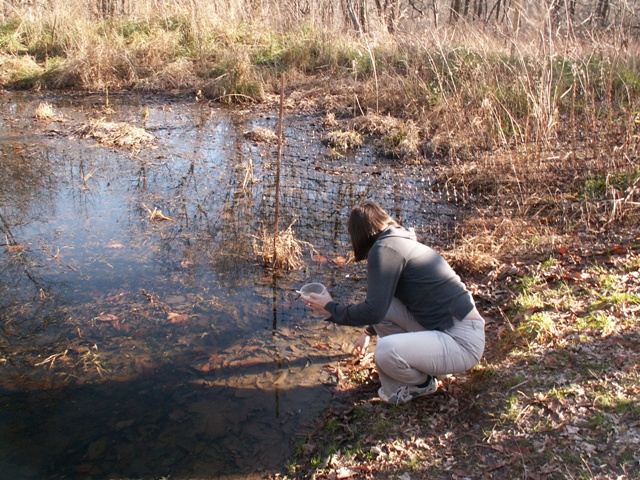
Here’s Jen catching tadpoles.


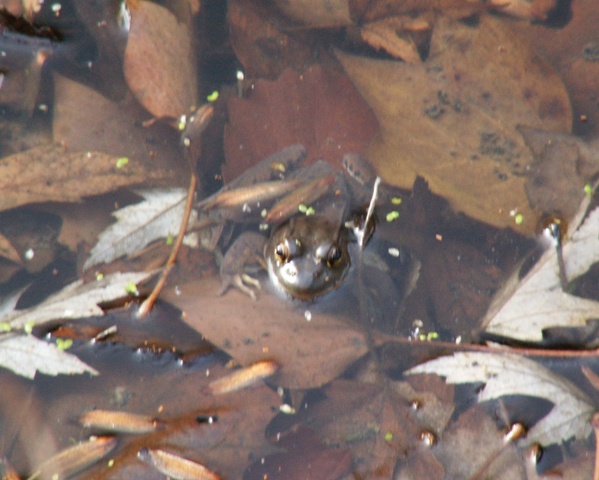
I did smile at the green frog (Rana clamitans melanota) Jen spotted. At “Cattail Pond” last summer we had a great time watching big male green frogs, who were flashing their bright yellow throats - breeding colors, call to each other and occasionally interrupt their concerts to leap up and catch mating dragonflies.

These guys were sitting placidly in the shallows, drab and cold, just trying to catch what little sun could squeeze through the clouds.


What amazed me was the garter snake (Thamnophis s. sirtalis) Jen spotted in the water. It was stretched out at the surface right near Jen’s perch on an observation platform. I yelled “grab it!” but it dove before she could get her hand on it.

What was that garter snake doing in the pond in this weather? I’m sure it hunts tadpoles and frogs there all spring and summer, but even if it nabbed something, how could it digest it at 57 degrees? I’ve seen plenty of accounts of garter snakes basking near den sites, so maybe it planned on hibernating in a burrow right near there.

We walked around the shore a little more, looking for more frogs and speculating about where the garter snake might have gotten to. We had given up on the snake and were putting away the camera when Jen shouted again.

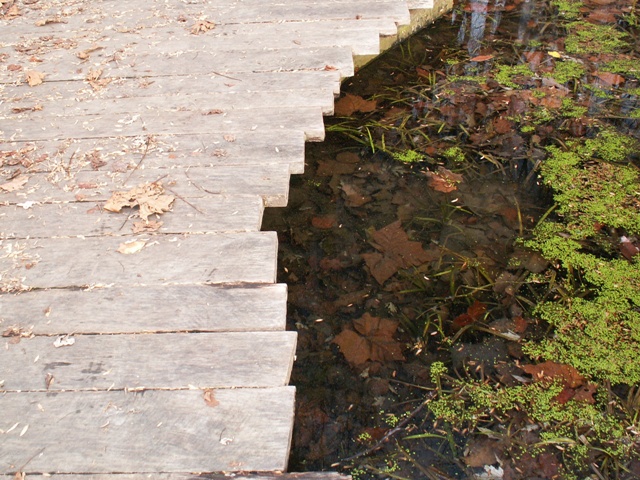
I have no idea how she spotted it (this kind of thing makes me wonder how much I don’t see when she’s not with me), but the garter snake was right there, a few feet away from where it had been before. It was peeking up from its hiding spot in the leaves at the bottom of the pond. Can you spot it in this picture?


Here are two zoomed-in shots.


I managed to catch it this time, but I took a moment before grabbing it to relish the view of it elegantly stretching up towards the surface and flicking out that scarlet and black-tipped tongue under the water.

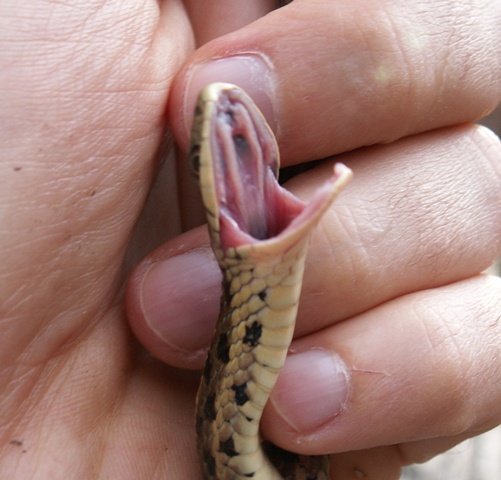
It seemed a little uncoordinated and spaced-out. I figure it was just cold, but it also looked a little thin to make it through the winter. I hope nothing was wrong with it. We let it go back where we found it after I had gotten a few pictures of it (including the classic bite-the-camera shot) and it had thoroughly smeared me with musk.


So, at what point should we give up on finding snakes? Maybe it’s not worth looking when there’s a lot of snow and ice on the ground, but as long as we get these days in the 50s, I think we should be out there looking, no matter what the month on the calendar.

Totals:

- 100+ tadpoles
- 3 green frogs
- 1 garter snake

Saturday, November 18, 2006

Some people wonder what butterflies do in rainstorms; I wonder about the salamanders. To be more specific, I wonder about the streambed salamanders. The redbacks (Plethodon cinereus) and the other woodland salamanders probably have a great time, the soaking freeing them to leave their hiding places and wander around where the ground had been too dry just minutes before.

The streambed salamanders, on the other hand, can find themselves suddenly in the middle of a torrent. I’ve mentioned before that I usually find two-lined salamanders (Eurycea bislineata) under rocks that are a little in the water, a little out of the water. I imagine they risk getting flushed away when all that rain water turns the edge of the stream into the middle of the stream.

At the end of the summer of 2004, a series of major storms flooded the Wissahickon Valley, causing millions of dollars of damage. Rock slides blocked Forbidden Drive, and flooded streams washed out bridges and trails. The streams running down the steep sides of the valley into the Wissahickon were already rocky and damaged from routine runoff upstream in the surrounding streets, sidewalks, and roofs, but the storms send tons of rock smashing through, not just scouring but completely remodeling the streambeds. Imagine a three inch creature so fragile as a salamander in that kind of tumult.

How we found two species of streambed salamanders (two-lines and longtails, Eurycea longicaudia) last year is beyond me, but it’s brought us back flipping rocks in some of the most polluted and degraded streams running in the region two or three times since.
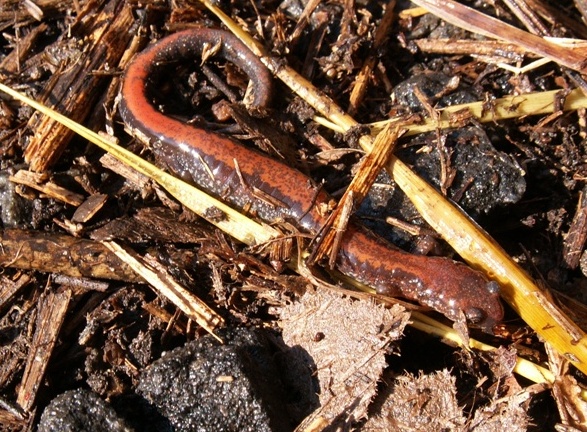


We were on a walk in the Wissahickon last week (Saturday the 11th), and while we were due to hang out at my grandparents’ apartment, we still had to stop to see if we could find anything. We checked a lot of rocks, but we just found one salamander.


Catching two-lines can be a bit of an adventure. You pick up dozens of rocks and find nothing. Then you pick up one rock and see the flash of wet motion that you barely saw well enough to be sure what it is. You pick up the next rock, and there it is again, but it’s gone again under another rock before you can grab it. Then it’s gone under a whole pile of rocks, and you’re faced with a real excavation if you want to catch it. Of course getting under the rocks is just part of the struggle; you also have to grab a wet, slippery little salamander out of the water, similar to catching a minnow barehanded.

I was upstream from Jen when I heard her shouting and cursing. I scampered down, and watched her go from rock to rock. It took at least eight tries, but she finally got her hands on this little guy:


Not much, I know, but a lot of fun for November.

Conditions were sunny and 68 degrees a little before 3pm.

Totals:

- 1 two-lined salamander

Saturday, November 11, 2006

The salamanders are what’s happening these days. I haven’t gone back to the great door of brown snakes (Storeria dekayi), since I don’t want to disturb them any more than I already have, but I have been looking around other brown snake haunts to see if I could find any similar hibernation parties.

I’ve looked on chilly days, and I’ve looked on a few of the beautifully warm days we’ve had lately, but I haven’t found any snakes.

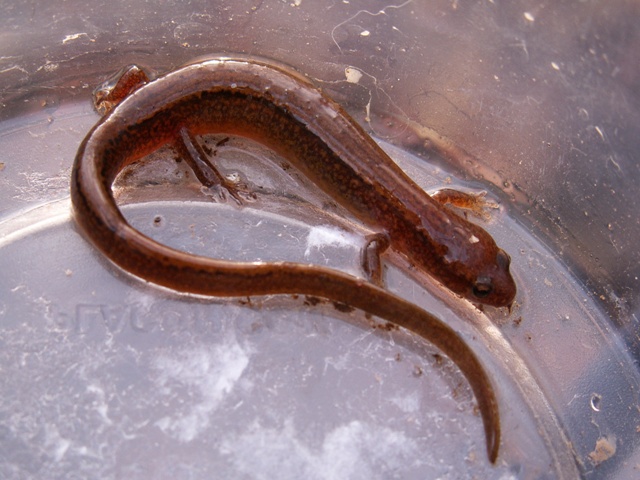
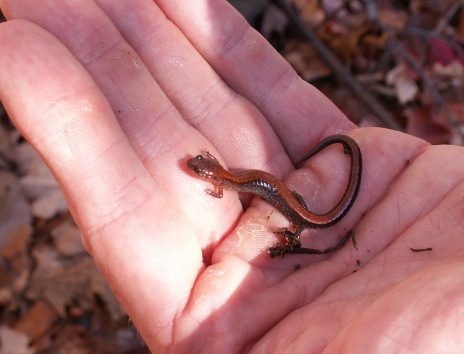
The redback salamanders (Plethodon cinereus), however, seem to have been enjoying the weather. I just checked my records, and I’ve found redbacks in every month of the year except for July, and almost always in temperatures below 80 degrees. These little critters stay underground in hot, dry weather, but give them a cool, moist hiding spot near the surface and they’ll use it.

A week ago, on the 5th, Jen and I went to the Mount Moriah Cemetery in SW Philly to check for brown snakes. It was sunny but chilly (low 40s) in the late afternoon, and I’d been thinking that the right piece of cover might possibly reveal some basking snakes, but what we found was salamanders:
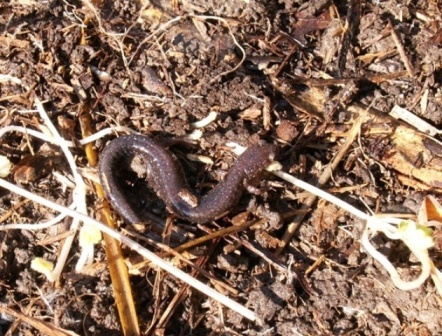


I went back midday yesterday (the 10th), another sunny day, but again found only salamanders. I need to stop saying “only salamanders,” since these are some beautiful salamanders. They were also pretty meaty looking for redback salamanders. Maybe they’ve been laying down fat for the winter, but they’ve lost a little of the slender grace I like so much in redbacks.

Of course maybe I've developed a really strangely critical eye for redback salamanders after finding so many this fall, and these look pretty normal. I'll let you be the judge.


Here’s one other salamander, a two-lined (Eurycea bislineata). We were hiking with some friends in Somerset County, NJ, on a sunny day (the 4th) in the high 40s. Jen checked a rock in a stream, and she found this very muddy looking guy:


Two-lined salamanders live in streams. You’ll find Redbacks anywhere in the woods except for streams, but two-lined salamanders stick under rocks in very shallow water or just at the edge of the water. I usually find them under rocks that are resting partly on the land and partly in the water. I think they like to be out of the water but want to be able to jump in if they need to make a speedy getaway.

Totals:

November 4th:
- 1 two-lined salamander

November 5th:

- 4 redback salamanders

November 10th:

- 6 redback salamanders

Monday, November 06, 2006

On Halloween we went to Centralia, PA. This was entirely by coincidence; Scott had been talking about going to Centralia all summer, but as an exploratory trip to a place where we figured we wouldn’t catch anything, it kept getting pushed back for more likely-productive trips.

Why Centralia? At first Scott was attracted by the idea of an abandoned town and all the abandoned structures and piles of trash that implied. I immediately thought of the strange temperature dynamics of an area of land heated by below rather than from above (by the sun).

Centralia was a very typical small coal mining town in Central PA (southern Columbia Country) up until the 1960s, when a trash fire in the town dump ignited a coal seam. The underground coal fire has burned every since. It undermined the main road running through town (Rt. 61) with smoking cracks in the asphalt, it caused hot, stinking sink holes in backyards, and it filled houses with carbon monoxide.

A few years ago the state and federal governments got together to buy out the remaining residents and condemn the town for safety reasons, although a few people still live there, and the postal service recently revoked the town’s zip code.

I had fantasies of blocks of collapsing houses and debris everywhere, surrounded by forest, and seething with cold-blooded creatures who could stay active longer into the winter because of the extra heat. Maybe they’d avoid the actively smoking cracks in the earth.

When we (Scott, Josh, and I) got there, though, we found an oddly neat abandoned town. There were a few well-maintained houses sitting by themselves, two very well-maintained cemeteries, and a few-blocks’ worth of very sterile-looking sinkholes (that were actually crawling with crickets). There really were smoking holes in the ground, which was kind of cool, but nothing about them suggested herp habitat.


Whoever’s been cleaning up in Centralia has done an excellent job of clearing away debris as the houses have come down, and we only found a few trash piles to look through, yielding only a few redbacked salamanders (Plethodon cinereus).


So, after lunch in a diner-type restaurant in the neighboring town of Ashland, we headed to Blue Mountain to see if we couldn’t stumble on any rattlesnake (Crotalus horridus) dens.

The sky was blue and the temperature was in the low 60s, making for wonderful hiking as we scrambled over boulder fields and rocky outcroppings. We found absolutely no snakes, in spite of our heavy hiking, however.

When it was time to head home, we cut up to a dirt run running through the state game land. We had some fun in a feed plot, where game managers plant corn to boost deer and other game populations. These can also indirectly boost populations of large snakes, since rodents also love corn, and lots of snakes love rodents. Josh and I tried the corn, but it was a little dry.


We did hit a little luck in a puddle next to the road. We were shocked to find tadpoles still in the water. How they’ll survive the winter in an exposed puddle on top of a ridge, we have no idea. We also found some newts in the puddle, but they’re a lot more mobile than the tadpoles.


I don’t think we’ll return to Centralia, but I had a great time, which once again steers me away from the Pine Barrens. I had a fabulous time hiking, and I was impressed by the prospect of driving around backroads in rural, economically-depressed Pennsylvania, flipping trash, and hiking in beautifully hilly countryside.

Totals:

4 redback salamanders
4 red-spotted newts
20+ mystery tadpoles
2 mystery frogs