Sunday, March 09, 2008

The wind almost blew me away last night. It was blowing at what had to be thirty miles per hour at least as we crisscrossed the shopping center parking lot, refueling on junk food after our fabulous amphibian herping outing on Sunday (March 8th). It helped that I was feeling particularly buoyant after the spotted salamanders (Ambystoma maculatum) we found at the end of the trip. They were such cool little creatures, and to find them at the end of a night and afternoon of not finding them was a perfect way to start the season; all the tension built up over the cabin-fevered winter months of scouting, researching, and fantasizing snapped in me, and I felt high the rest of the night.


We’ll start at the beginning with Cobbs Creek. I’ve written a lot lately about my plans for herping Cobbs Creek this year, and this past week I had a long conversation with a naturalist who spends a lot of time in our wild frontier with Delaware County. I learned a lot about what lives in the creek, what has lived in the creek, and the restoration work that has vastly improved the creek from how it was before I moved to Philly.


In particular I learned the history of the small marsh basin just south of the Environmental Education Center. This was first planned to be several small pools, but was then dug out into its current single basin. It was stocked with American toads (Bufo americanus – remember me wondering why there are no American toads in there? I guess I was wrong.) and spring peepers (Pseudacris crucifer). So, around three in the afternoon Jen and I headed over to the mini-marsh. The heavy rain had just stopped and the wind was picking up. The temps were still high (low 60s), and I was optimistic that we might hear something calling.


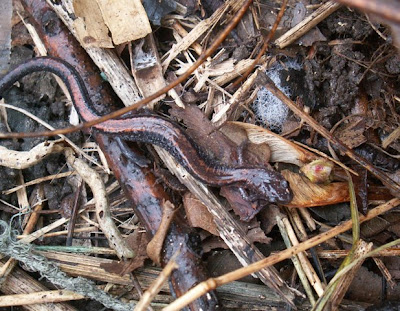
I was wrong on that count, but we did flip five redback salamanders (Plethodon cinereus) around the edge of the marsh.


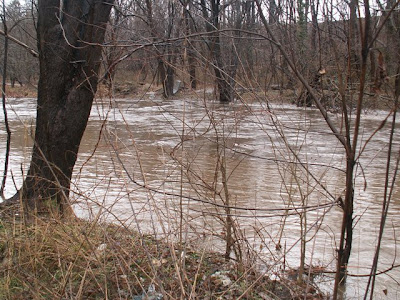
The creek was high and in fact had breached the basin, filling it up. Here's a shot of how high the water was in the creek.


Hearing no frogs and seeing no frogs, we hopped in the car and called Scott. He had called me in the morning coming off an overnight shift. At that time he was a little incoherent. I caught about half of what he was mumbling before he hopped into bed, but one thing was clear: he wanted to go herping. So, figuring he had caught up on sleep, we called him and after a couple persuasive minutes on the phone with Jen (I was driving), he pulled his waders on and got ready to go.
The plan was to herp the woods and marshes in the mixed farm/exurban landscape of Chester, Berks, and Lancaster Counties. After about an hour we pulled off the Interstate and started picking our way through two-lane country roads.


The spring peepers greeted us at our first stop. It is certainly a thrill to hear them for the first time in the spring. Even if they were named something else (‘Mini Peepers’?) their choruses of sweet, high chirping would be the official theme music for the opening of the season. With the whistling and rushing of the wind around us as we walked into the woods, it was hard to make them out at first; from far away it’s the kind of sound you think you could be imagining, but they only grew louder as we started wading into the flooded portion of the forest.


I should stop here to make clear they were not greeting us. However beautiful I find their singing, and even though I interpret it as the announcement that spring is back, these frogs are calling out of acute lust and hard headed territorialism. Each frog is announcing his availability to females and claiming his wad of dry grass against the encroachments of his neighbors.


These guys are dead set on love and war, but they still pay enough attention to predators to shut up when they hear you coming. This can make for some pretty frustrating herping. You hear a peeper, you’re pretty sure he’s right over there about ten feet away, but just as you’re about to really fix on him, he shuts up. Locating individual calling frogs is best done with fellow herpers so that you can triangulate on the calling location, but I have yet to dedicate the time and effort to do this successfully (this will always be my excuse for failing to photograph peepers, no matter how much time and effort I dedicate.). The way to do it is to freeze and wait until he figures you’re an inanimate object and resumes calling. Then you all point at where you hear the noise, and the intersection of the lines to where each person is pointing is the location of the frog. We actually did try to pinpoint one peeper, but we lost patience at the freezing step in the plan. It was getting darker, we hadn’t seen any salamanders or evidence of salamanders in an hour of wading around, and we had two more locations to check.


Location number two was a bust. None of us had been there before, and although we could hear peepers, we couldn’t figure out where to park, so we skipped on to the third destination.


At this point I can’t say I held out much hope for finding spotted salamanders. This didn’t ruin my mood; I was feeling pretty warm and fuzzy about the spring peepers calling, but I figured this was yet another noble but relatively fruitless herping effort.


Have I mentioned how windy it was Saturday evening? When I was gassing up the car I was a little worried a gust would take my credit card out of my hand before I could swipe it. It proved windy enough to knock a tree across the road we planned on taking. Some locals were already hard at work on it with chainsaws, but we decided not to wait and circled around another way.


Finally we parked and headed downhill into the woods. Only Scott knew where he was going, and the darkness combined with the low temperatures (38 degrees – the temps didn’t drop; they plunged) and the brambles we couldn’t see until they tore into our arms and thighs (Jen got the worst of it since only Scott and I had hip waders) made for a grumpy, albeit short, hike to the pool.


Scott called out the first spotted salamander before I stepped into the water. It disappeared into the leaf litter at the bottom of the pond before I got a good look at it, but I saw my first a moment later.


I think sometimes we regard the animals we hunt too much as static objects, frightened creatures frozen in our hands. We snatch them up as soon as we see them because we’re afraid they’ll hide themselves before we can get a good look, but sometimes it’s worth the risk to watch our animals move around on their own, even in escape from us. Last summer I was awestruck by the grace of a garter snake swimming away from me across Cobbs Creek, undulating curves of black and yellow lines, a gliding crease in the surface tension of the water. On Saturday I was impressed by the slower fluidity of the salamanders. They don’t use their legs much in the water, but seem to get around by slowly bending back and forth in gentle sine curves through the leaves at the bottom of the pool.


Of course the low temperatures contributed something to that slow grace that impressed me so much. Cold blooded animals don’t move very fast at 38 degrees. In this way Jen enjoyed the cold temperatures more than Scott or I did. She’s always chasing after frogs and almost never actually catching them. There were wood frogs in that pool, and they were just too cold to get away. Jen could reach out and grab them, and they were still there when her hand hit the water.


My camera has a hard time focusing in the dark, but note the frog floating in the flashlight's circle on the water.


Here's a wood frog Scott caught. It was complaining the whole time he had it in his hand - chuckling out a soft version of their usual call.


Here are some salamander pictures. Note the swollen area at the base of the tail; males' cloacas swell up in the breeding season.


This one looked particularly wrinkly.


Eventually we figured we’d examined our share of salamanders and frogs. Our hands were in a lot of pain by that point. Somehow I left the net in the car, and it is not easy to keep your hand in near-freezing water, even if you’re grubbing around for a much-coveted salamander.

The drive back is a bit of a blur to me. Both Scott and Jen fell asleep (I was driving), but I was buoyed by the salamander high all the way back home. The season has begun.


Sunday, March 02, 2008

A few weeks ago I was saving some photos of locations I’d scouted and noticed that all my photos from this year so far were scouting photos. I had no pictures of reptiles, which was not surprising, but what was odd was the lack of photos of amphibians. Redbacks (Plethodon cinereus) aren’t too hard to find in the 40s. I must not have been looking. The same goes for dusky salamanders (Desmognathus species) and other common streamside/streambed salamanders, the two-lines and long tails (Eurycea bislineata and longicaudata).

I was out scouting again today, this time around the Manayunk Canal. I hear a lot about the turtles in there from non-herpers. Also the far end of it, near the head of the canal, is at the bottom of a long slope of green space, at least as it appears on the satellite images. My hope is that the area could produce some milk snakes (Lampropeltis triangulum) in another month or so.

Although the snakes are still in or around their hibernation dens, and I wasn’t out there to find salamanders, I was having trouble passing cover without flipping it. Some sheets of bark around the base of a dead tree caught my eye, and I bent down to peel it up from the ground. Bark is great stuff; it’s kind of like nature’s own plywood – great cover that efficiently transmits the heat of the sun. I turned up two bright redback salamanders, deep red backs with sparkly gray flanks.

I lost the pictures in a weird memory card accident when I was trying to download them, but you’ll have to trust me that redback salamanders are never more beautiful than when you haven’t caught anything for two months.

This is a difficult time of year for Philadelphia herpers. Spring might be here, but it’s not sure it wants to stay. Monday the temperature is supposed to go up into the higher 50s, which could actually make it a nice day for spotted turtles (Clemmys guttata) if I didn’t have to work, and then Tuesday night, when I’m committed to work late, that rain could very well bring out the spotted salamanders (Ambystoma maculatum). Then we settle back into the 40s for some more redback (maybe longtail?) weather.

Monday, February 25, 2008

I do love three day weekends. I think I enjoy them more in the spring, when there’s more to find, but last weekend I took advantage of the extra time off and made two scouting trips.

On Sunday I took my morning run in a section of Cobbs Creek that I don’t know very well. I rode out on my bicycle and rode up and down the bike path as well, and I found a couple old fields with some potential for the spring. Both are old ball fields that have been left to the weeds. Both have their share of dumped debris, and although of course I don’t condone illegally dumping trash in city parks, I took the time to better-distribute some dumped boards. The only problem was the dogs. I was heading back up to the bike trail when two pit-bull type dogs ran after me barking their heads off. They didn’t get closer than thirty yards or so, but still picked up a couple rocks just in case. I don’t think they’re residents of the park; most likely someone was walking his dogs off leash. Either way, I think it’ll be important to keep my eyes open for dogs down there in the future, and I’ll keep my cultivator (or snake hook, or potato rake) in hand.

Dogs are relatively simple to handle; angry land owners and the state police are something else.

Scott and I planned an all-day scouting trip out in our western suburbs, and I had spent a lot of time (probably way too much) studying satellite images for sites to check out on the ground. I was looking for two types of terrain: wetlands, accessible rights of way, and abandoned buildings. Wetlands are pretty easy to spot on satellite images, as are rights of way. Abandoned buildings are trickier, so I paid attention to buildings on land that looked overgrown with weeds or young forest. Well, it turns out I was wrong about the buildings; they were all occupied and also thoroughly posted with ‘No Trespassing’ signs. The rights of way turned out to be inaccessible for the most part – fences and more ‘No Trespassing’ signs.

The wetlands were much more of a hit. We only drove by three of them. One of those featured a lovely mix of wet marsh, flooded forest, and a small creek, and it looked accessible, showing potential for oodles of amphibians and turtles. One was all open marsh but it looks like we’ll have to talk to the neighboring land owners to get access. One was absolutely mind blowing in size, at least a few square miles, but similarly difficult to access, with hardly any roads even cutting through it or near it (in itself a good sign – not much road mortality).

The last that I’ll mention (actually the first we visited) was also wonderful, and we had permission to scout it. Here are some photos (it’s clear that winter wetlands are not the most attractive landscapes out there).


It’s got strong potential for at least five species of turtles I can think of, hordes of frogs, and a handful of snakes, not to mention some interesting salamander species you don’t see every day (such as red salamanders, Pseudotriton ruber, and four-toed salamanders, Hemidactylium scutatum).

I’ll blame Scott for not reminding me to bring hip waders. Should I have thought of them myself? Maybe, but Scott still should have stopped me, when I got in his car, to say “Hey dude, you should probably get your hip waders.” My hiking boots started out their lives water proof, but over the last few years have become more and more porous. I think some of the seams are giving way, so they’ll hold off the water for a minute or two, but then it all starts to trickle in. About an hour in, my socks were pretty wet, but not quite soaked; I hadn’t quite reached the sloshing point. On our way out there was a thigh-deep brook we had to cross, however, and we made a strong effort to bridge it with downed branches we found on either side. The bridge looked pretty good, and I figured I wouldn’t have any trouble taking the one step I needed to push off into a jump to the other bank. I was wrong, and a burst of snaps and cracks plunged me into the icy water. I scrambled right back out, but it was too late for my boots.

We figured that was the worst of our trip, but apparently permission to scout the property wasn’t enough. We also needed permission to park across the street. At the time we parked Scotts car, that seemed absurd. We chose a graveled pull-off that looked like public land, something for county vehicles or left over from earlier road work. There were no ‘No Trespassing’ signs posted, and we figured it was a find place to leave the car. When we crossed the road, however, we saw a man in a beat up, blue compact pickup truck who had parked us in. He had also strung yellow ‘caution’ tape across the entrance to the parking spot and had even tied some to one of Scott’s wiper blades.

Apparently we had parked on his land, and he was not happy about it. At first we thought he was inebriated, but he might just have been extremely flustered. His anger undermined by his appearance – red faced with a red with white polka dots conductor’s cap on. He looked like the town drunk from a Western.

Our irate host demanded to see our driver’s licenses and threatened to call the state police. I’ll fast forward through most of the next five minutes of ‘conversation’, but the key is that I refused to show him my ID and told him to go ahead and call the police. I didn’t want to find out two weeks later that I was being accused of some outlandish crime and preferred to have it settled right there and then, especially since I was convinced we had done nothing wrong.

The state police officer showed up after twenty minutes or so (I took the opportunity to empty the water from my boots and wring out my socks), and things went swimmingly from there. Our friend (Scott has named him Beardy McAngrypants) drove off, and the cop turned to us with a grin that showed that the officer thought about as much of him as we did. We pointed out the complete lack of ‘No Trespassing’ signs, and we explained to the officer that we had permission to be on the land we’d been scouting. He let us go with a warning to not park right there again, and we continued on our tour, a little delayed but incredibly relieved.

Saturday, February 16, 2008

I head for the blank spots on the map when I’m scouting. You can’t always see abandoned green space when you’re looking at street maps, but you can see where the streets aren’t. In a town with a declining (mostly declined) industrial base like Philly, those blank spots usually indicate the weedy, overgrown wasteland I’m looking for.

On Sunday (February 10th) afternoon I had planned to explore some of the blank areas near the confluence of Cobbs Creek and Darby Creek in far Southwest Philadelphia and neighboring Delaware County.

I’m not sure how well you remember Sunday afternoon, but after a sunny morning, the temperature dove into the 20s, swept along by 20 mph+ icy gusts of wind.

Jen and I canned the idea of hiking around for an hour and a half, and we mostly scouted from by car. We headed west on street after street to where they dead ended or curved around at the blank spot on the map. We were pleased by what we found.

First, there’s a lot of green space back in there. Some of it is scrubby floodplain forest and dense banks of phragmites reeds – what I expect to find along Cobbs Creek – but some of it was mowed park with a bike path running through it. I found a small hill right south of where Cobbs Creek runs into Darby Creek, and it struck me as weird in a couple ways – first I couldn’t figure out what a hill was doing there, and second it looked like it was covered with phragmites reeds, which I usually associate with wetlands. They might have been some other kind of reed-like grass, but even if they were, I still expect to see a hill covered with trees. I’m betting it’s an old landfill site. If anyone reading this knows, please contact me.

Here are a couple photos – one of the path heading into the reeds, and one of some nice boards that have garter snake (Thamnophis sirtalis) and brown snakes (Storeria dekayi) (in the spring) written all over them.


Sunday, February 10, 2008

Last Sunday (the 3rd of February) we went out scouting out in the western side of our area. We saw some impressive wetlands, but I was disappointed by the reach of suburbanization.

I can’t say I was surprised, and it makes perfect sense now that I think about it; the radius defined by how far I feel like driving to go herping will be the same as the radius defined by how far some people feel like commuting in a large metropolitan area.

What I’m getting at is that we saw a lot of well-groomed hobby farms and gated subdivisions, but not much in the way of collapsing barns or abandoned, overgrown fields. It may just be that there is nowhere like that within about an hour and a half of where I live (West Philly – close to Center City), because there are just enough people who are happy to commute about an hour and a half.

We did find some nice wetlands. Here are a couple shots – first of a big, open marsh. This is great habitat for lots of amphibians, turtles, and a few aquatic snake species.


The second is a large vernal pool that could be full of spotted salamander and wood frog eggs in a few weeks. I hope to come back and check.

Saturday, February 02, 2008

I guess it makes sense to follow the highlights of 2007 with my goals for 2008, but it’s a much harder entry to write. I can plan all I want, but who knows what unexpected find will shift my fancy, and who knows where peer pressure will steer me.

That said, I can think of a few species I’m looking for in particular places – scarlet snakes (Cemophora coccinae) in New Jersey, eastern milk snakes (Lampropeltis triangulum) in Northwest Philadelphia, or black racers (Coluber constrictor) anywhere in Philadelphia – but I can’t say I intend to target much of my time so specifically, except perhaps hunting those milk snakes.

These guys have been haunting me for almost three years. I dream of finding them, and each time someone tells me about finding them somewhere in the Wissahickon or in some Roxborough backyard, I feel like punching the wall. I know I can find milk snakes much more easily upstate or in any collapsed barn anywhere in agricultural PA (I know, Scott), but it’s the Philly milk snakes I’m after.

Here's one of my stock photos of a milk snake, caught far, far away from Northwest Philly:


Aside from that obsession, I’m keeping a landscape focus. I will keep trying the Pine Barrens here and there, but I’m most interested in exploring the Pine Barrens’ wetlands in the spring. I’ll probably still head out on the occasional flipping trip and Scott will probably manage to drag me out for a few road cruising trips, but I would like to turn my herping energies elsewhere.

Where else? First, I’d like to spend more time in Cobbs Creek. I’ve got a notion of hiking the length of Cobbs Creek, at least where it runs along Philadelphia. It’s my backyard park, and I think there’s more there than I’ve given it credit for.

I’d like to spend a little more time in some specific parks and State Game Lands upstate. I do like my mountain herping, and now that I’ve got some good spots pinned down in my two hour radius, I’d like get deeper into them. It would be nice to find some relatively nearby red belly snake (Storeria occipitomaculata) spots. They are one of those species that is locally common but has a spotty distribution, meaning you’ll drive yourself batty finding none of them while your friends are talking about how common they are at their vacation spots in the mountains.

Here's a picture of one Kyle took. How could you not fall in love with this snake?


If I’d like to do anything new, it’s exploring out towards Central PA. My parents recently moved to Media, PA. An old timer I once had the privilege to talk with once claimed that Delaware County has plenty of old barns that are full of milk snakes. I gingerly pointed out that Delaware County no longer has many barns – all subdivisions – but now I’ve got the urge to explore out a little beyond. Maybe there are some old abandoned barns lingering out there in Delaware, Chester, or even Lancaster County. I do have that fantasy of rescuing a bucket of snakes from a soon-to-be-developed farm, just before it’s bulldozed and planted with a few hundred McMansions. I think we’ll go scouting tomorrow. Wish us luck.

Monday, January 21, 2008

I’ve never thought of myself as an expert in anything, certainly not about herpetology. If I know more about reptiles and amphibians than anyone else in the room, it’s because herping is such an arcane (= nerdy) pastime. Put me in a room of actual professional herpetologists or old-timer herpers and I quickly sink to the bottom of the barrel. Still, that article I had published in Reptiles last year apparently earned me some cachet. Jesse Rothacker, the director of the Forgotten Friend Reptile Sanctuary (a rescue/adoption agency) and an active member of the Lancaster Herpetological Society, invited me to talk to the Society about urban herping.

I took him up on the offer. I probably don’t know more about brown snakes (Storeria dekayi) or redback salamanders (Plethodon cinereus), than a lot of people in the Society, but how often to I get to talk to a room of people just as interested in herps as I am? So on Friday Scott, Jen, and I drove off to Lancaster, PA. We had trouble with traffic getting out of Philadelphia, but we had programmed enough buffer time into the ride and arrived just in time.

The talk went well. No one fell asleep and several people were polite enough to laugh at my jokes. In retrospect it turns out I might be an expert on herping West Philadelphia, if not herping Philadelphia in general. I’m no Ned Gilmore (who works at the Academy of Natural Sciences and has done a lot of surveying around Philadelphia), but I’ve got a local expertise that only a lot of time and energy in a specific place can earn.

A few weeks ago I finished reading Swampwalker’s Journal: A Wetlands Year by David M. Carroll. Phillyherping readers probably remember that I’m a HUGE fan of Carroll, a turtle man who has developed a deep knowledge of the New England wetlands he hunts. He knows every trough and bank of reeds in every oxbow lake and marsh in his territory. He’s been catching some of the same turtles for years, and each time he finds them it’s like checking in on an old friend. I bring up the book because reading Carroll reminds me of what I like about herping locally: place matters. A sense of ownership and belonging comes from knowing your local landscapes and from understanding the place of reptiles and amphibians within them. You can be an expert about the herps wherever you are. All it takes is a little bit of research and a lot of time getting your feet wet and your fingers dirty.

On another note, the trip reinforced our desire to see an active Philadelphia herpetological club. The PHS hasn’t met for several years, and as a relative newcomer to Philadelphia I know I don’t have a complete grasp of all the reasons behind its decline. That said, Scott and are planning on looking into what would be involved in something up and moving again. We’re not thinking tomorrow, and I know I don’t want to end up in charge of anything, but we’re looking at putting some wheels in motion. Please don’t hesitate to contact me if you have any thoughts or comments about what you’d like to see in terms of a Philly-area herpers’ community.

Wednesday, January 09, 2008


Now that 2008 has officially begun, I think it’s okay to do a 2007 retrospective. Although my thoughts naturally turn to all the things I didn’t find or do (not as much aquatic turtling as I had hoped for, for example), that will be more the topic of my upcoming to-do list for 2008.

It would be inappropriate for me to lead off with the lifers for the year since I’m always saying the lifers don’t matter much to me. Of course I’ve got a few I’d love to find, like hognose snakes (Heterodon platyrhinos) and scarlet snakes (Cemophora coccinae), but tops on my list are usually common species in particular places. For example I’m dying to see an eastern milksnake (Lampropeltis t. triangulum) inside the city limits of Philadelphia. I am almost as eager to see a black racer (Coluber c. constrictor) in Philadelphia and a snapping turtle (Chelydra serpentina) in Cobbs Creek.

Following that stream (or creek), in 2007 I was thrilled to discover that Cobbs Creek is alive, that it isn’t just a rocky storm sewer but an aquatic environment that deserves my herping attention.


It all started with someone sending me a photo of a snapper next to the creek, and my interest grew with every conversation I’ve had with locals about what they see there. I found a northern water snake (Nerodia s. sipedon) in Cobbs Creek, although north of City Line Ave. I’m sure I’ll find some south of City Line once I start looking more.


I witnessed an amazing abundance of turtles in the Impoundment of the Heinz National Wildlife Refuge on two occasions. I don’t know about you, but I just love watching turtles. It’s rare to see them doing anything but bask, and that bridge over the Impoundment is the perfect observation perch.


I also witnessed some of my neighborhood kids enjoying the turtles (plus a watersnake and a bullfrog – Rana catesbeiana) and having an absolute blast. Those boys and the joy of herping with kids for whom everything is amazing, even redback salamanders (Plethodon cinereus), might be my top story of the year. For sure I’m doing more of this in 2008.

As much as I write and talk about boardlines, I’ve only had the fun of visiting one really productive one: Scott’s in north central PA. We’re always spreading out trash piles we find wherever we go, and this is our goal: five snakes in two quick mornings, and three of them the milksnakes I’m hungry for in Philadelphia.


I’m still missing my brown snakes (Storeria dekayi) that were bulldozed at their hibernaculum in the West Parkside Industrial Park’s parcel number 1. This is probably part and parcel of urban herping; unless it’s a park, it’s fair game, and we shouldn’t get too attached to any piece of land. I’ve still got other brown snake spots (the Woodlands’ production this fall proving the point), and I guess I need to continuously keep my eye open for more.


Lifers:

This year I found five new species in our region and one maybe. By ‘maybe’ I am referring to the red bellied water snake (Nerodia erythrogaster) Scott and I found down the Delmarva in Maryland. I’m not sure I count somewhere three hours away as part of our region. Either way I’m warming to water snakes, and I got a kick out of how Scott managed to stalk it from the water rather than watch it jump into the water from the shore like almost all the other water snakes we see.


The cricket frogs (Acris gryllus) Chris and I found in South Jersey was a special treat. We weren’t looking for them, but as a species I’d heard has been declining in our region, it was fun to have them hop across our path.


I’ve been expecting to find a spring salamander (Gyrinophilus porphyriticus) for a long time. Whenever we go out flipping rocks in creeks, the big, orange salamander hunters are a possibility, so it’s a little weird we haven’t found one yet. Maybe this one should be another ‘maybe’ since we found it upstate at Scott’s place. But then it isn’t quite three hours away, so maybe I’ll count it.


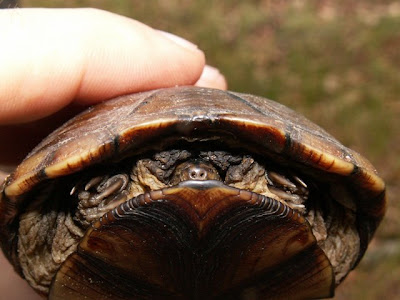
I’m also a little surprised I hadn’t found mud turtles (Kinosternon subrubrum) before this year. These are really common but secretive bottom crawlers in South Jersey wetlands, lakes, and ponds. This girl was just plain adorable, and I look forward to finding more of them this year.

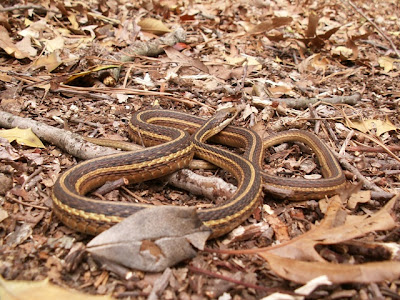
Ribbon snakes (Thamnophis sauritus) are also quite common for me not to have found one yet, or rather to not have found one alive, since they show up dead on the road pretty often. This one we found in March was a real looker with its rich browns and drawn-out, slender build, almost a cartoon you’d draw if wanted to exaggerate a snake’s speed and agility.


Last are the timbers (Crotalus horridus). One of my goals in 2007 was to pinpoint some dens that I can follow in the long term. I found two such sites in Pennsylvania’s mountains this year. No rattlers were sitting out in the open for me to photograph, but I did hear a couple, and I got this hazy shot of one during a game of hide and seek. (look for the head in the gap in the rocks in the middle, just to the left/below the stick running across the shadow from top-left to bottom-right).


The tie for saddest find of the year award falls between the recently-shot, magnificent black rat snake that Eitan, Scott, Simon, and I saw in upstate PA and this dying timber rattlesnake Scott, Frank, and I found on the road in the Pine Barrens. I hope to find some live ones in South Jersey to wash this out of my head.


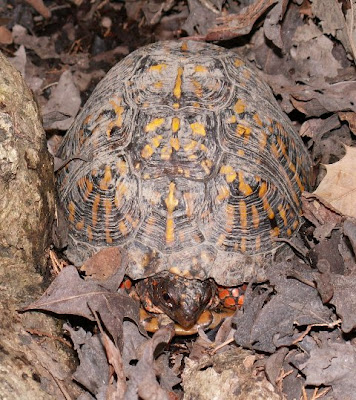
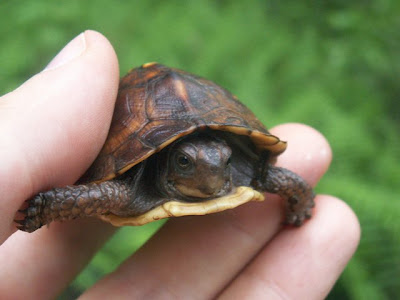
One more thing almost escaped my notice until I was reviewing my photos: this year I found a lot of box turtles. I credit this to Kid Chelonia (Chris), mainly because he actually spotted most of them or told me where and how to look, but they sure are a pleasure to find. Some herps can save any trip, and finding an orange or yellow boxie will brighten any day, no matter how hard it is to find anything else or how badly the deer flies are biting. This is also a good note to end the year in review. Enjoy the parade of box turtles, and look forward with me to finding many more in 2008.


Sunday, December 30, 2007

On Thursday (December 27th) I called Scott to see how his herping expedition with Josh to Florida was going. “Did you bag your indigo snake yet?” I said, almost entirely joking.

Indigo snakes (Drymarchon corais) are one of the most highly-sought-after snakes on the continent. They are big snakes, growing to over eight feet, and beautiful at any size. Their name refers to their deep, shiny blue-black color, often highlighted with a rose chin and throat. Indigo snakes are also rare. They’re federally listed due to a combination of their demand in the pet trade and their basic incompatibility with human civilization – a large diurnal snake is an easy mark for anyone who wants to kill it, and with a range of several hundred acres, an adult indigo has to dodge a lot of traffic to survive. Finding an indigo snake will make your day if not your month (… if not your year).

Scott had invited me along on his Florida excursion sometime in early December, long after our plans had been set (and plane tickets bought, vacation arranged at work, etc.) to spend Christmas with Jen’s family in Roswell, GA. Scott has a habit of inviting me on trips when it’s too late for me to change plans to come along. This isn’t his fault; he frequently learns his work schedule a few weeks out, making long-range herping trip planning difficult. Still, it would have been nice to have been roaming Florida, and as much as I was enjoying the holidays in Georgia, I was a little miffed at missing out on another expedition. So there were a few layers of meaning packed into my sarcastic, “Did you bag your indigo yet.”

I was talking to him on my cell phone in a movie theater lobby (we had just seen Charlie Wilson’s War – quite good) with mediocre reception, and so I didn’t quite understand his reply or believe the most likely interpretation of the crackling. I asked again, and he repeated what I thought he’d said: “Well yes, actually we did.” It was a young indigo at just three feet, but still Josh apparently jumped into Scott’s arms with joy. I sighed and recounted the previous day’s herping success in Roswell, which suddenly sounded pretty lame.

Atlanta has been experiencing one of its worst droughts in history (this weekend’s weather will determine whether they beat their driest year on record), so I can’t be too grumpy about the rainy weather that kept me inside most of the time I was there. In fact the moisture probably helped us find the salamanders we did uncover.

We worked a couple streams in the Island Ford Park section of the Chattahoochee National Recreation Area. It was partly cloudy and in the low 50s that afternoon, so we concentrated on stream-bed salamandering. We worked our way upstream and uphill in one stream flowing into a pond, and I figured we’d start seeing our familiar duskies (Desmognathus species) and two-lines (Eurycea species) once we hit the rockier stretches.


The first salamander we found was this half-grown lifer, a three-lined salamander (Eurycea guttolineata). These used to be considered a subspecies of our longtailed salamander (Eurycea longicaudata), and when grown up have a similarly slender build. I dig the bold black stripes and the silver and black mottling on the belly.


When I looked these guys up back home I learned they stick more to the flatter, boggier sections of streams instead of the rockier sections dominated by their two-line relatives, meaning my strategy was dead wrong and I probably would have found more downstream, not upstream. Jen soon flipped this tiny salamander, a baby slimy (Plethodon glutinosis) under a log just uphill from the bank.


Jen had been to our second stream a week earlier (she had come down to Atlanta before I did) and had reported large dusky-type salamanders. It only took a few minutes to catch two of these:


These were about five inches long and beefy. Their backs were a dark purplish gray/brown color with only a vague pattern, and their bellies looked to be a uniform medium gray. I had a similar experience IDing duskies in Georgia last year, and I’m pretty sure these are seal salamanders (Desmognathus monticola), since everything but the color is typical. Seal salamanders are supposed to have light backgrounds and distinct patterns with white bellies, but old individuals in the southern portion of their range (where we were) can get uniformly dark, including their bellies.

The last find was a DOR southern ringneck snake (Diadophis p. punctatus) we found walking back to our car. Late December is not when you usually expect to spot a snake, even a dead one, but it must have been run over just a couple days before.

This might be my last blog post of the year. I know other folks have been posting Best of 2007 posts, but I’m going to wait until the year is definitely over (and I’ll probably get in a New Years Day trip) and I’m stuck in a deep cold snap to assess and review the year.

Saturday, December 22, 2007

I can get a little obsessive about scouting. Of course I enjoy the actual hunt, the direct contact with reptile and amphibian species, and communing with nature, but a lot of what I enjoy about herping is the research that backs up the finds. Sometimes another herper tells you a spot and that's all there is to finding good habitat, but given two routes to getting my hands on a spotted turtle (Clemmys guttata), a scarlet snake (Cemophora coccinae), or a spring salamander (Gyrinophilus porphyriticus) – getting a tip or finding the spot myself – I'll take the triumph of starting from scratch and finding my way to the site and the animal myself.


I use the term "scouting" loosely. For the most part it refers to getting out into the woods, fields, swamps, what have you, and seeing if you can find good habitat. That might mean finding a vernal pool in the forest that looks good for spotted salamanders (Ambystoma maculatum). It might mean finding the perfect rocky outcropping for timber rattlers (Crotalus horridus), and it might mean finding a decrepit, abandoned building with sheets of tin and plywood scattered about in the weeds. I also include electronic searching when I talk about scouting. Google and other companies can show you satellite images down to a few feet of resolution, and I use these to spot things I can't see from the ground.


The satellite images do have their shortcomings. A few feet of resolution can show you a tree, but it can't show you a two-inch-wide fence. The images might be a few years old and lack recent buildings. Also, for reasons I don't understand, the images are inconsistent in their resolution. I might be able to get better resolution if I paid for it, but the free services have horrible resolution for most of central and northern Pennsylvania. You might be able to see a large rocky outcropping, but good luck finding a small vernal pool. In southern New Jersey, however, the resolution is good, and I've focused my electronic scouting there.


I started by finding some known vernal pools and using their appearance on the screen to guide my scanning. Some of the smaller pools could be mistaken for shadows of trees, but the bigger ones were notable as dark spots or holes in the texture of the surrounding forest. In a funny side note, the carpet in the hallway where I work is green with a dense pattern of raised, wormy spots on it – a lot like a satellite images of forest. A couple weeks ago I found myself doing double takes at stains on the carpet, dark spots that had all the appearance of vernal pools seen from a satellite.


My early results on actual satellite images surprised me. I examined some territory I thought I knew pretty well – not back of my hand well, but I'd been through a few times exploring. I'd found marbled salamanders (Ambystoma opacum) there and since marbled salamanders only breed in seasonal wetlands, there had to be the vernal pools nearby (here's one of my 'stock images' of a marbled salamander):


I'd looked on foot but had never found pools. The satellite images showed a couple obvious pools to check out, however, and I almost couldn't believe I hadn't seen them before on the ground.


Chris "Kid Chelonia" and I met up early on Saturday (December 15th) to investigate. We struck off in the direction of the pools, but stopped at some permanent ponds I already knew about and checked them out for egg masses,on the slight ( extremely slight) chance tiger salamanders (Ambystoma tigrinum) were in the area and had bred in them. We saw no evidence of tigers, but we did see something plop in the water right in front of Chris. We looked at each other in surprise and befuddlement. That's just what you'd expect a frog to do, but it was cold. Sure it was sunny, but the thermometer showed 31 degrees. We continued our examination of the pond and then checked out this small pool next to the main pond. You can see that the surface is iced over.


The ice was only a quarter inch thick at most, so we could still see through well enough to see the leaves on the bottom. Somehow Chris spotted a frog under the ice. By the time I made it over, the frog wasn't there anymore, but he quickly spotted another. Can you see it?


Here it is a little closer in.


We're pretty sure it's a southern leopard frog (Rana utricularia).


We hiked on, and when we got close to where the hidden pools were, I pulled out my handy GPS unit and my notes with the coordinates. We went a little farther, and then I announced that it was time to take a turn off the path and into the woods. There was nothing obvious marking that point of the path; the woods looked about the same as they had to that point. Chris shrugged and followed, and after a few dozen yards of normal woods we started hitting briars. These weren't the rose that you can find just about anywhere but the less wicked variety you often find at the edge of wetlands in Jersey. A few yards more and we'd found our pool.


It was dry (a little concerning, but consistent with the dry weather at the end of the summer and into the fall), but the sparse brush and mossy bases around the trees and stumps told us that the spot indeed floods by the spring. Here is a picture to show what I'm talking about:


It isn't too far from a creek, which means the water-loving herps that live in the creek (ribbon snakes – Thamnophis sauritus, garter snakes – Thamnophis sirtalis, water snakes – Nerodia sipedon, spotted turtles, etc.) probably hop on over to eat the amphibians that breed in it come March and April.


The same thing happened with the next spot I had noted. We found an actual pond, and it had the added benefit of connecting to an acre or so of forest that looked like it floods in the spring as well.


I was feeling pretty full of myself at this point, and we drove off into the nearby Pine Barrens to confirm five additional ponds and pools – all hidden by trailside vegetation or just a little too far off into the woods to be visible. These were all off trails I've walked three or four times with no clue of what was back into the woods.


Chris and I kept on exploring for a couple more hours, and we racked up two more clusters of seasonal wetlands elsewhere in South Jersey (I think we ended up covering 4 counties). The only downside was the lack of water (the two photos above are permanent ponds). Although they call them 'vernal' pools, the pools actually fill up over the fall and winter, so we need water in them soon to have all the fun we're planning in March through May.