Sunday, July 30, 2006

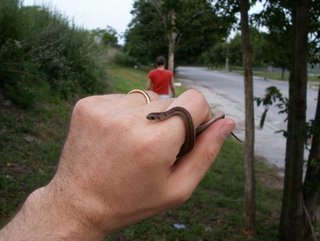
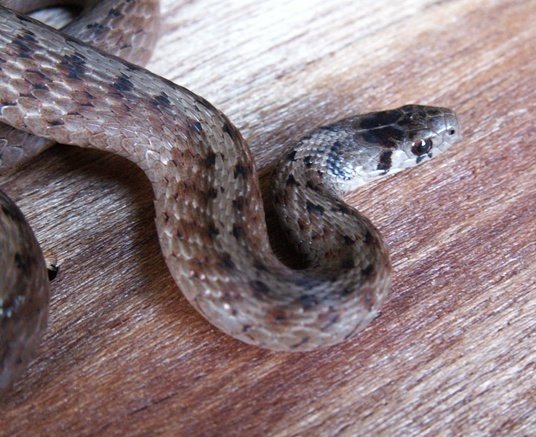
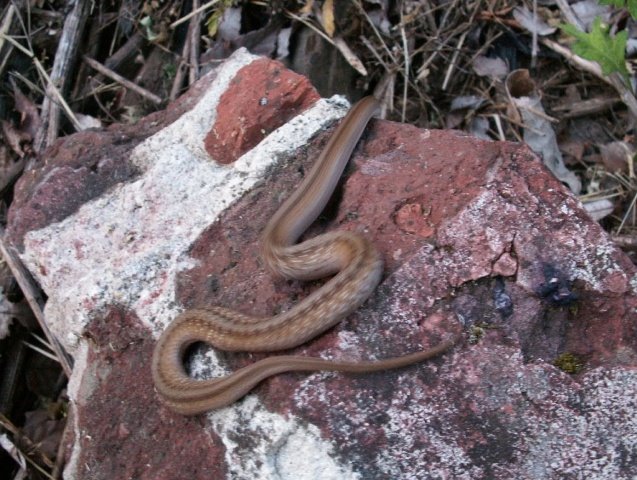
I’ve caught a few dozen pregnant northern brown snakes (Storeria d. dekayi) over the past couple months. Most I immediately let go, but I held onto one really pretty one from the Mt. Moriah Cemetery. I decided to take her home for pictures, and then I decided to keep her a little longer to see her offspring (see the July 3 post).

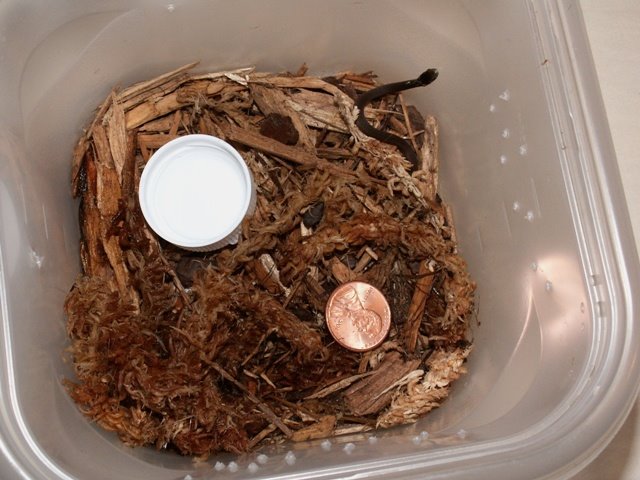
The idea had been to take some pictures of the babies and then let them go. I’d never done this before, but it’s a fun little natural history project. Of course if you want to try this yourself, pick a common species like brown snakes and house the female in a container that will be escape proof for the babies. Baby brown snakes are as thin as rice grains, so ordinary air holes will be like open windows to them.

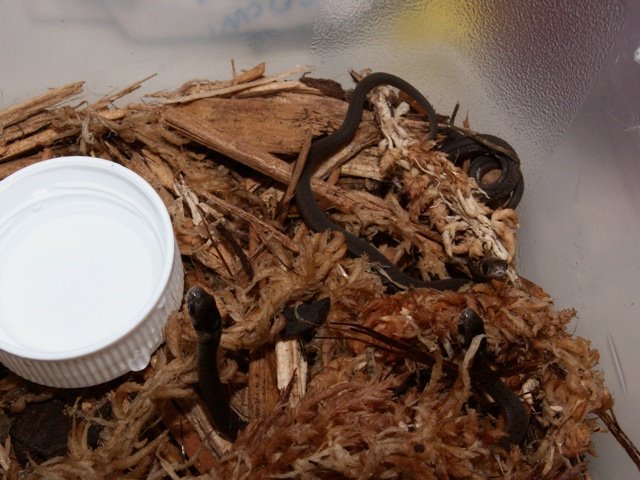
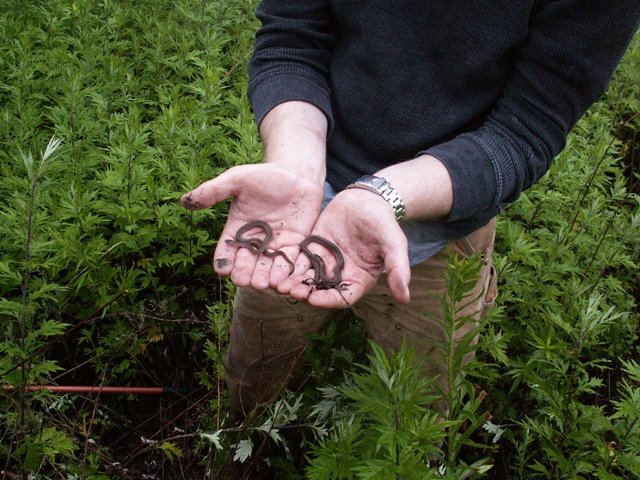
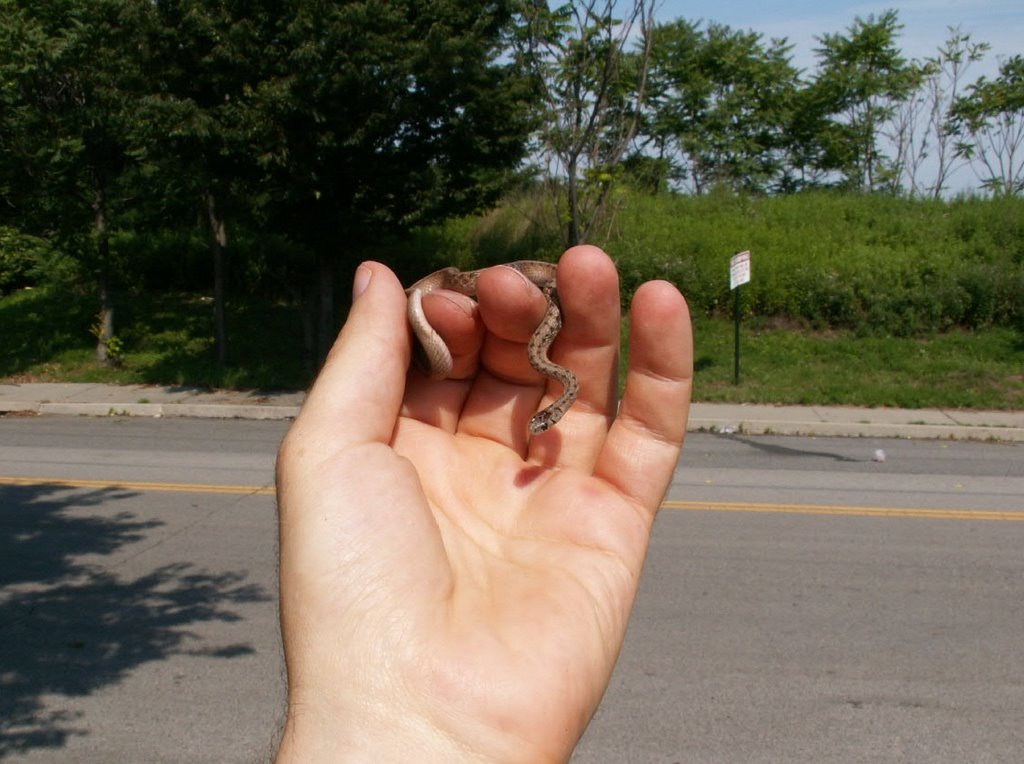
I missed the big event while I was on the road for work. I had started thinking the snake was never going to give birth, but Jen called me (I was in Warren, PA) on my cell phone Thursday (6/27/06) morning to tell me that there were fourteen itty-bitty (three to four inches long) snakes crawling around the enclosure. She moved them into a holding container to wait for my return. When I got home Thursday night I took some pictures.

My plan was to release them Saturday when I released the mom back where I found her. Jen, though, had grown attached to the little guys. So, the plan now is to keep them through the fall and the winter and then release them in the spring when they’re a little bigger. That way they don't have to face predators until they're a little bigger, and they don't have to worry about the hazards of hibernation until next year.

How did the plans change? I made the monster mistake of commenting that they would be highly unlikely to survive in the wild. I calculated their survival odds at about one out of thirty-two. Jen was horrified that they all would most likely perish in the next year, and the low odds of their survival made it pretty easy to decide that even if some didn’t make it, we could probably do better over the next seven or eight months than could on their own in the wild.

If I hadn’t caught the mother and brought her home, all those little snakes would be trying to make it in the weeds of the cemetery right now, and the odds are all of them would either be eaten by something else (spiders, centipedes, opossums, birds, etc.) or would freeze or starve to death in the winter. The same would have been their fate if I had let them all go this weekend with their mother. Now, though, I have brought them into our household, and we feel like we have some responsibility to help them beat the odds.

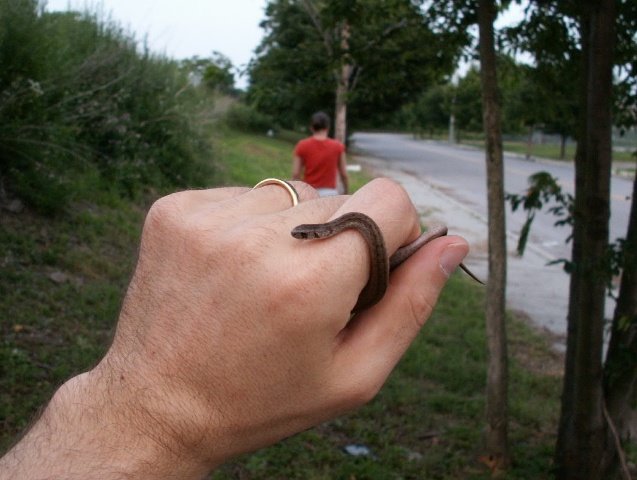
Here they are. That’s a soda bottle cap/water dish for perspective. They really are adorable.


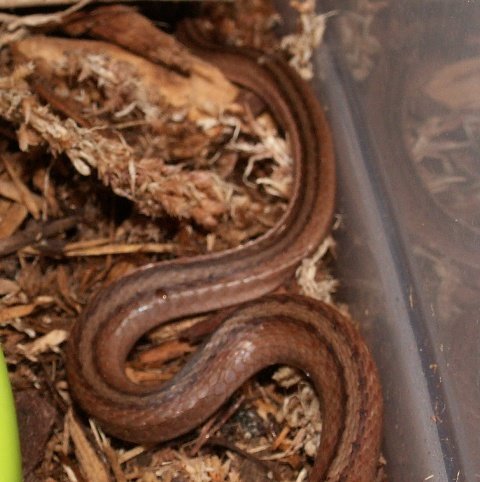
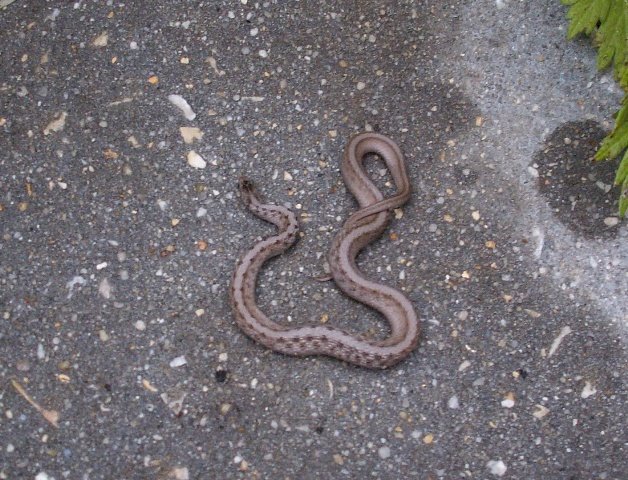
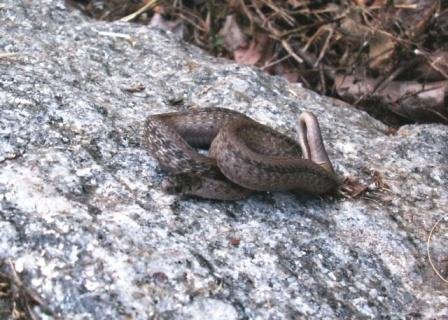
Here’s the mom. See the crease of skin on her side? That used to be all filled out with babies.

Wednesday, July 19, 2006

I was looking for eastern milksnakes (Lampropeltis t. triangulum) in Roxborough and Manayunk of all places on Sunday (July 16). Mannayunk and Roxborough don't have much wild green space at first glance. Every time I drive by on the Schuylkill Expressway I look over the river at the steep hillsides thick with rowhouses, and I don’t see much room for snakes.

Eastern milksnakes are medium-sized snakes (up to about three feet) patterned in red-brown blotches on a dirty gray background. As hatchlings they are beautiful; the background is cream and the blotches scarlet, but the bigger they get, the drabber they get. They change their diet as they grow as well. Young milksnakes eat almost nothing but small snakes and lizards. Adults eat almost nothing but rodents.

All this makes them more demanding than the little brown snakes (Storeria d. dekayi) I’ve been finding. Brown snakes just need slugs and worms, and at twelve inches, they don’t need much space. The larger milksnakes need more space, not to mention rodents and, of course, brown snakes, to eat.

Still, I’ve heard reports of eastern milksnakes in Mannayunk and Lower Roxborough, and while the landscape looks all wrong to me, I gave it a shot.

I did not find any milksnakes, but then I didn’t get out of the car; I did not find too many places that looked accessible for me without trespassing. There are a lot of steep rock faces I hadn't noticed before, though, and lots of back yards with gardens. The streets are quiet and narrow (easy for a snake to cross?). Maybe next time I’ll be a little more gutsy about hopping out and looking on private property.

Anyhow, I headed on up to the Wissahickon to look for the milksnakes there. I tried the hillside where I had found the milksnake that started all this hunting, as well as a couple nearby meadows that I thought looked promising.


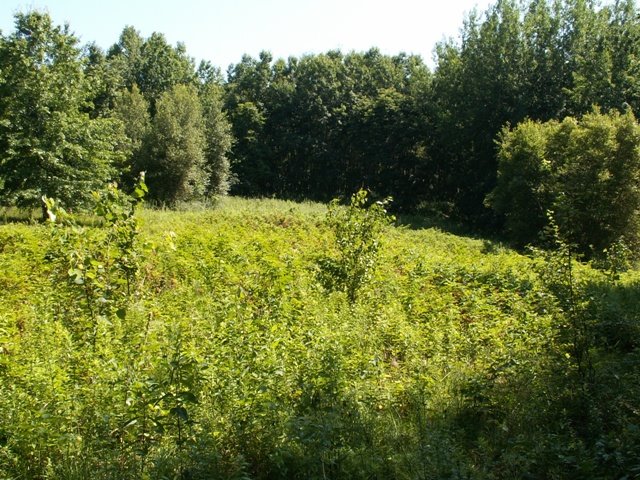
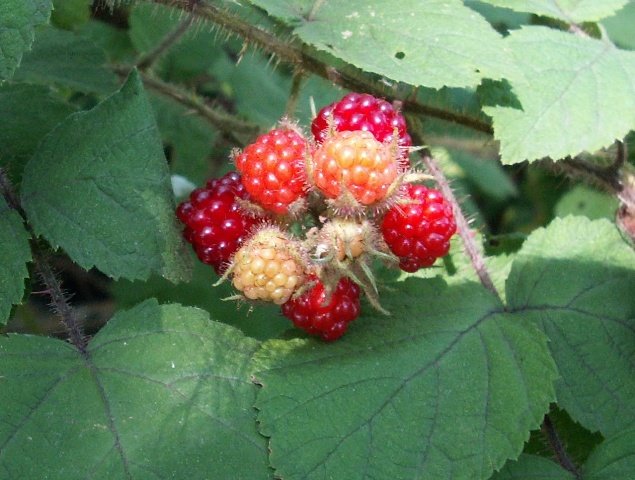
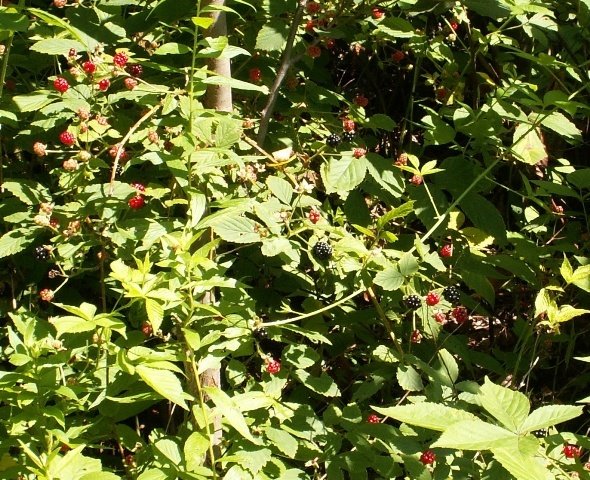
I still think those are great places to look, but I had no luck this time; I did find a lot of berries, though. I thought I had hit it big when I saw all the ripe raspberries around me, but then I found the blackberries. Wow. I ate a lot – I think I figured out that it added up to about five or six big handfuls of berries. It was all so perfect. I was hungry, and there was food all around me. I was finding no snakes, but suddenly I was able to direct all this hunting energy towards easy-to-find, instantly rewarding fruit.


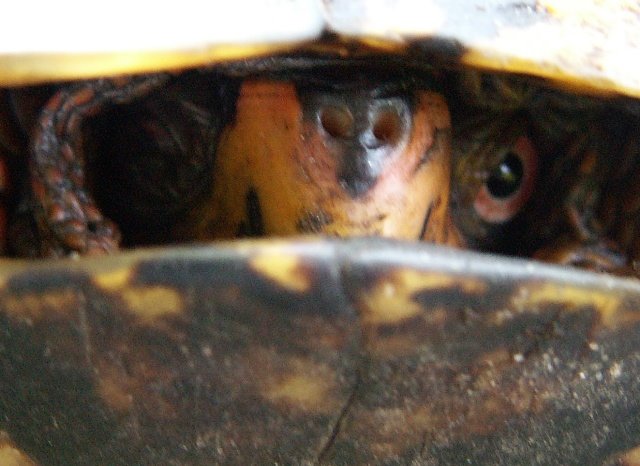
I had completely given up on the herps and nearly sated myself on the berries when I turned around and saw this:


A box turtle (Terrepene c. carolina)! Here’s a shot of his belly, showing the concave plastron that tells you he’s a he (don’t worry, I turned him back over).


He would not come out for a better look the whole time I was examining him. I waited a while, trying to stand as still as possible, but still he would not open up for me. He did look kind of timid.


Scott, who is a turtle nut, has been telling me about box turtles in the Wissahickon. Others have suggested it to me, but I haven’t believed it. I still don’t believe there’s a healthy population there – maybe a few old survivors like this old boy – but any box turtle instantly turns any outing into a success.

Conditions:

It had rained the day before so the air was humid and the ground was wet, which is important for slug- and worm-loving box turtles. The temperature increased from the low 70s when I headed out around 6am to the low 80s when I found the box turtle at 11am.

Totals:

1 box turtle

Thursday, July 13, 2006

So, I’m finally having some success in the Pine Barrens. True, this does somewhat undermine my identity as a luckless, long-suffering Pine Barrens herper, but I am trying to stay pessimistic, since, as my more-experienced herping buddies have assured me, success is not typical in the Barrens.

At the end of June it was the eastern kingsnakes (Lampropeltis g. getula); this past Sunday (July 9th) it was a northern pine snake (Pituophis m. melanoleucus). What’s next, a coastal plains milk snake (Lampropeltis triangulum temporalis)? I need to be careful with that kind of joking or the Pine Barrens gods will curse me with bad luck again.

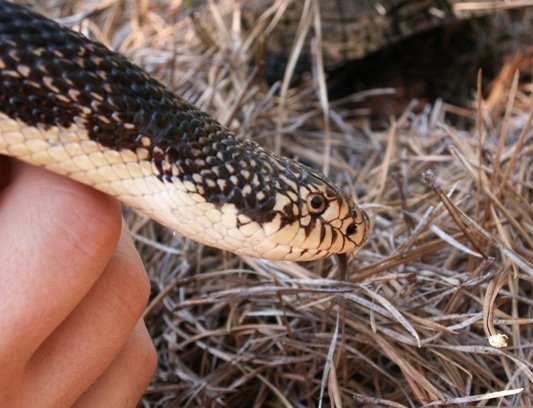
The northern pine snake is one of the iconic herp species of the Pine Barrens. It’s a pine snake, after all. These are big, powerful constrictors that burrow into sandy soil and chase gophers down in their tunnels. They can be beautiful snakes, with a cream background with black and deep brown spots.

Part of the challenge of finding pine snakes is that they spend most of their time underground. Even though you might be in the middle of a big population of them, you won’t necessarily know it since you can’t see them. They are also kind of rare; New Jersey classifies them as threatened. These big snakes need a lot of land, and since they’re big and don’t move too fast, they don’t do well crossing roads.

In hot weather they generally move on the surface early in the morning. So, early in the morning, so early it hurts me to think about it, Scott picked me up. After the obligatory Wawa stop, we raced the rising sun into Ocean County, New Jersey. There is a lot of Pine Barrens out there, but we were headed for a couple locations where Scott had found them before. Keep in mind that Scott has not found them with much frequency: he had caught 3 live pine snakes before Sunday, and he had seen only a few more dead ones on the road.

Our plan was to drive the sand roads of the pine woods and keep an eye out for pine snakes crossing in front of us. I’ll say quickly that this did not work for us. We found lots of dead snakes that way – garter snakes (Thamnophis s. sirtalis), eastern milk snakes (Lampropeltis t. triangulum), rough green snakes (Opheodrys aestivus) – and even some dead turtles – one box turtle (Terrepene c. carolina) and one common musk turtle (Sternotherus oderatus).

We found the pine snake after this strange looking guy (kind of a short, tattooed Jesus) with his large wife and little kid flagged us down to give them a jump. That’s an odd experience – coming across a stranded family early in the morning in the middle of the Barrens.

Anyhow, after the good deed of the morning, we drove on to where this promising sand road branched off and we parked. It turned out to be a short cul de sac, and towards the end of it I heard something rustle in the underbrush.


I heard it again, not far enough from the first rustle to be a fence lizard – this was something slower. I finally fixed on the motion and found a toad: a small Fowlers toad (Bufo fowleri), one of the millions and millions of Fowlers toads that rule the Pine Barrens.

They might look fat and clumsy, but toads have a habit of hopping right when you’re sure you’re about to grab them. I missed him a few times, and I was ready to try another grab when Scott called out from maybe thirty yards away. He had found some boards that looked promising. I looked at the toad, I thought about it a moment, and then I decided I could give up on that one.


I walked over and realized how cool this board pile was. I’m still not sure what it was originally, but what we found was several square yards of wood planks neatly lined up and mostly buried in sand, with some small plants growing in between here and there. The boards were set on cross beams, leaving some space between them and the sand below. I almost think it was the floor to an old structure, or maybe an old wall that had tipped over and was being swallowed up by the Barrens.


Scott worked with his Stumpripper and I with my hands (I can’t find my cultivator). We picked up a board and put it back down. We picked up the next to look and repeated. Suddenly I spotted something moving right in front of my face.

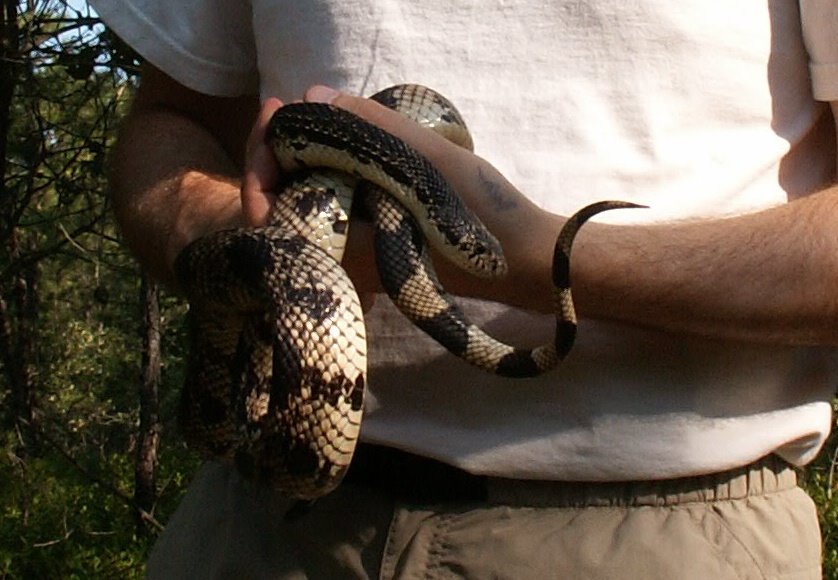
It was a pine snake! I shouted and grabbed it right away. I had kind of been hoping for a good defensive display – pine snakes are famous for rearing up off the ground and hissing really loudly – but this one was pretty placid. She hissed a little, but did not thrash around and did not bite. She also didn't hold still very well for photos, so here are a bunch of photos with us holding her.


Maybe she was worn out. A lot of the pine snakes we’ve heard of people catching in June were gravid females, and this big girl (at least four feet long) looked a little skinny. The timing’s right for her to have recently laid eggs.

Scott found a couple mouse nests in that board pile, and I found what we think was the pine snake’s shed skin.


We figure that board pile might be her home base, or at least she’s been hunting around it lately to eat and gain some of her weight back.

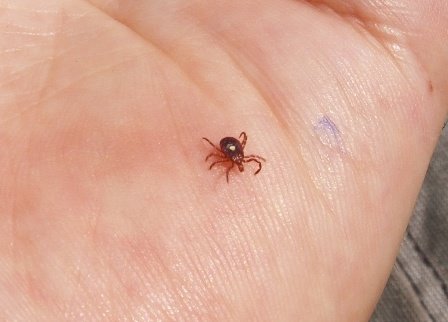
We didn’t find much else that day, but we didn’t need to. I went back and got my toad, and then a few more later on. We spotted some fence lizards, but that was it. One snake, a few toads and fence lizards, and zero turtles, salamanders, and frogs might not be a spectacular total, but when you spend months looking for something and finally find it, your high defies all usual complaints. Even the ticks didn't bother us too much, and there were a lot of ticks.


And of course there were the blueberries. It’s that time of the year again, when hungry Pine Barrens herpers can forgot about bringing snacks on the trip, because the snacks are growing wild all around them!


The temperatures started in the mid 60s, but were in the high 70s when we found the pine snake. It was sunny.

Totals:

1 DOR eastern milk snake
2 DOR eastern garter snakes
1 DOR common musk turtle
1 DOR eastern box turtle
1 DOR rough green snake
1 DOR black rat snake (Elaphe o. obsoleta)
2 fence lizards
7 Fowler’s toads
About 7 calling green frogs (Rana clamitans melanota)
1 northern pine snake

Sunday, July 09, 2006

Evening road cruising is one of the most popular herping methods there is, and I had never done it before Frank, Dave, and Bill took me out last Wednesday (June 28). Out in deserts and other hot places where many herps are only active at night and hide deep in burrows during the day, it’s practically the only way to find anything. In the Pine Barrens it is also one of the most productive summer herping techniques. I’ve heard the stories of eastern king snakes (Lampropeltis g. getula) corn snakes (Elaphe g. guttata) and timber rattlers (Crotalus horridus) and, in the rain, roads hopping with all manner of frogs and toads.

Sounds great, right? So why haven’t I gone evening road cruising before? I can think of a couple reasons. The first is that it always struck me as a little nutty. You drive around at slow speeds at night, and then jump out of the car into the road as soon as you spot something in your headlights. A herping acquaintance in Baltimore once explained that the real way to do it is to have someone up on the hood of the car so nothing gets away in the time it would take to open the car door.

The other reason is that it strikes me as a little too technological. I know it’s really time-efficient, and I’m no Luddite, but road cruising seems like a pretty perverse way to experience nature. I feel that we’re maximizing the number of finds to the detriment of the overall experience.

One of the main reasons I go out looking for herps is to access the wonder of the natural world through the objects of my particular obsession: reptiles and amphibians. I love to hike out to immerse myself in their world and observe how they fit into it. I like to get my boots dirty and see the critters in their habitats. A snake crossing blacktop is almost totally isolated. It is not the snake in its environment, it is the snake isolated and horribly vulnerable on an artificial surface, viewed through a windshield.

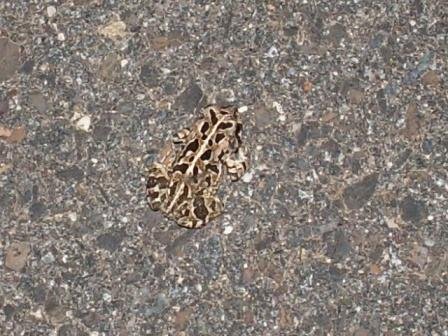
One of my favorite Pine Barrens finds of all time was a Fowler’s toad (Bufo fowleri) I found in the Pine Barrens sitting next to a small log from which a steady stream of winged termites was emerging. The toad was the most beautiful pale grey with sharp black spots, a pattern that blended in perfectly with the sandy soil, and it was ridiculously fat from all the termites it had already stuffed in its belly. We saw at least 130 Fowlers toads last Wednesday, but they all seemed a little out of place to me. [Here is one toad on the road]


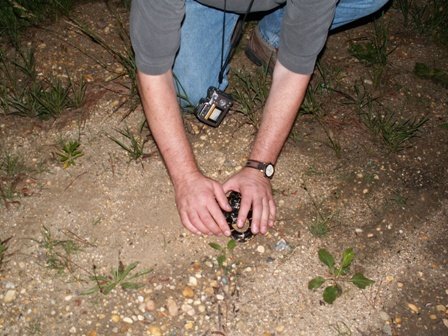
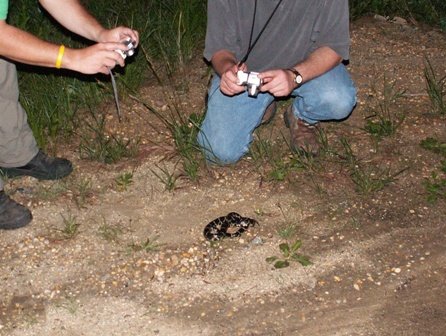
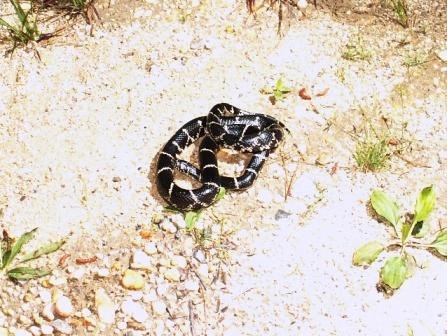
Now that I’ve gotten all of that out of my system, I need to admit (a little guiltily) that I had a blast! Toads are nice and all that, but they’re not kingsnakes. I’d never caught an eastern kingsnake (Lampropeltis g. getula) in the Pine Barrens, and we saw two. True, one had just been killed by another vehicle, but it was still thrilling. [Here is the live kingsnake. One of the best ways to get a picture of a squirmy snake is to hold it down for a few seconds, take your hands away, and snap the photo before it bolts.]


I also had a great time with my fellow road cruisers. I’d only communicated with Bill, Dave, and Frank by email before, but there’s something about sharing such a rare, nerdy passion that breeds instant familiarity. It’s clear right away that you’re among your own kind.

Road cruising also unifies observation in funny ways. When you’re out with other people hiking or flipping cover, you’re each looking at something different – multiple people searching independently. In a car, you’re all staring forward together, and when something herp-like (snake or stick? turtle or rock?) appears at the hazy edge of the headlights’ field of view, you all lean forward and stare together, you all hold your breath together, and you all lean back together once it’s obvious that yep, that’s a stick.

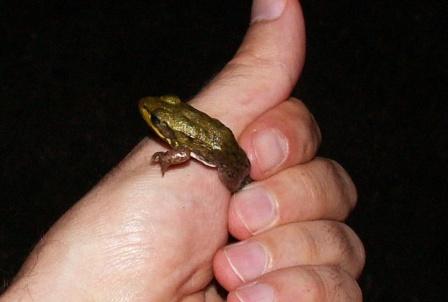
We headed out from Frank’s place in South Jersey and cruised around Burlington County and a little of Atlantic County. We saw those kingsnakes, the hordes of toads (mixed in with a few green frogs – Rana clamitans melanota), and heard a lot of frogs calling off beyond the edge of the road. Maybe next time I’ll come more equipped to charge off into the woods to spotlight the little guys. [Here is one of the green frogs]


We found two northern water snakes (Nerodia s. sipedon) also, again one live one and one recent DOR (dead on road) – its tail was still reflexively twitching even though its head was still and its guts were splattered out on the pavement.


I’m glad we ended with the live water snake. [Here is the live one, on the sand road and then suffering the indignity of being measured]


I know we had nothing to do with killing the two dead snakes, but it breaks my heart to see them dead like that. The kingsnake was the worse of the two – a gravid female with at least six shelled eggs in her, all ready to be laid. One had been shot out her vent by the impact of the tire that killed her, and most of the others had been broken inside her, so what oozed out of her was a yolky, bloody mess. [We pulled the dead female off the road for a closer examination]


I want to end (before the totals) by thanking Bill, Dave and Frank for taking me along. I learned a lot on that trip, both by watching them work (these guys probably have 100+ years of field herping experience between them) and by talking while we were driving. I had a great time, and I look forward to our next trip.

The weather was humid with temps falling from the high 70s into the high 60s

- 130+ Fowler’s toads (5+ heard calling)
- 20+ green frogs
- 2 eastern kingsnakes
- 2 northern water snakes
- 10 carpenter frog (Rana virgatipes) heard calling
- 3 Pine Barrens tree frogs (Hyla andersonii) heard calling

Monday, July 03, 2006

[I've been editing this post for half an hour, but no matter what I do I can't seem to unjumble the photos and the text so it's all laid out in one line. I'm sorry about how cluttered it looks]

I don't have time for more than a quick post right now. We have family in town for the weekend and the holiday, and I'm working on a post about a trip to the Pine Barrens last Wednesday night (June 28), but for now here is more on northern brown snakes (Storeria d. dekayi), including my best photos yet with the macro settings on my new camera.

On Tuesday (June 27) Scott and I headed out brown snake hopping around West Philly. The weather was wet and rainy, with temperatures in the high 70s. We herped from around 7pm until dark.

I was a little nervous - you don't want to take someone to spots you swear are really great and then find nothing, but my little beige friends did not disappoint.

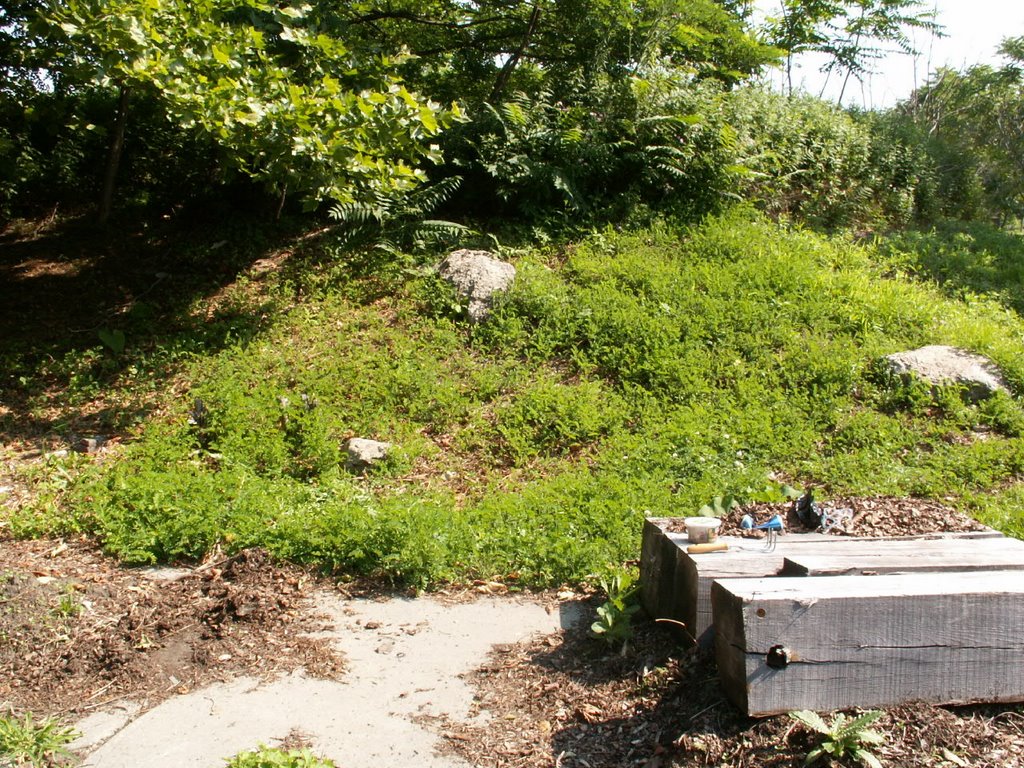
We started in the West Philly savannah off 49th south of Parkside. Yes, those are horses off in the distance in the second photo.

We explored a lot of cover in about a half hour, including this trash pile,

the rocks and debris on the berms around the lots,

and this old lawn chair.

The lawn chair hid two little brown snakes, and the rest of the cover produced as well.

We found a total of nine snakes, and then we moved on to Mount Moriah.

Here we "only" found four snakes. One, which I stupidly did not photo, had a kink in its spine a little above the base of its tail. Sometimes snakes hatch or are born with these spinal deformities. Breeders usually cull them, the assumption being that they're not going to survive. This little guy proved them wrong - it was full grown and looked robust.

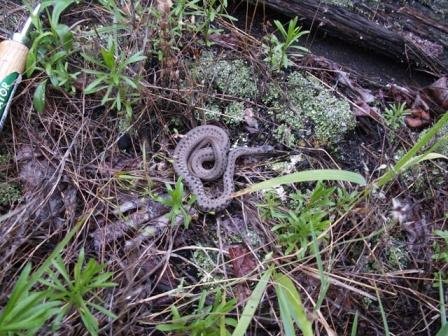
I took one large female home for some more photos. Here they are.

Trip Totals:

13 brown snakes

Saturday, June 24, 2006

I’ve been going jogging in the Woodlands Cemetery for a couple years now, and I hadn’t found any snakes there until last week. Now I’ve found two. Both were under the same board, though on different weekends. I’ve checked this board probably twenty times. Has it just now decided it likes me?

The deer that hang out in the Woodlands are suspicious of me, I think. They jump up and run away when I get too close and then stand no less than thirty yards off watching me with their tails up in the air as I pass them. The squirrels, including the charcoal-gray melanistic one, don’t seem to pay much attention to me, and the robins also go about their business like I’m not there.

The plot of land the cemetery occupies dates back to the 1700s when it was an estate way out in the country. In the mid 1800s it was converted to a cemetery so people could get buried out in the country, but, by that point in the development of our transportation system, close enough for their families to visit. For a while it was quite a fashionable place to spend eternity. Several wealthy Philadelphians of the 19th century are there, as is Thomas Eakins, the famous painter.

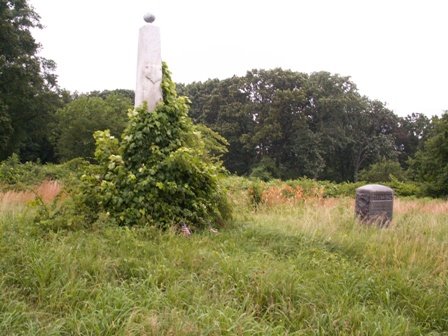
Unlike its counterpart on the other side of West Philadelphia, the Mount Moriah Cemetery, the Woodlands is well cared for. There are no trash piles or fields overgrown with grass and weeds, and most of the graves have their headstones on straight.

Of course there is less for me to look under, so I have only looked while already there for walking or jogging.

It was quite a victory to find that first snake, a northern brown snake (Storeria d. dekayi), under that one board in the cemetery. It proved my suspicions correct. There are snakes in the Woodlands, dammit, even if they took me two years to find. I tried the board this Saturday morning, and this time it produced a hefty garter snake (Thamnophis s. sirtalis), which was a total surprise. The Schuylkill is not very far, I guess, but I was still shocked, since there is no water in sight, and garter snakes generally hang out where they can hunt frogs, fish, and tadpoles. I find them near the Wissahickon, along Cobbs Creek, at Tinicum – all near water.

This garter snake was a really chunky girl, and though she was dusky, when she puffed up she showed the most beautiful interstitial (between the scales) skin – marked with that bright, light green-blue that seems almost lit from within.

Of course I did not have my camera for either find. I have yet to come up with a comfortable way to go jogging with my camera.


I did have a camera for some more brown snakes from the vacant post-industrial lots up near 49th and Parkside.

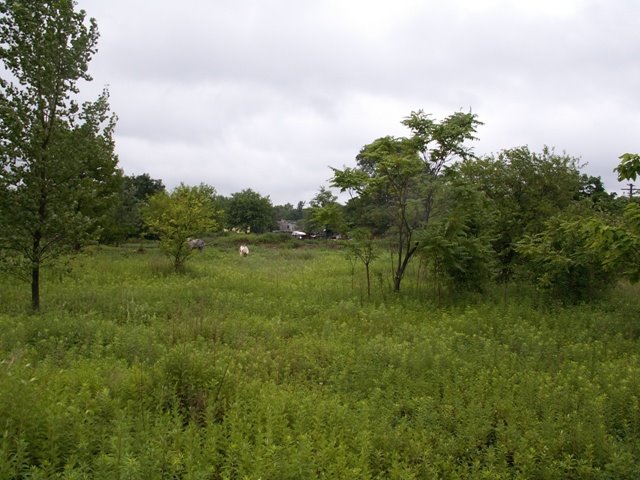
I found several more brown snakes on a couple trips there on June 17th and June 22nd. On the 17th I headed over before a brunch date. I decided to check out some slightly smaller neighboring lots.

First I looked under some cover at the corner, and I found one under the very first rock.
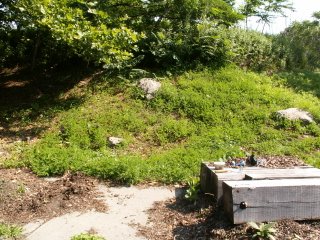


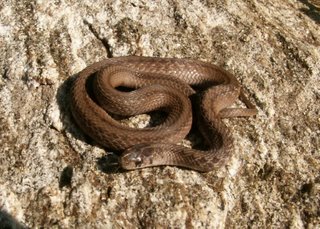
It wasn’t pretty, it wasn’t all that big, but I always get a kick out of finding something under the first rock I try.


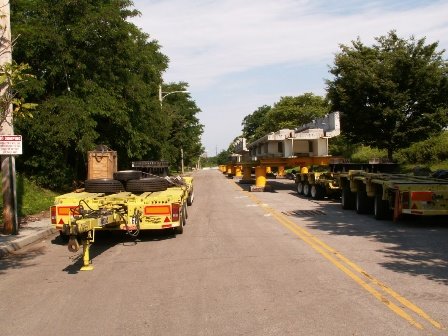
I wandered back past this equipment parked in a blocked-off street.
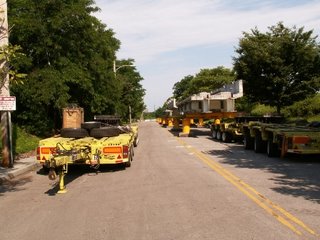


I have no idea what these are, but maybe they have something to do with the commercial buildings that are supposed to go up at 52nd and Jefferson.

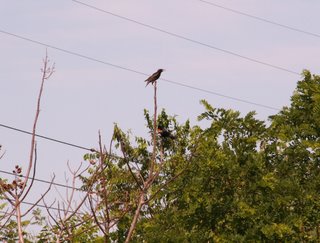
I found no herps back here, but I did see some blackbirds.


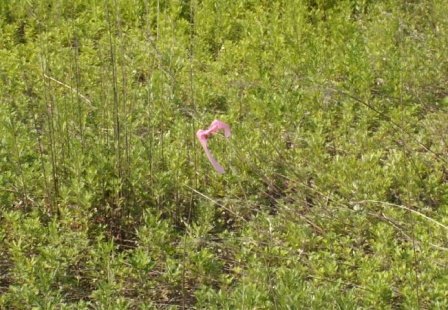
I also saw some orange ribbons in a couple of the lots, so I figure they’re slated for construction. I plan to go back and maybe relocate some snakes if I find them.


I checked some cans I had missed at that same corner. My sister had just called me to say Jen and I had an hour and a half to meet her in South Philly for brunch, but I had to get in just a few more pieces of cover before I got on my bike again.

I found two brown snakes under one of those cans. I only caught one of them.


Right before I found those two snakes I had a pleasant interaction with the police. They had driven by me a few minutes before, and on their way back the other direction, the cruiser stopped and the window went down. I was worried I’d be cited for some kind of trespassing or something, but the officer in the passenger seat simply asked, “Are you catching bugs or something? We were just curious.” I said no and then explained herping. She gave me that blank nod that showed she was trying to be nice even though she thought I was nuts, she said goodbye, and she drove away.

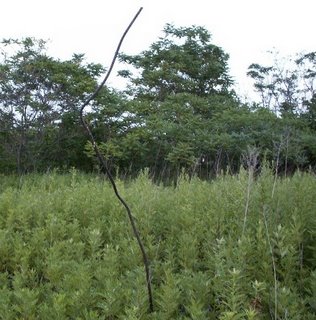
Jen and I went back on the evening of June 23rd so I could take some more photos of the area and look for some earthworms while we were at it. We found no worms, but I did get this shot of rebar sticking out of the berm, just in case we forgot what is under all the grass and weeds.


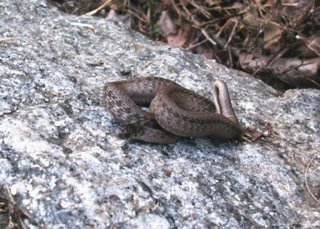
We also found three snakes: one very standard-looking gravid brown snake,


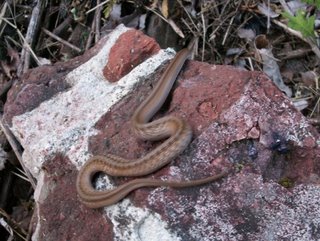
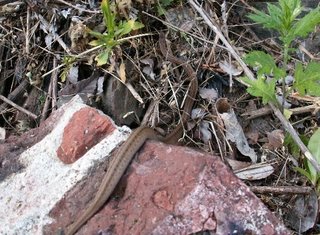
one dusky little guy under an old piece of rug (no photo), and one absolutely magnificent beauty, near bursting with developing babies and colored in chestnut on the sides and lighter taupe down the back.

Of course I didn’t get a good picture of the gorgeous one. I tried, but she wouldn’t sit still, and the light was fading. Here are two pictures. The first is my favorite. It is totally out of focus, but it gives the sense that she’s really zooming off that rock, her front half accelerating into hyperspeed.


Totals:

June 17th, from 9am to 10am, sunny and in the low 70s.

3 brown snakes

June 18th at 9:15am, sunny, humid, and 75 degrees.

1 brown snake
June 23rd 8pm to 8:30pm, dusk, very humid and high 70s.

3 brown snakes

June 24th, at 10am raining lightly and in the low 70s.

1 garter snake