I made my summer’s last early morning trip into the Pine Barrens last Sunday, September 17. I don’t mean that as a trick statement, since next weekend is past the autumnal equinox. I could again wake up before dawn and be in the Barrens by 6:30am to cruise over the sand roads, burn through a third of a tank of gas and flip the same boards, but I won’t.
Why not? For starters I’m starting to feel like I’m neglecting Pennsylvania. I haven’t gone herping around Philadelphia much lately, there are spots in Bucks County I’d like to check out, and I haven’t been up in the mountains since the spring.
I am also tired of feeling delighted by a couple cool finds, but then looking at how long I spent out there (nine hours on Sunday) and feeling deflated by how much time and energy went into finding so little. I’m not saying that I don’t enjoy my Pine Barrens trips, but I’m feeling like I can probably find as much and have as much fun in other places, all in less time and using less gasoline.
On Sunday my most notable cool finds were a dead eastern hognose snake (Heterodon platyrhinos) and a live spotted turtle (Clemmys guttata).
Of course the hognose snake was less cool for being dead. It was pretty recently run over, in fact, but hognose snakes are cool enough that even a dead one was interesting. What most motivates me to find a hognose snake is their defensive behavior. They are harmless and almost never bite, but they are famous for flattening their necks and hissing like little cobras. Then, if that doesn’t scare you off, they go the opposite route; they flip over on their backs, stick their tongues out, and play dead. I’d be really impressed if they could shoot their guts out of their mouths and vents like the DOR one I found.
As their name implies, hognose snakes have a funny little upturned nose which they use to dig up toads. You can sometimes find hognose snakes crawling around in the morning, but they are very difficult to find under boards or other cover. With all the Fowlers toads (Bufo fowleri) in the Barrens, I would expect to find hognose snakes swarming all over the place, but I haven’t seen a live one yet.
The Spotted turtle was a nice antidote to the hognose snake. I saw it by the side of the road at a small creek crossing, and I thought to myself, ‘that’s a little too flat to be a box turtle (Terrepene carolina).’ I backed up, hopped out of the car, and sure enough it wasn’t a box turtle; it was a spotted!
Spotted turtles are, in my opinion, the cutest of our turtles. They don’t get much bigger than five inches and they have shiny black shells marked with bright yellow polka dots. I was delighted to find this guy (concave shell and long tail, so I’m thinking it was a male) alive, and I helped him across the busy two-lane road. [If you ever find a turtle crossing a road, always help it go in the direction it’s headed. If you bring it back it will just try to cross again; turtles are stubborn that way.]
I would love to show you a picture of him, but my camera broke. I can’t get it to focus, and half the time the zoom doesn’t work, so I need to send it in for repairs. Wish me luck.
To wind up my day I spent some time on foot in an area of pygmy forest. The pygmy forest refers to sections of the Barrens where the pines and oaks don’t grow much taller than five feet. It’s a bizarre landscape, with the white ‘sugar’ sand and the shrubby trees all around. It would make for some cool photos, but like I said, my camera wasn’t working.
I started by smashing up a cantaloupe and throwing the pieces into a pond near where I parked. Doesn’t that sound nutty? I thought so, but Scott claimed it was a great way to attract turtles close to shore, so I gave it a shot.
I left the melon in the water and went on a hike. All I saw was one Fowlers toad, but it’s behavior is worth describing in more detail. Up until now I’ve found these toads hopping around on the surface, but this one was underground. I was walking along, enjoying the scenery and scanning ahead for hognose snakes and pine snakes (Pituophis m. melanoleucus). Suddenly a spot of sand in front of me boiled up, and out hopped this fat little toad.
After an hour of wandering around after that, I headed back to check the cantaloupe. I was surprised and impressed to see a painted turtle (Chrysemys p. picta) scoot away as I approached. Another three watched me from the water at a safe distance. Next time I’ll know to go in from the water on my belly to catch them more by surprise.
On Sunday it was sunny or partly cloudy the whole time I was out. The temperatures started off in the low 60s at dawn and rose into the high 70s by the time I headed home.
Totals:
1 DOR hognose snake
1 spotted turtle
1 Fowlers toad
4 Painted turtles
4 Southern leopard frogs (Rana sphenocephala)
One last note: My cousin Jeff let me know that the MacArthur Foundation made David Carroll a fellow. These fellowships are often called “genius awards,” and consist of $500,000 to use however the fellow sees fit over five years. [If any of this blog’s fans are nominators, feel free to submit my name – I’d drop anything else to herp for five years and get paid just to write about it] Carroll is a great naturalist, artist, and author who focuses his attention on turtles, especially on spotted turtles, and their habitat. Check out the links below for more information, and read the Year of the Turtle to immerse yourself in the world of the spotted turtle.
http://www.macfound.org/site/c.lkLXJ8MQKrH/b.2070789/apps/nl/content2.asp?content_id={792DF754-B774-4C09-A2B3-B93BD9071661}¬oc=1
http://www.davidmcarroll.com/david.htm
Thursday, September 21, 2006


Wednesday, September 13, 2006
I am starting this post with a defense of two much-maligned species of the Pine Barrens: the ringneck snake (Diadophis punctatus) and the black racer (Coluber c. constrictor).
Veteran Barrens herpers call them “trash snakes.” They complain about them taking up space under boards. They don’t even bother photographing them. If they go out on a beautiful day and find “nothing” but racers or ringneck snakes, they’ll even say they got skunked!
As you can tell, I am outraged by the discrimination against these beautiful serpents. I am quite happy to find them, even if they are more common than the corn snakes and timber rattlers, kind of like how a pretty fowlers toad (Bufo fowleri) can brighten my day, even though I find them on almost every trip.
On Saturday (September 9th) Scott and I headed to the Pine Barrens really early. Scott asked me when he should come by and pick me up, and I said 5am. He called my bluff (this is the problem with an emergency medicine intern as a herping buddy; to him there is no such thing as a ridiculous time to be awake), and so was there bright and early (actually dark and early – the sun didn’t wake up for another hour and a half) to pick me up and head out to South Jersey.
We wandered the sand roads, mostly of Gloucester and Burlington Counties, flipping trash and logs, and actually spending a lot of time rearranging the trash that locals have dumped in disorganized heaps in the Wildlife Management Areas and other patches of forest.
I know, trash does not belong in the forest at all, but if it’s going to be there, it might as well be spread out in such away as to provide the best cover for reptiles and amphibians. Our goal is that the next time we wander across those same spots, we have more-productive piles of trash to search.
We did find some snakes under the boards and other debris we turned over, namely the racers, one ringneck snake, and a worm snake (Carphophis amoenus). I know, I did not defend the worm snake in my introduction to this post, but while I do enjoy finding them, I just don’t think they’re all that beautiful.
Is this a double standard? I don’t think so. What galls me about the prevailing derisive attitude towards racers and ringnecks is that I think they are beautiful snakes that are not valued because they are common, whereas I don’t think anyone would think the worm snake was beautiful even if it were rare.
Take the rough earth snake (Virginia v. valeriae), a small, drab, rarely found species that occurs throughout New Jersey. Anyone would be interested to find one, but no one would frame the photos. The coastal plains variation of the milk snake (Lampropeltis triangulum “temporalis”), by contrast, is rarely encountered but gorgeous, with bright red saddles on a cream background, and herpers justifiably ooh and ah when they find one. My beef is with the herpers who don’t ooh and ah when they find a ringneck snake or a racer.
Here, judge for yourself. The ringnecks in the Pine Barrens are a mix (or “intergrade”) of two subspecies, the northern (Diadophis p. edwardsii) and the southern (Diadophis p. punctatus). Northern ringnecks usually have blank yellow bellies and a full ring around the neck. Southern ringnecks usually have a row of half-moon spots down the belly and their ring is usually broken by dark scales midway across the neck. This one has both the spots and the full ring, as have the others I’ve found in the Barrens.
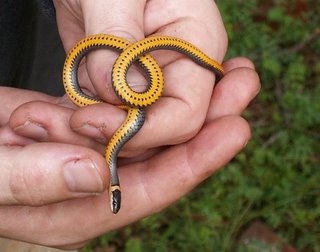
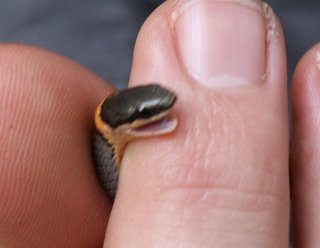
This picture came out blurry, but I thought it was adorable how it was trying to bite Scott.
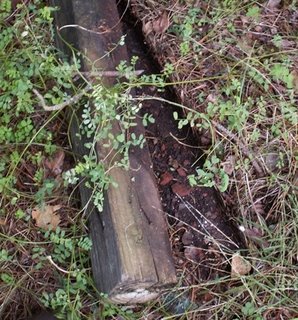
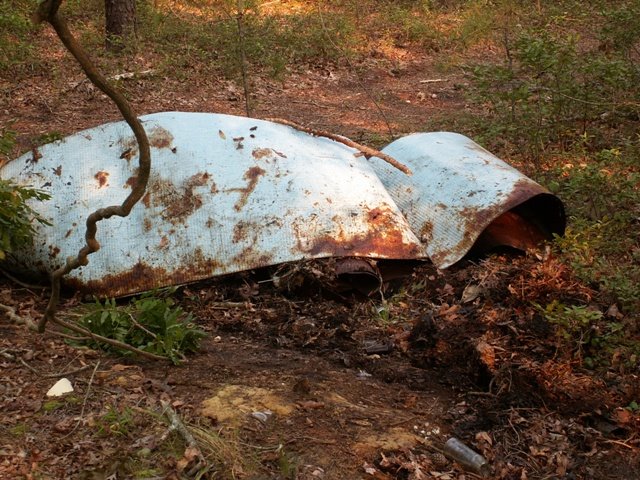
Here’s the post under which we found it.
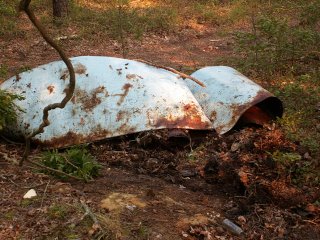
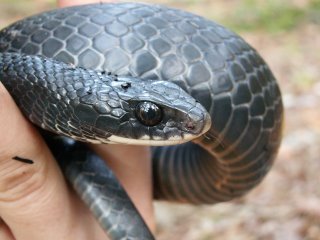
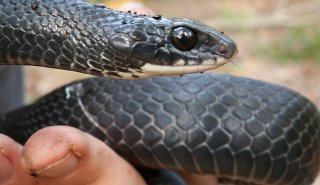
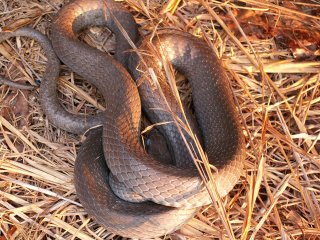
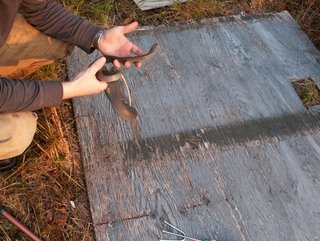
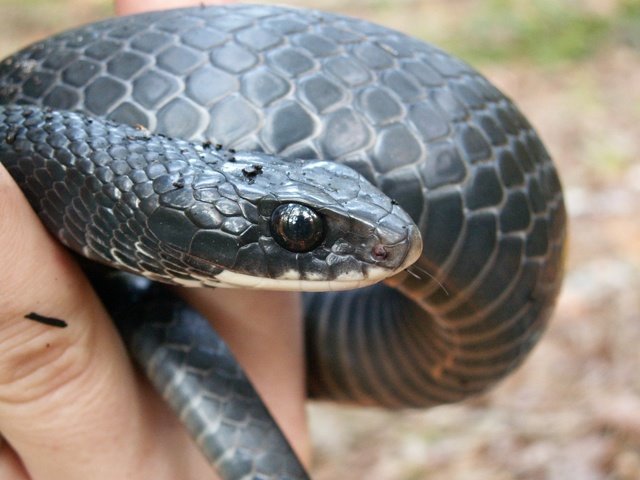
Here’s the prettiest of the racers along with the piece of metal sheeting under which we found it. Look at that big, liquid eye and the deep, powdery black body color set off by the white chin.
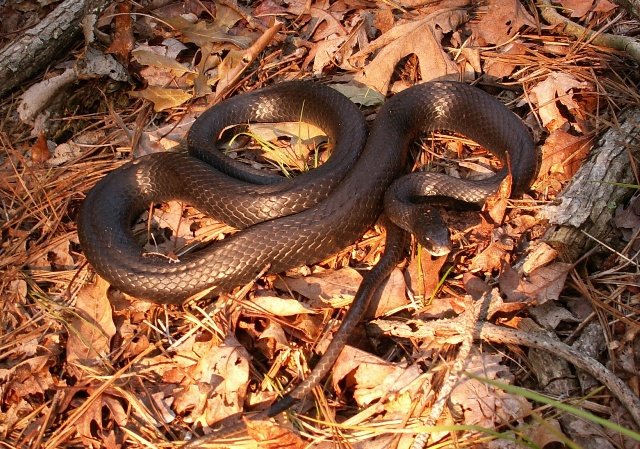
I’ll point out that this one was cold to the touch, and for that reason was pretty easy to handle. Racers are strongly defensive snakes, and, though not venomous, will usually do their best to chew your face and hands off when you catch them. This one posed without any blood loss and then chose an escape path that ran under Scott.
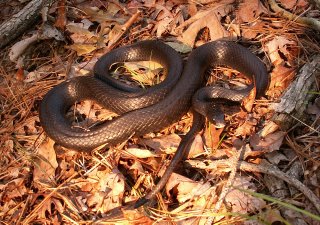
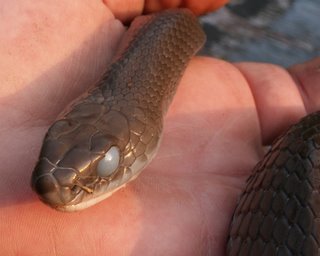
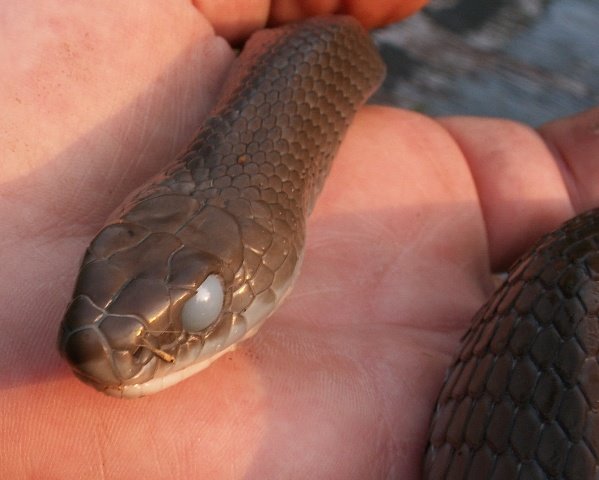
Here’s another racer we found. This one was preparing to shed, hence the milky eyes and gray color. When snakes get ready to shed their skin, they secrete a milky fluid between the old layer of skin and the new layer. During this period they are referred to as being “in shed,” or “opaque,” a reference to their eyes being obscured by that fluid.
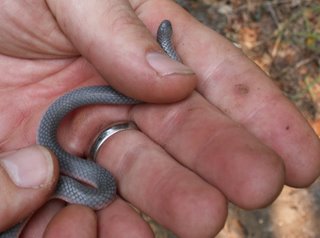
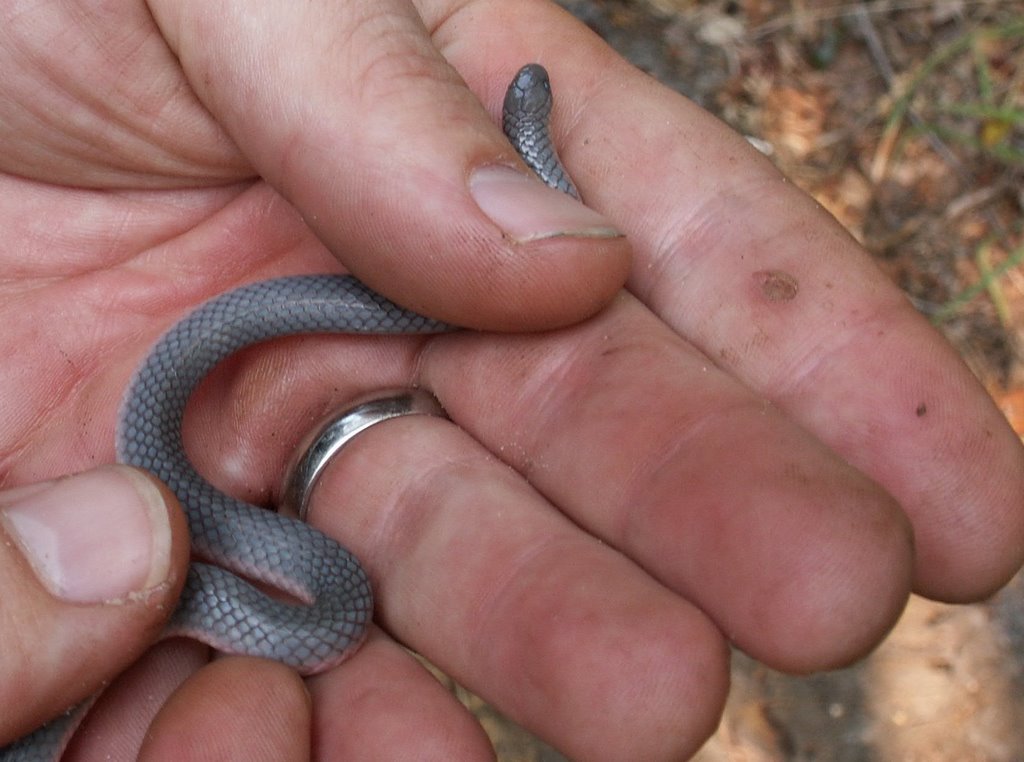
The worm snake was also in shed.
Last, here’s a little fence lizard (Sceloporus undulatus hyacinthinus) that we found under some wooden shipping pallets.
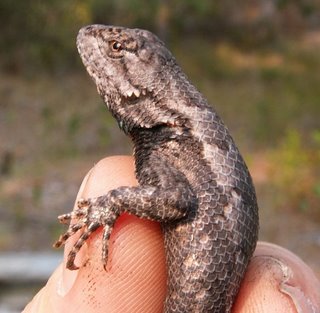
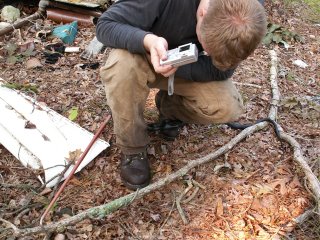
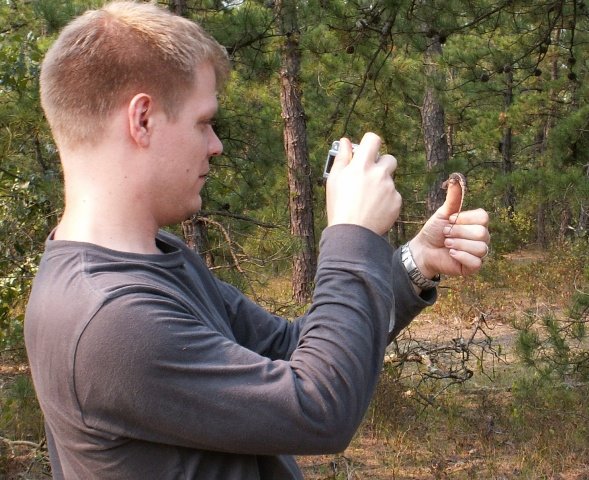
When we tried to put it down, it did not want to let go of Scott’s finger.
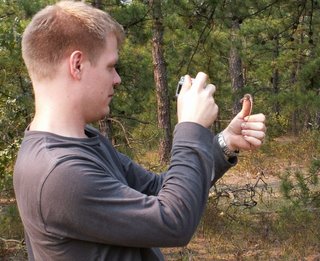
The weather started off humid and in the low 60s and rose well into the 70s as the sun came out.
Totals:
2 black racers
1 ringneck snake
1 worm snake
1 fence lizard
1 DOR painted turtle (Chrysemys p. picta)
Veteran Barrens herpers call them “trash snakes.” They complain about them taking up space under boards. They don’t even bother photographing them. If they go out on a beautiful day and find “nothing” but racers or ringneck snakes, they’ll even say they got skunked!
As you can tell, I am outraged by the discrimination against these beautiful serpents. I am quite happy to find them, even if they are more common than the corn snakes and timber rattlers, kind of like how a pretty fowlers toad (Bufo fowleri) can brighten my day, even though I find them on almost every trip.
On Saturday (September 9th) Scott and I headed to the Pine Barrens really early. Scott asked me when he should come by and pick me up, and I said 5am. He called my bluff (this is the problem with an emergency medicine intern as a herping buddy; to him there is no such thing as a ridiculous time to be awake), and so was there bright and early (actually dark and early – the sun didn’t wake up for another hour and a half) to pick me up and head out to South Jersey.
We wandered the sand roads, mostly of Gloucester and Burlington Counties, flipping trash and logs, and actually spending a lot of time rearranging the trash that locals have dumped in disorganized heaps in the Wildlife Management Areas and other patches of forest.
I know, trash does not belong in the forest at all, but if it’s going to be there, it might as well be spread out in such away as to provide the best cover for reptiles and amphibians. Our goal is that the next time we wander across those same spots, we have more-productive piles of trash to search.
We did find some snakes under the boards and other debris we turned over, namely the racers, one ringneck snake, and a worm snake (Carphophis amoenus). I know, I did not defend the worm snake in my introduction to this post, but while I do enjoy finding them, I just don’t think they’re all that beautiful.
Is this a double standard? I don’t think so. What galls me about the prevailing derisive attitude towards racers and ringnecks is that I think they are beautiful snakes that are not valued because they are common, whereas I don’t think anyone would think the worm snake was beautiful even if it were rare.
Take the rough earth snake (Virginia v. valeriae), a small, drab, rarely found species that occurs throughout New Jersey. Anyone would be interested to find one, but no one would frame the photos. The coastal plains variation of the milk snake (Lampropeltis triangulum “temporalis”), by contrast, is rarely encountered but gorgeous, with bright red saddles on a cream background, and herpers justifiably ooh and ah when they find one. My beef is with the herpers who don’t ooh and ah when they find a ringneck snake or a racer.
Here, judge for yourself. The ringnecks in the Pine Barrens are a mix (or “intergrade”) of two subspecies, the northern (Diadophis p. edwardsii) and the southern (Diadophis p. punctatus). Northern ringnecks usually have blank yellow bellies and a full ring around the neck. Southern ringnecks usually have a row of half-moon spots down the belly and their ring is usually broken by dark scales midway across the neck. This one has both the spots and the full ring, as have the others I’ve found in the Barrens.
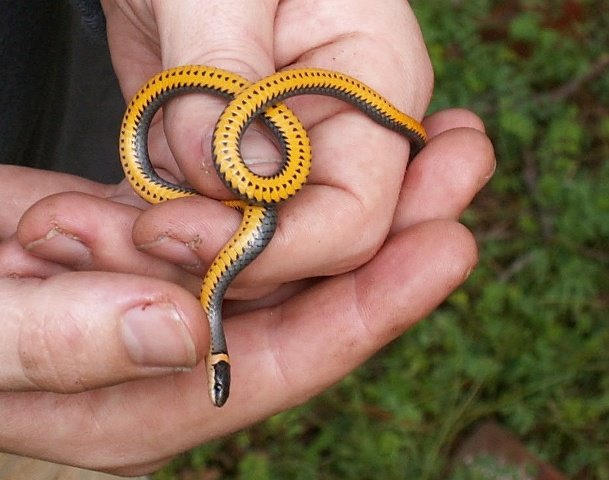
This picture came out blurry, but I thought it was adorable how it was trying to bite Scott.

Here’s the post under which we found it.
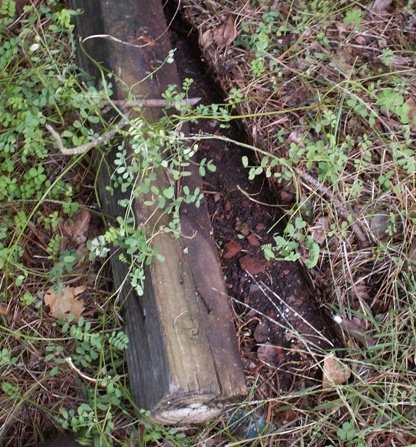
Here’s the prettiest of the racers along with the piece of metal sheeting under which we found it. Look at that big, liquid eye and the deep, powdery black body color set off by the white chin.
I’ll point out that this one was cold to the touch, and for that reason was pretty easy to handle. Racers are strongly defensive snakes, and, though not venomous, will usually do their best to chew your face and hands off when you catch them. This one posed without any blood loss and then chose an escape path that ran under Scott.


Here’s another racer we found. This one was preparing to shed, hence the milky eyes and gray color. When snakes get ready to shed their skin, they secrete a milky fluid between the old layer of skin and the new layer. During this period they are referred to as being “in shed,” or “opaque,” a reference to their eyes being obscured by that fluid.

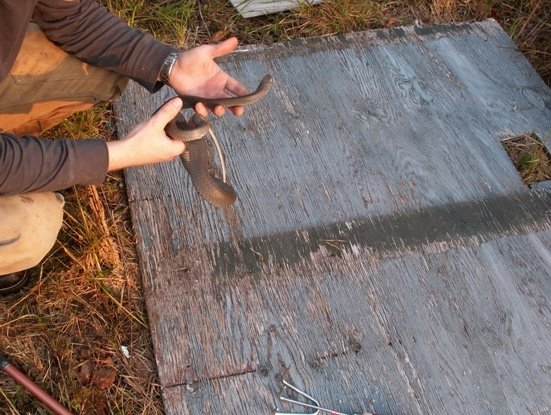
The worm snake was also in shed.
Last, here’s a little fence lizard (Sceloporus undulatus hyacinthinus) that we found under some wooden shipping pallets.
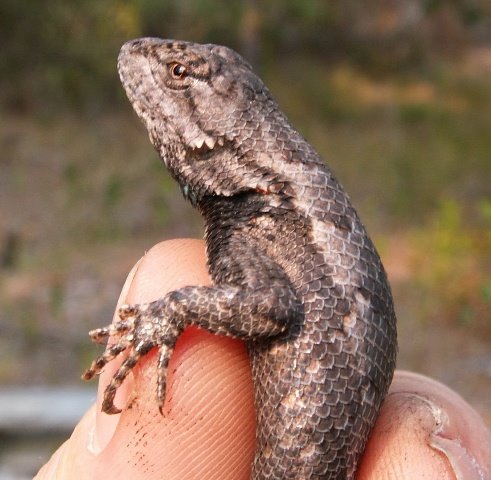
When we tried to put it down, it did not want to let go of Scott’s finger.
The weather started off humid and in the low 60s and rose well into the 70s as the sun came out.
Totals:
2 black racers
1 ringneck snake
1 worm snake
1 fence lizard
1 DOR painted turtle (Chrysemys p. picta)
Wednesday, September 06, 2006
On Labor Day (September 4th) I learned two good reasons why people don’t go swimming in old cranberry bogs.
Reason number one is very simple: they’re too shallow! I don’t know why this hadn't occurred to me before, since cranberry bogs are dug to only to wading depth, and, once abandoned, gradually fill in with sediment and debris.
On Monday I never sank in deeper than hip deep while I was on my feet, and that included up to a foot of mud on the bottom. There were a lot of stumps and fallen branches in there as well. The mud and branches made walking extremely awkward, and in the water it was impossible to get in any strokes besides the occasional breast stroke. So, the easiest way to move forward was to lay flat and pull myself along by grabbing stumps and branches.
The other reason, much more speculative than the first, since I haven’t polled others who have tried swimming in old cranberry bogs and chosen not to do it again, is the burrs. I’m not sure what plant they come from, but I came out of that pond covered in prickly little burrs. Now, I did go in with my clothes on, so maybe if I went in topless and changed out of my bathing suit right away that problem would be solved, but these burrs were a royal pain to pick off once I was out.
So, was this trip a total failure? No, I actually did learn something important in the hour and a half I spent literally wallowing in the mud of a Pine Barrens bog: Turtles are not as scared of me when I’m on my belly. Most basking turtles will jump in the water the moment they spot you, if you’re on foot. They let you get to only a few yards away, however, if you’re flat on your belly in the water. I hope I can find a deeper body of water, so that I can dive from about twenty feet away and swim the rest of the way from below.
Here are some photos of the turtles I took from the shore. I’ve been asking herping buddies, and most agree that the big turtles in these pictures are redbelly turtles (Pseudemys rubriventris). The others are the ubiquitous painted turtle (Chrysemys p. picta).
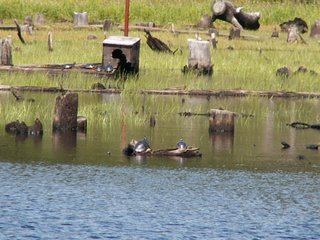

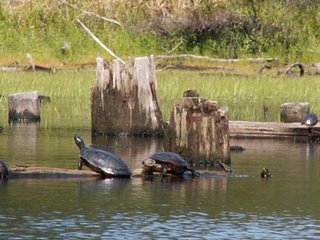
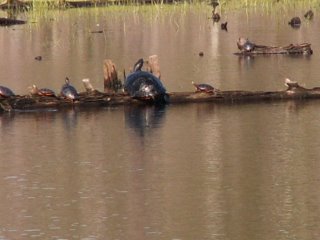
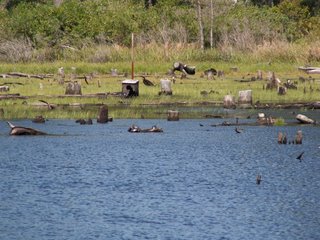
Redbelly turtles are threatened in Pennsylvania, and in many waterways have been displaced by introduced red-eared sliders (Trachemys scripta elegans). From far away most big basking turtles look alike, and they always seem to jump in the water before I can get a good look at them.
Here are a couple photos of a Fowlers toad (Bufo fowleri) I saw later in the day.
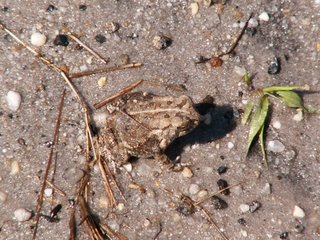
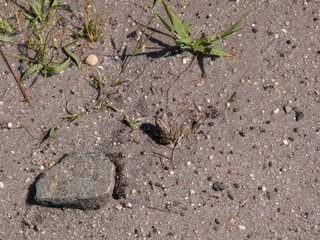
The weather on Monday when I went out was damp and a little hazy with temperatures in the mid 60s soon after dawn. The temperatures rose into the low 70s and the sun was shining when I headed home around mid-day.
Totals:
10+ Painted turtles
2+ redbelly turtles
4 Fowlers toads
15+ unidentified frogs
2 calling green frogs (Rana clamitans melanota)
Reason number one is very simple: they’re too shallow! I don’t know why this hadn't occurred to me before, since cranberry bogs are dug to only to wading depth, and, once abandoned, gradually fill in with sediment and debris.
On Monday I never sank in deeper than hip deep while I was on my feet, and that included up to a foot of mud on the bottom. There were a lot of stumps and fallen branches in there as well. The mud and branches made walking extremely awkward, and in the water it was impossible to get in any strokes besides the occasional breast stroke. So, the easiest way to move forward was to lay flat and pull myself along by grabbing stumps and branches.
The other reason, much more speculative than the first, since I haven’t polled others who have tried swimming in old cranberry bogs and chosen not to do it again, is the burrs. I’m not sure what plant they come from, but I came out of that pond covered in prickly little burrs. Now, I did go in with my clothes on, so maybe if I went in topless and changed out of my bathing suit right away that problem would be solved, but these burrs were a royal pain to pick off once I was out.
So, was this trip a total failure? No, I actually did learn something important in the hour and a half I spent literally wallowing in the mud of a Pine Barrens bog: Turtles are not as scared of me when I’m on my belly. Most basking turtles will jump in the water the moment they spot you, if you’re on foot. They let you get to only a few yards away, however, if you’re flat on your belly in the water. I hope I can find a deeper body of water, so that I can dive from about twenty feet away and swim the rest of the way from below.
Here are some photos of the turtles I took from the shore. I’ve been asking herping buddies, and most agree that the big turtles in these pictures are redbelly turtles (Pseudemys rubriventris). The others are the ubiquitous painted turtle (Chrysemys p. picta).
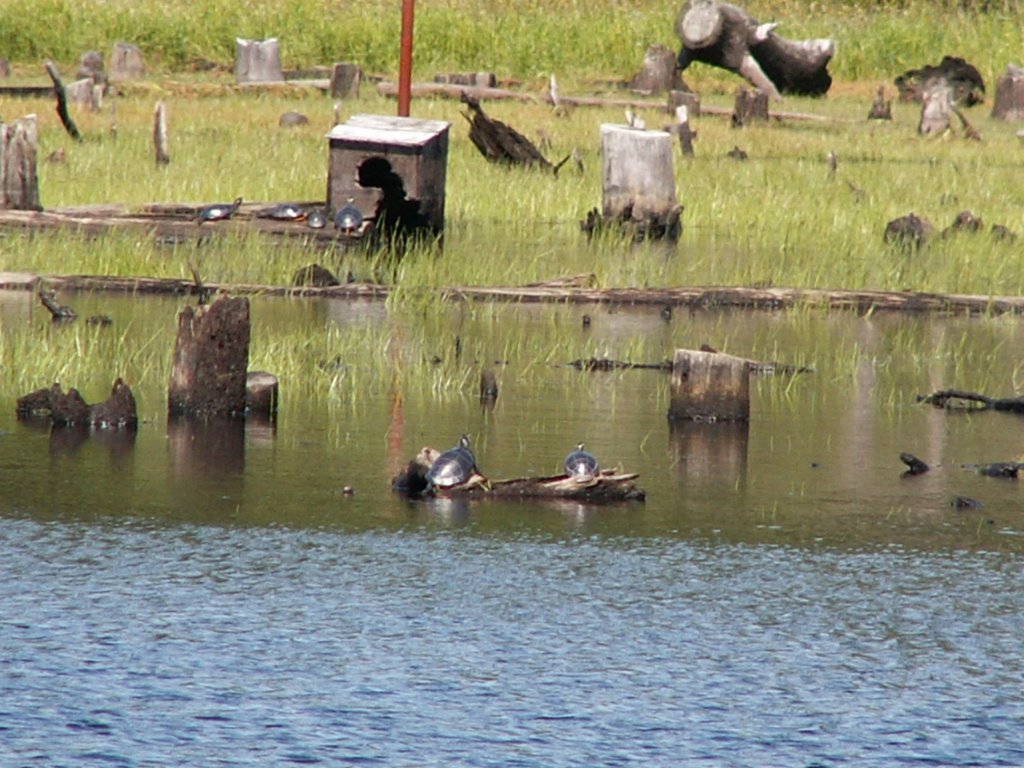
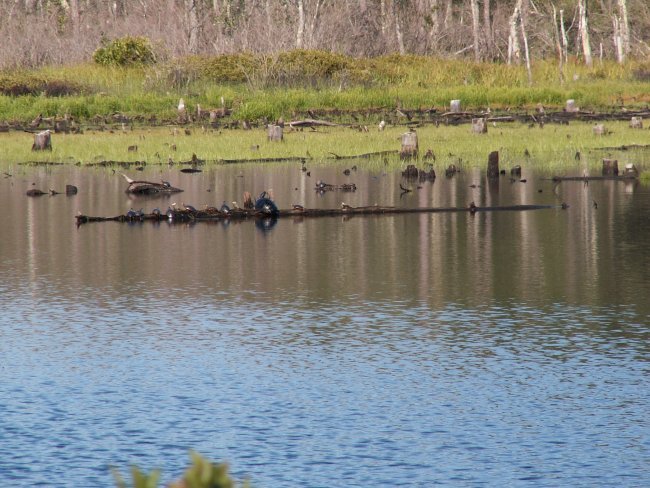
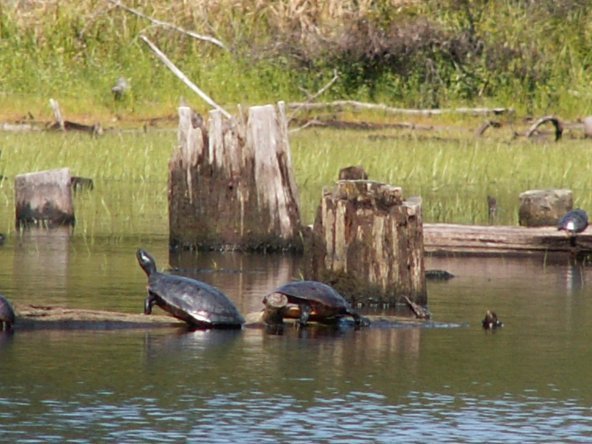


Redbelly turtles are threatened in Pennsylvania, and in many waterways have been displaced by introduced red-eared sliders (Trachemys scripta elegans). From far away most big basking turtles look alike, and they always seem to jump in the water before I can get a good look at them.
Here are a couple photos of a Fowlers toad (Bufo fowleri) I saw later in the day.


The weather on Monday when I went out was damp and a little hazy with temperatures in the mid 60s soon after dawn. The temperatures rose into the low 70s and the sun was shining when I headed home around mid-day.
Totals:
10+ Painted turtles
2+ redbelly turtles
4 Fowlers toads
15+ unidentified frogs
2 calling green frogs (Rana clamitans melanota)
Thursday, August 31, 2006
I don’t know Salem County, NJ very well at all, but last Saturday the 27th I decided to check out some ponds there for turtles I could swim after. This was stupid, since going somewhere new means I need to spend valuable herping time finding my way around. Even if I quickly figure out where I am, the place could be a total dud.
Salem County looks like the garden in the Garden State. Satellite images show a tight patchwork of fields for growing soy, corn, and vegetables. I passed some cow pastures too, all making for a strong contrast to the woods and wetlands I’m used to in the Pine Barrens. It’s actually pretty boring for me on the ground. I'm not looking for peppers or Herefords; I’m looking for turtles and other herps.
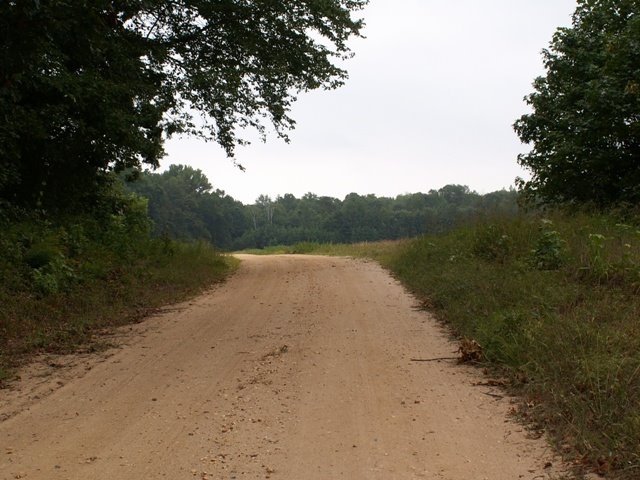
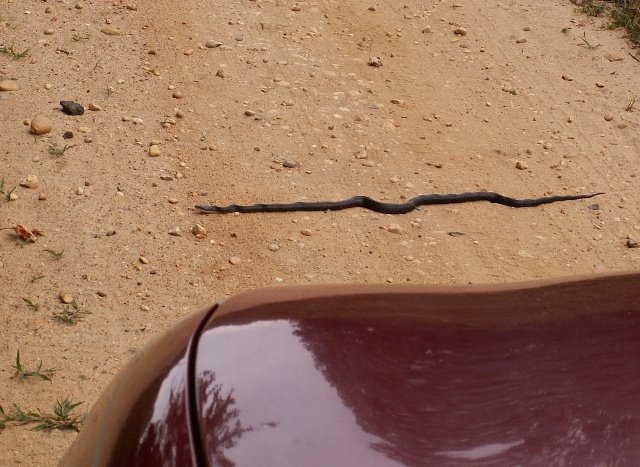
Looks were deceiving, however. I was casing the area around the first pond when I spotted a snake stretched out across the dirt road. I slammed on the brakes and jumped out. I took a quick photo as I got out of the car.
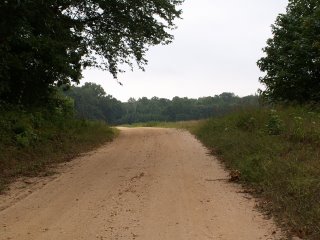
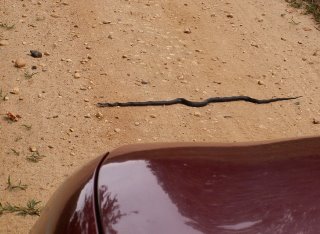
It was a black rat snake (Elaphe o. obsoleta). I took pictures of him stretched out and frozen, but he snapped into a defensive pose as soon as I touched him.
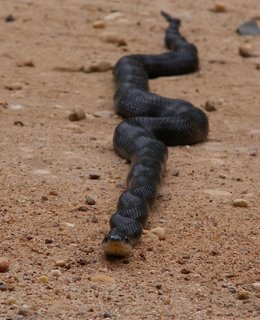
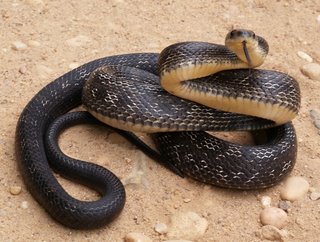
He did not like the camera. I gently picked him up, and he seemed quite at home on my arm: no musking and no biting. As soon as I pointed the camera at him, though, he pulled his head back and I felt his tail twitching back and forth (that creates a rattling noise against leaf litter).
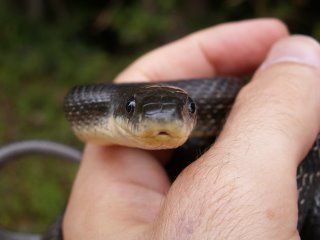
I let him go and eventually parked to walk around the pond. I surprised a few frogs for the ever-frustrating unidentifiable hops and splashes: something moves out of the corner of your eye and hits the water. You know it’s a frog, but you didn’t see what kind. After six of seven of these I was able to get enough of a look at one to identify it as a green frog (Rana clamitans melanota). I saw one painted turtle (Chrysemys s. scripta) as well, but I also saw plenty of people casting lines into the water.
I ended up getting stage fright. It’s one thing to explain a routine herping activity like chasing after frogs or looking under logs, but another to look at a total stranger performing a completely normal activity (fishing) and explain why I’m doing something as untested and ridiculous-looking as swimming after turtles.
I saw another snake on a paved road near the town of Salem, and I pulled a quick U turn to check it out. This five-foot beast of a black rat snake was thoroughly dead, though, so I took no pictures and continued on my way.
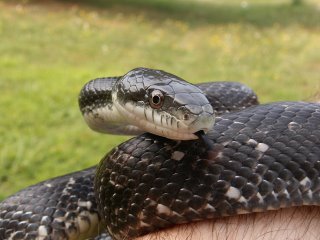
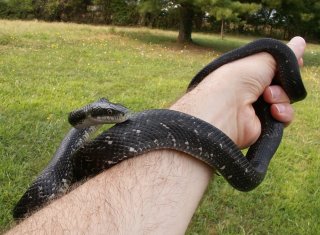
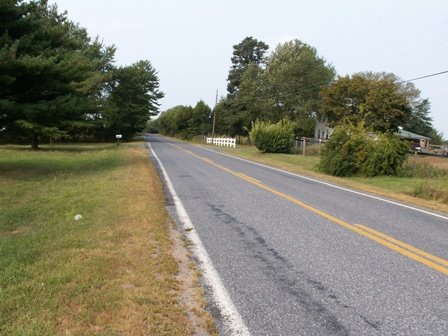
DOR herps are always heartbreakers, but the disgust and sadness were mitigated somewhat by yet another black rat snake I dodged another twenty miles or so into my travels. I missed its head (thank God), and jumped out. It was alive! I grabbed it as it was heading into the grass at the side of the road. This one was also pretty calm and did not bite either, but it musked on me, a smell which stuck to me the rest of the trip (a good thing – remember, musk is the smell of success!). Here he is with a picture of the road on which I found him:
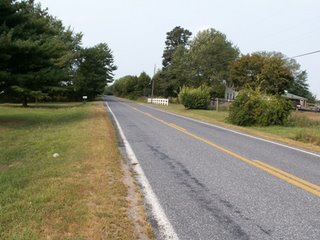
Of course the emotional trajectory changed again with the next DOR black rat snake and a DOR rough green snake (Opheodrys aestivus).
What was up with Salem County? It had rained the night before, but was that enough to bring out all the snakes? Do I need to spend more time road cruising there? Is this a sign from the herping gods to forget about turtles and just focus on the snakes?
The second pond seemed like a good spot. I saw no other parked cars when I parked mine, and I hopped down to check out a pool at the base of the dam on the pond.
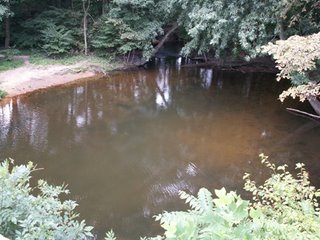
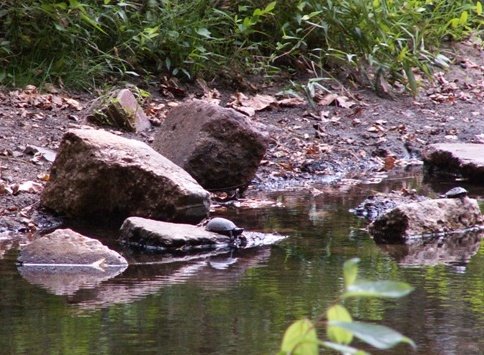
What was that on the concrete chunks at the shore? A basking stinkpot (Sternotherus oderatus)?
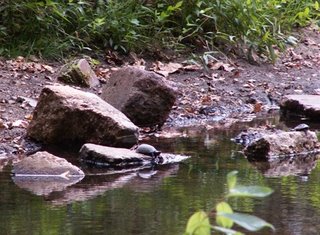
It’s not every day I see a stinkpot basking like that, and I quickly made the decision to jump into the water and head it off before it could get too far into the pool. I put down the camera and charged into the shallows.
Redbelly turtles (Pseudemys rubriventris) and painted turtles see you and they’re in the water before you can move. This stinkpot looked at me for a second and sort of took a step. It kept looking for another second, and then it finally made up its mind to jump off into the water once I was splashing through the water in its direction.
Even with all that delay, I failed completely. I was still ten yards or so away when he got into the water, and the little guy made it under a submerged pile of concrete chunks that I couldn’t excavate.
Feeling pretty defeated, I waded out into the pool about waist-deep and looked around. I could see the fuzzy shapes of fish swimming calmly around me – some bluegills I think, some carp, and a huge largemouth bass I would have been ecstatic to catch back when I used to fish. I strapped on my goggles and bent over to immerse my face. Looking down at my feet, I could make out two vague white shapes, certainly my sneakers, but that’s about as much as I could make out.
The murkiness of the water made me a little suspicious of it, and I didn’t think I’d be able to see turtles too well anyhow, so I hesitated to dive in. I was tempted when a turtle (either a redbelly or a red-eared slider – Trachemys scripta elegans) surfaced a few feet away. He watched me while I tried to make up my mind, and then he dove again. The same thing happened with another, smaller stinkpot before I gave up and got out of the water.
My suspicions about the water quality were confirmed when I walked around to see the main portion of the pond. Here’s how it looked:
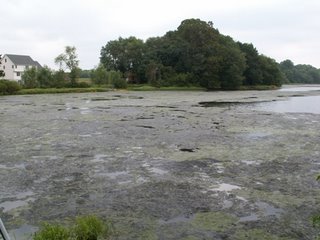
All that scummy-looking algae is a sign of high nutrient levels. That’s another way of saying there’s a lot of fertilizer in the water. Fertilizer is unpleasant to think about bathing in no matter how it is produced. Had I been splashing around in a brew of petrochemicals or manure?
So, my task for next week is to check out some ponds I’ve driven past or walked around before and hope they’re clean and isolated. Wish me luck.
The temperatures rose from the high 60s to the high 70s on Saturday morning and early afternoon.
Totals:
4 black rat snakes (2 DOR)
1 dead rough green snake (DOR)
2 stinkpots
5-6 mystery frogs
1 green frog
1 mystery turtle
1 painted turtle
Salem County looks like the garden in the Garden State. Satellite images show a tight patchwork of fields for growing soy, corn, and vegetables. I passed some cow pastures too, all making for a strong contrast to the woods and wetlands I’m used to in the Pine Barrens. It’s actually pretty boring for me on the ground. I'm not looking for peppers or Herefords; I’m looking for turtles and other herps.
Looks were deceiving, however. I was casing the area around the first pond when I spotted a snake stretched out across the dirt road. I slammed on the brakes and jumped out. I took a quick photo as I got out of the car.
It was a black rat snake (Elaphe o. obsoleta). I took pictures of him stretched out and frozen, but he snapped into a defensive pose as soon as I touched him.


He did not like the camera. I gently picked him up, and he seemed quite at home on my arm: no musking and no biting. As soon as I pointed the camera at him, though, he pulled his head back and I felt his tail twitching back and forth (that creates a rattling noise against leaf litter).

I let him go and eventually parked to walk around the pond. I surprised a few frogs for the ever-frustrating unidentifiable hops and splashes: something moves out of the corner of your eye and hits the water. You know it’s a frog, but you didn’t see what kind. After six of seven of these I was able to get enough of a look at one to identify it as a green frog (Rana clamitans melanota). I saw one painted turtle (Chrysemys s. scripta) as well, but I also saw plenty of people casting lines into the water.
I ended up getting stage fright. It’s one thing to explain a routine herping activity like chasing after frogs or looking under logs, but another to look at a total stranger performing a completely normal activity (fishing) and explain why I’m doing something as untested and ridiculous-looking as swimming after turtles.
I saw another snake on a paved road near the town of Salem, and I pulled a quick U turn to check it out. This five-foot beast of a black rat snake was thoroughly dead, though, so I took no pictures and continued on my way.
DOR herps are always heartbreakers, but the disgust and sadness were mitigated somewhat by yet another black rat snake I dodged another twenty miles or so into my travels. I missed its head (thank God), and jumped out. It was alive! I grabbed it as it was heading into the grass at the side of the road. This one was also pretty calm and did not bite either, but it musked on me, a smell which stuck to me the rest of the trip (a good thing – remember, musk is the smell of success!). Here he is with a picture of the road on which I found him:


Of course the emotional trajectory changed again with the next DOR black rat snake and a DOR rough green snake (Opheodrys aestivus).
What was up with Salem County? It had rained the night before, but was that enough to bring out all the snakes? Do I need to spend more time road cruising there? Is this a sign from the herping gods to forget about turtles and just focus on the snakes?
The second pond seemed like a good spot. I saw no other parked cars when I parked mine, and I hopped down to check out a pool at the base of the dam on the pond.

What was that on the concrete chunks at the shore? A basking stinkpot (Sternotherus oderatus)?
It’s not every day I see a stinkpot basking like that, and I quickly made the decision to jump into the water and head it off before it could get too far into the pool. I put down the camera and charged into the shallows.
Redbelly turtles (Pseudemys rubriventris) and painted turtles see you and they’re in the water before you can move. This stinkpot looked at me for a second and sort of took a step. It kept looking for another second, and then it finally made up its mind to jump off into the water once I was splashing through the water in its direction.
Even with all that delay, I failed completely. I was still ten yards or so away when he got into the water, and the little guy made it under a submerged pile of concrete chunks that I couldn’t excavate.
Feeling pretty defeated, I waded out into the pool about waist-deep and looked around. I could see the fuzzy shapes of fish swimming calmly around me – some bluegills I think, some carp, and a huge largemouth bass I would have been ecstatic to catch back when I used to fish. I strapped on my goggles and bent over to immerse my face. Looking down at my feet, I could make out two vague white shapes, certainly my sneakers, but that’s about as much as I could make out.
The murkiness of the water made me a little suspicious of it, and I didn’t think I’d be able to see turtles too well anyhow, so I hesitated to dive in. I was tempted when a turtle (either a redbelly or a red-eared slider – Trachemys scripta elegans) surfaced a few feet away. He watched me while I tried to make up my mind, and then he dove again. The same thing happened with another, smaller stinkpot before I gave up and got out of the water.
My suspicions about the water quality were confirmed when I walked around to see the main portion of the pond. Here’s how it looked:
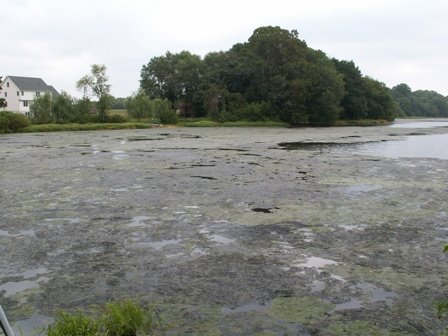
All that scummy-looking algae is a sign of high nutrient levels. That’s another way of saying there’s a lot of fertilizer in the water. Fertilizer is unpleasant to think about bathing in no matter how it is produced. Had I been splashing around in a brew of petrochemicals or manure?
So, my task for next week is to check out some ponds I’ve driven past or walked around before and hope they’re clean and isolated. Wish me luck.
The temperatures rose from the high 60s to the high 70s on Saturday morning and early afternoon.
Totals:
4 black rat snakes (2 DOR)
1 dead rough green snake (DOR)
2 stinkpots
5-6 mystery frogs
1 green frog
1 mystery turtle
1 painted turtle
Thursday, August 24, 2006
I’ve been avoiding posting about herping trips outside of the Philly area. My idea has been to save them for the winter. I’ve been getting out enough locally enough to write about, and I figure I’ll welcome having the material in February when everything is frozen solid.
That said, the past week I did not get out much locally. So, I’ll write about a concept that hit me when I was up visiting cousins in Massachusetts. This incredible new concept is aquatic herping.
Our cousins took us out to a swimming pond near their house in Conway, a small town in the Pioneer Valley, not far from the Connecticut River. The landscape is a mix of small farms, houses on mowed or wooded lots, and patches of forest. The pond in question is filled by a spring that feeds out through a short length of wooded brook.
Jen’s cousin Jeff had commented that some kids had found a snapping turtle (Chelydra serpentina) earlier in the year back in some reeds, and we came ready to do some herping. We found some common frogs and salamanders around the edges, and then I strapped on my goggles and got in the water.
I did not find any turtles, but I did have a blast catching newts (Nopthalmus v. viridescens) underwater. I thought that these little aquatic herps would be faster and more agile than I am, but for the most part when I went after one, I caught it. I enjoy swimming laps for exercise, but there was something far more exhilarating about chasing something down under water.
I couldn’t stop talking about it the rest of the trip, and while we weren’t able to get back to the pond before we headed back to Philly, I see no reason I can’t do this locally.
I’m always stopping at the water’s edge when amphibious herps are getting away from me. A turtle jumps in the water, and I shrug and keep walking. The newt dives for the bottom, and I look for another to photograph. I need to hit the woods prepared to go in after them.
There are a lot of tactical questions for me to resolve about catching herps in the water, but early feedback from other herpers on the topic is promising. Apparently this is a great way to grab basking water snakes (Nerodia species). These usually drop right in the water as soon as you get close, but they are reportedly easy to approach from the water. This is also a great way to observe snapping turtles and stinkpots (Sternotherus oderatus) under water, and one guy even reported that you can swim up on basking turtles this way and grab them before or as they jump off their logs.
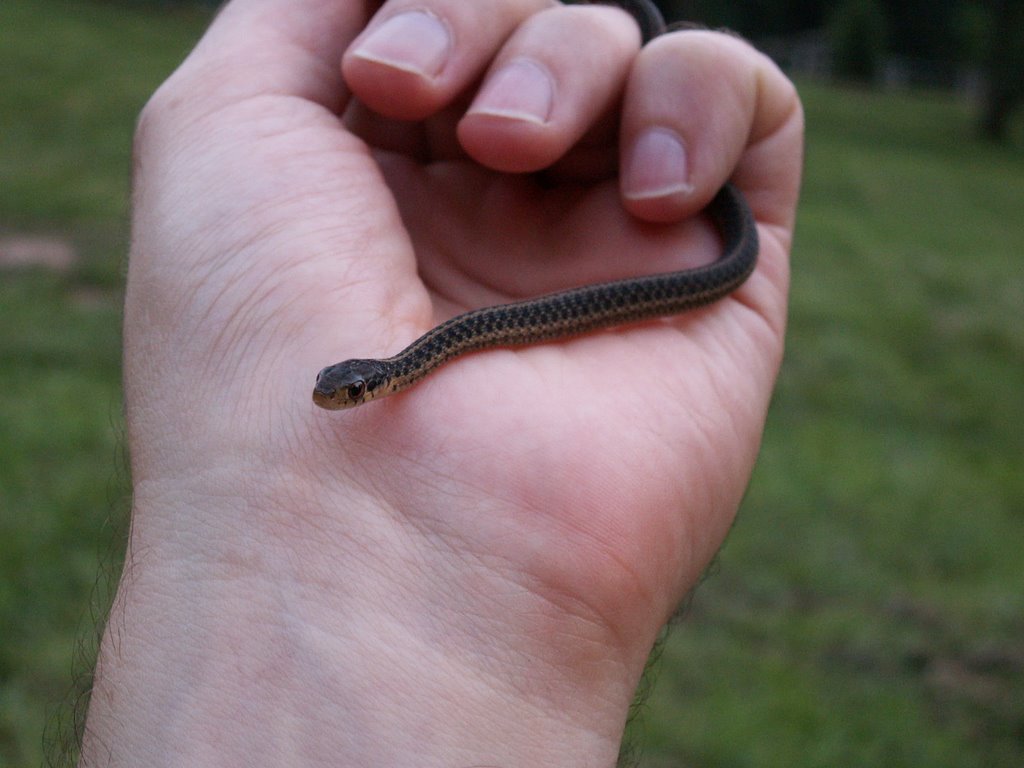
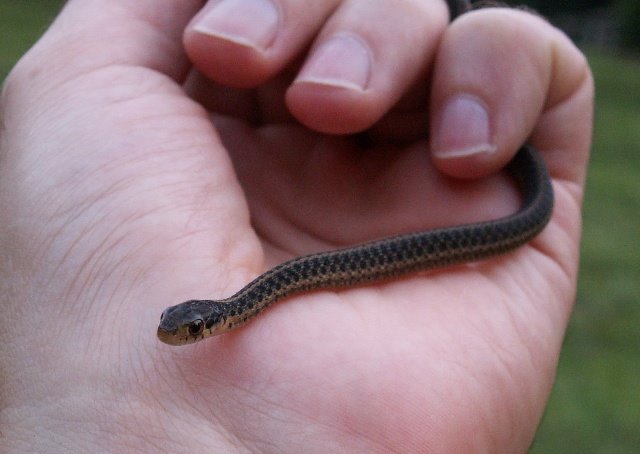
Now for a photo: This is a little garter snake (Thamnophis s. sirtalis) – I think it’s a yearling – I found at Cobbs Creek on August 10th. The temps were in the high 70s at about 8:00pm, and I found it under a small log.
Last, there is a new website for an extension of the mostly-concluded PA Herp Atlas Project. They need data on 36 relatively rare herp species, and the website makes it really easy to submit your finds: http://www.ship.edu/~tjmare/herp.htm
That said, the past week I did not get out much locally. So, I’ll write about a concept that hit me when I was up visiting cousins in Massachusetts. This incredible new concept is aquatic herping.
Our cousins took us out to a swimming pond near their house in Conway, a small town in the Pioneer Valley, not far from the Connecticut River. The landscape is a mix of small farms, houses on mowed or wooded lots, and patches of forest. The pond in question is filled by a spring that feeds out through a short length of wooded brook.
Jen’s cousin Jeff had commented that some kids had found a snapping turtle (Chelydra serpentina) earlier in the year back in some reeds, and we came ready to do some herping. We found some common frogs and salamanders around the edges, and then I strapped on my goggles and got in the water.
I did not find any turtles, but I did have a blast catching newts (Nopthalmus v. viridescens) underwater. I thought that these little aquatic herps would be faster and more agile than I am, but for the most part when I went after one, I caught it. I enjoy swimming laps for exercise, but there was something far more exhilarating about chasing something down under water.
I couldn’t stop talking about it the rest of the trip, and while we weren’t able to get back to the pond before we headed back to Philly, I see no reason I can’t do this locally.
I’m always stopping at the water’s edge when amphibious herps are getting away from me. A turtle jumps in the water, and I shrug and keep walking. The newt dives for the bottom, and I look for another to photograph. I need to hit the woods prepared to go in after them.
There are a lot of tactical questions for me to resolve about catching herps in the water, but early feedback from other herpers on the topic is promising. Apparently this is a great way to grab basking water snakes (Nerodia species). These usually drop right in the water as soon as you get close, but they are reportedly easy to approach from the water. This is also a great way to observe snapping turtles and stinkpots (Sternotherus oderatus) under water, and one guy even reported that you can swim up on basking turtles this way and grab them before or as they jump off their logs.
Now for a photo: This is a little garter snake (Thamnophis s. sirtalis) – I think it’s a yearling – I found at Cobbs Creek on August 10th. The temps were in the high 70s at about 8:00pm, and I found it under a small log.
Last, there is a new website for an extension of the mostly-concluded PA Herp Atlas Project. They need data on 36 relatively rare herp species, and the website makes it really easy to submit your finds: http://www.ship.edu/~tjmare/herp.htm
Wednesday, August 16, 2006
I haven’t done much with water turtles this year. Last year we went down to the John Heinz Wildlife Refuge at Tinicum a few times. The Refuge is a great place to watch painted (Chrysemys p. picta) and redbelly (Pseudemys rubriventris) turtles bask and swim around, but last weekend I was interested in seeing a couple other species, both with wonderfully evocative names: common map turtles (Graptemys geographica) and stinkpots (Sternotherus odoratus).
Map turtles are named for their markings: yellow squiggly lines on dark green. Most of their range is in the Mississippi river system, but there are populations along the Susquehanna river and some of its tributaries as well as a section of the Delaware above Trenton. They are known for being wary. They jump in the water faster than most water turtles, which makes them a challenge to spot, let alone photograph.
Stinkpots are little, round, ugly turtles. Their other common name is the Common Musk Turtle; both names refer to their habit of exuding a pungent musk when scared. I love stinkpots. They don’t bask as much as other turtles, but when they do they like to actually climb up into tree branches, making for a really fun picture if you can catch them in the act.
They are pretty common. To find them you need to look carefully in the shallows of almost any body of water. You’re looking for a round, smooth rock or clump of algae that is walking along the bottom. They don’t swim fast, so you can just jump in and grab them if you don’t mind getting wet and muddy. They do bite, so keep your fingers away from their mouths.
On Saturday we headed for Washington Crossing State Historical Park. What the park has going for it is the Delaware River to one side, which is map turtle habitat, and the narrower, shallower Delaware Canal, which I had heard is full of stinkpots.
I haven’t ever looked for anything in Upper Bucks County, and I haven’t looked for map turtles ever, so I was prepared for a fruitless scouting trip. We started off on a good note, though, with a bunch of other turtles in a pond right next to where we parked. We saw a couple red-eared sliders (Trachemys scripta elegans), a whole lot of painted turtles, and I think I saw a redbelly turtle.
Painted turtles are probably the turtles people most frequently see basking around here. Adults range from the size of a coffee saucer to the size of a salad plate. They are flat, dark, and have two light spots on each side of their heads.
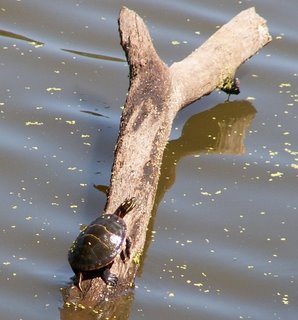
Redbelly turtles are a threatened species in Pennsylvania, but they seem pretty common where they do occur. One of the three large, rounder turtles we saw had no red stripe on its head, and I think it might have been a redbelly, but from far away it was hard to be sure.
Red-eared sliders are native to middle part of the United States, but they are spreading. These are the little green turtles with red stripes on their heads that people buy as pets. Of course they get a lot bigger, and few people are prepared to get the gigantic fish tank or backyard pond an adult needs, so they are released in ponds, rivers, and lakes all over the world. Most of the released turtles starve to death, but enough survive to establish breeding populations.
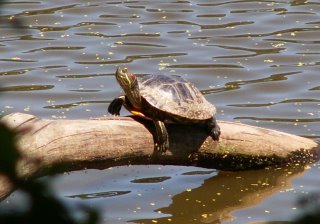
We walked along the path next to the Canal, and after a few minutes I spotted that round, dirty rock that might be… yup, walking slowly along the bottom.

I handed my backpack to Jen and jumped in.
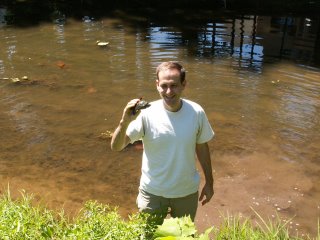
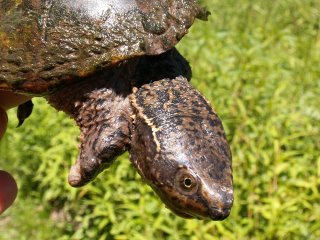
Here it is out of the water. They’re not at all graceful, they’ve got rough, warty, bumpy skin, but I think that somehow their ugliness combined with their small size makes them really cute.
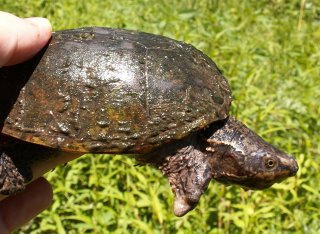
I didn’t notice this until I looked at the photos, but this stinkpot is missing the toes on its right, front foot.
We saw some more painted turtles, but we didn’t find any spots on the river without lots of other people to scare away any map turtles that could have been there (not that we looked that hard). We got lunch on the Jersey side of the river at an expensive but mediocre restaurant and then decided to look for salamanders as an afternoon-cap.
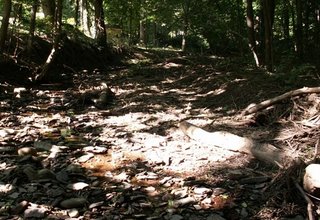
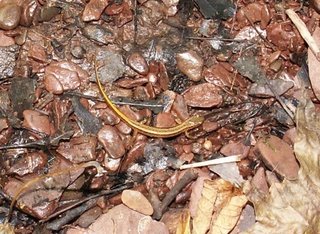
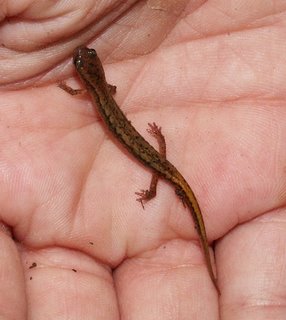
We haven’t gone flipping rocks in river beds for a few months now, so it was fun to splash around in the shallows and uncover a few of these little two-lined salamanders (Eurycea bislineata).
The temperatures on August 12 were in the low 80s and the sky was partly cloudy.
Totals:
6 Painted turtles
1 Redbelly turtle
1 red eared slider
1 stinkpot
About 10 green frogs (Rana melanota clamitans)
3 two-lined salamanders
Map turtles are named for their markings: yellow squiggly lines on dark green. Most of their range is in the Mississippi river system, but there are populations along the Susquehanna river and some of its tributaries as well as a section of the Delaware above Trenton. They are known for being wary. They jump in the water faster than most water turtles, which makes them a challenge to spot, let alone photograph.
Stinkpots are little, round, ugly turtles. Their other common name is the Common Musk Turtle; both names refer to their habit of exuding a pungent musk when scared. I love stinkpots. They don’t bask as much as other turtles, but when they do they like to actually climb up into tree branches, making for a really fun picture if you can catch them in the act.
They are pretty common. To find them you need to look carefully in the shallows of almost any body of water. You’re looking for a round, smooth rock or clump of algae that is walking along the bottom. They don’t swim fast, so you can just jump in and grab them if you don’t mind getting wet and muddy. They do bite, so keep your fingers away from their mouths.
On Saturday we headed for Washington Crossing State Historical Park. What the park has going for it is the Delaware River to one side, which is map turtle habitat, and the narrower, shallower Delaware Canal, which I had heard is full of stinkpots.
I haven’t ever looked for anything in Upper Bucks County, and I haven’t looked for map turtles ever, so I was prepared for a fruitless scouting trip. We started off on a good note, though, with a bunch of other turtles in a pond right next to where we parked. We saw a couple red-eared sliders (Trachemys scripta elegans), a whole lot of painted turtles, and I think I saw a redbelly turtle.
Painted turtles are probably the turtles people most frequently see basking around here. Adults range from the size of a coffee saucer to the size of a salad plate. They are flat, dark, and have two light spots on each side of their heads.

Redbelly turtles are a threatened species in Pennsylvania, but they seem pretty common where they do occur. One of the three large, rounder turtles we saw had no red stripe on its head, and I think it might have been a redbelly, but from far away it was hard to be sure.
Red-eared sliders are native to middle part of the United States, but they are spreading. These are the little green turtles with red stripes on their heads that people buy as pets. Of course they get a lot bigger, and few people are prepared to get the gigantic fish tank or backyard pond an adult needs, so they are released in ponds, rivers, and lakes all over the world. Most of the released turtles starve to death, but enough survive to establish breeding populations.

We walked along the path next to the Canal, and after a few minutes I spotted that round, dirty rock that might be… yup, walking slowly along the bottom.

I handed my backpack to Jen and jumped in.

Here it is out of the water. They’re not at all graceful, they’ve got rough, warty, bumpy skin, but I think that somehow their ugliness combined with their small size makes them really cute.

I didn’t notice this until I looked at the photos, but this stinkpot is missing the toes on its right, front foot.

We saw some more painted turtles, but we didn’t find any spots on the river without lots of other people to scare away any map turtles that could have been there (not that we looked that hard). We got lunch on the Jersey side of the river at an expensive but mediocre restaurant and then decided to look for salamanders as an afternoon-cap.
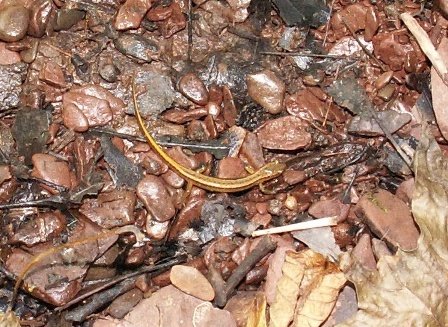
We haven’t gone flipping rocks in river beds for a few months now, so it was fun to splash around in the shallows and uncover a few of these little two-lined salamanders (Eurycea bislineata).

The temperatures on August 12 were in the low 80s and the sky was partly cloudy.
Totals:
6 Painted turtles
1 Redbelly turtle
1 red eared slider
1 stinkpot
About 10 green frogs (Rana melanota clamitans)
3 two-lined salamanders
Sunday, August 13, 2006
Here’s an update on the baby browns. We let them go on Saturday (August 12) back in the Mount Moriah Cemetery.
They had refused all the food we could find to throw at them – whole small worms, chopped worms, chopped slugs. They had refused them in different cage arrangements. They just weren’t going to start eating without even more experimentation (it would be great if I could find baby slugs, but I can’t find baby slugs).
It was all getting too time consuming for us, and the longer they went without eating, the worse their odds were when released, and their odds were already pretty poor. So, that’s the end of this little story. I wish them luck.
They had refused all the food we could find to throw at them – whole small worms, chopped worms, chopped slugs. They had refused them in different cage arrangements. They just weren’t going to start eating without even more experimentation (it would be great if I could find baby slugs, but I can’t find baby slugs).
It was all getting too time consuming for us, and the longer they went without eating, the worse their odds were when released, and their odds were already pretty poor. So, that’s the end of this little story. I wish them luck.
Thursday, August 10, 2006
One of Philadelphia’s biggest herpetological shortcomings is that it doesn’t have many lizards. There are five-lined skinks (Eumeces fasciatus) and fence lizards (Sceloporus undulates hyacinthus) in the area, but I haven’t actually seen any lizards outside of the Pine Barrens.
We particularly lack active lizards that do all their business out in the open, like the anoles (Anolis and Norops species) of the Southeast and those Tropidurus torquatus we saw so many of in Brazil. It’s fun to spot lizards basking on fence posts as you walk to work, and it’s always a kick to watch the males doing head bobs and pushups to impress the females, fun that Philadelphians miss out on. Maybe that’s why Philadelphians are known for being so ill-tempered; does lizardlessness breed crankiness?
I might or might not be onto the next great breakthrough in psychology, but either way I had a great time visiting the Italian wall lizards (Podarcis sicula) of the Bronx Botanical Gardens on Saturday (August 5th).
I headed out from my sister’s place on the Lower East Side and took the D train up to the Botanical Gardens. I got there a little after they opened at 10am (admission is free 10am to 12pm Saturdays). I made my way directly to the rock garden, and there the kid at the admissions booth gave me directions to where I was most likely to see the lizards.
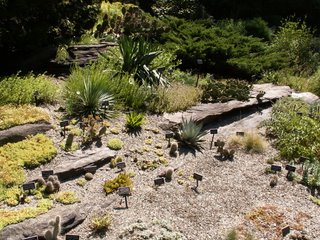
I walked back and forth for maybe fifteen minutes and saw absolutely nothing (and imagine my frustration at being surrounded by all those rocks I couldn’t look under!). To all casual observers I must have looked like a serious rock garden enthusiast, staring at all the little clumps of grasses and succulents from around the world with an intense, studious frown.
Of course that was a frown of frustration, but I reminded myself that it’s so often like this with spotting lizards. You don’t see any at first. You stare and stare at every pebble and leaf, wondering where they all are. Are they all sleeping? Is this the wrong spot? Have you scared them all into hiding?
Suddenly, though, you see one out of the corner of your eye. You turn to look at it, and just as suddenly it’s gone. Then you turn your head and see another, then another, and then you realize they’re all over the place. Maybe it’s a question of them all coming out at once, and maybe it’s that your brain needs the first to know what how to recognize all the others, but that’s how it is with lizards: you see one, then you see them all.
I had not chosen this spot at random, but at the advice of Russell Burke, a biologist at Hofstra who has studied the transplanted Italian wall lizards of Long Island and the Bronx. I had initially sought out Dr. Burke for information of the wall lizards of West Philadelphia.
Wall lizards of West Philadelphia? Surely I would have written about them by now, right? Well, while there once was (in the mid-1900s) a population of Italian wall lizards near the zoo along the railroad tracks towards Market Street, that population has gone extinct.
Some guy may tell you his friend says he knows a guy who found one once, or they overheard a guy talking at the Hamburg reptile show about them still running around the city, but it’s all urban herping myth. One person says “there used to be wall lizards in West Philly,” and, as in a game of telephone, a few iterations later you’ve got a fourth-hand account of them having been found there last Tuesday.
Dr. Burke, as well as several other professional and amateur herpers (while all recognizing the difficulty of definitively proving the absence of a small animal) have reported seeing no wall lizards after many hours of searching and have heard no first-hand reports from other herpers or neighborhood residents. These are active, highly visible lizards, and if no one in the neighborhood has seen them and experts who have spent hours upon hours observing them elsewhere haven't either, they’re not there.
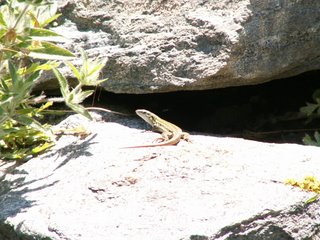
So, with no hope of seeing the Italian wall lizards in West Philly, I had traveled to a place they do live. After fifteen minutes of pacing and frowning, I finally caught my glimpse. Something green dashed off the path as soon as I saw it. I paced a little more slowly and more intently at that point, and after another minute I saw a much smaller lizard dash from plant to plant, each time running just as I was about to take its picture.
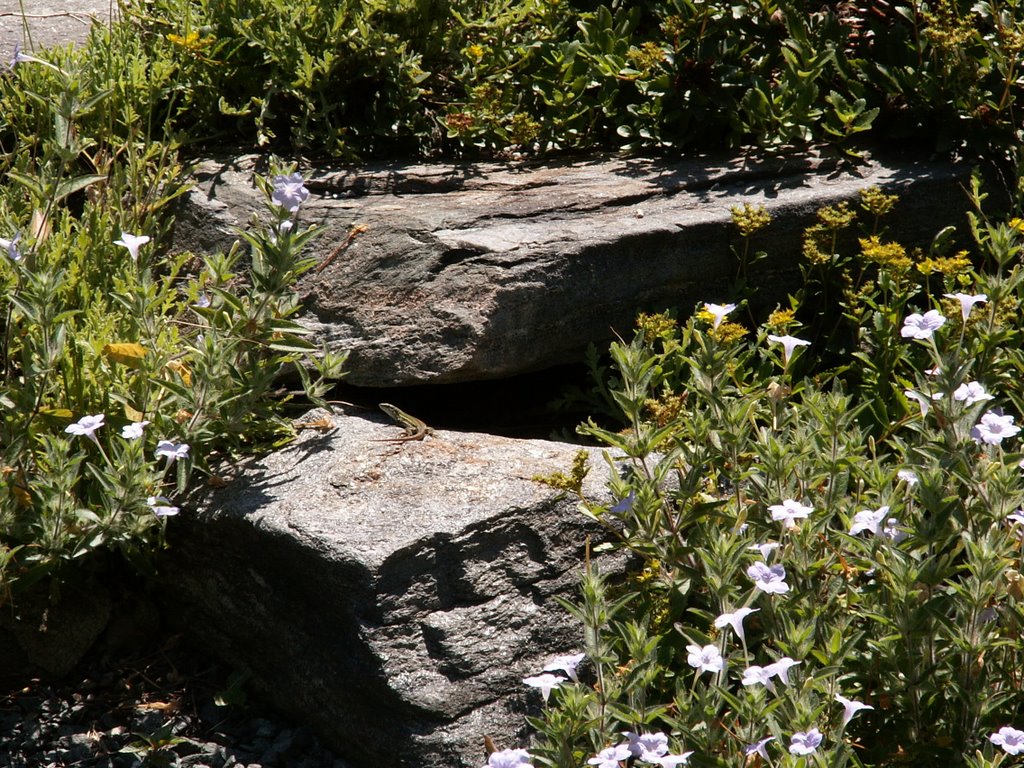
A few more minutes of pacing, and then I saw an adult slowly crawling around the rocks. Here it is.
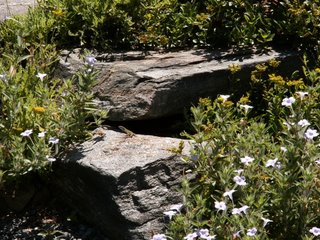
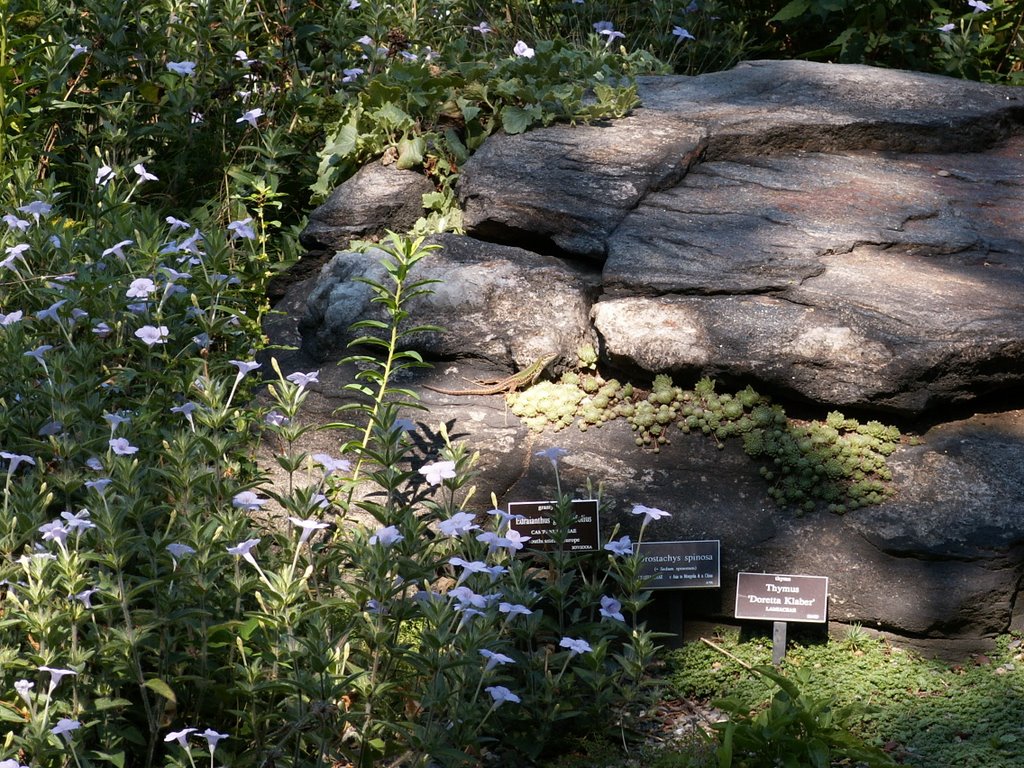
After that it got easy. Here’s a particularly nice one I saw a minute later and a few yards away.
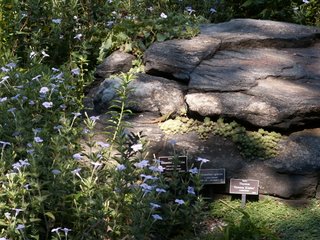
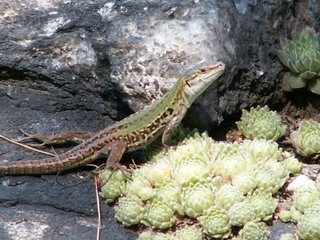
At that point my camera batteries died. I was a little miffed, but I had a few pictures, so I had accomplished that part of the mission. I kept walking slowly back and forth. I saw more adults slinking around. One seemed to be following another, keeping about one foot behind. Another ran away from me and into a large clump of grass, only to run right back out towards me, pursued by a slightly larger neighbor.
More people were showing up in the rock garden at that point, and I only put in a few more minutes of lizard watching. I said arrivederci and headed back to the subway station.
The temperatures were in the high 70s and it was sunny.
Totals:
5-6 Italian Wall Lizards
Here is a link to more information about the Italian wall lizards:
http://www.newsday.com/other/special/naturalworld/ny-walllizard3272636may11,0,7403536.story
We particularly lack active lizards that do all their business out in the open, like the anoles (Anolis and Norops species) of the Southeast and those Tropidurus torquatus we saw so many of in Brazil. It’s fun to spot lizards basking on fence posts as you walk to work, and it’s always a kick to watch the males doing head bobs and pushups to impress the females, fun that Philadelphians miss out on. Maybe that’s why Philadelphians are known for being so ill-tempered; does lizardlessness breed crankiness?
I might or might not be onto the next great breakthrough in psychology, but either way I had a great time visiting the Italian wall lizards (Podarcis sicula) of the Bronx Botanical Gardens on Saturday (August 5th).
I headed out from my sister’s place on the Lower East Side and took the D train up to the Botanical Gardens. I got there a little after they opened at 10am (admission is free 10am to 12pm Saturdays). I made my way directly to the rock garden, and there the kid at the admissions booth gave me directions to where I was most likely to see the lizards.
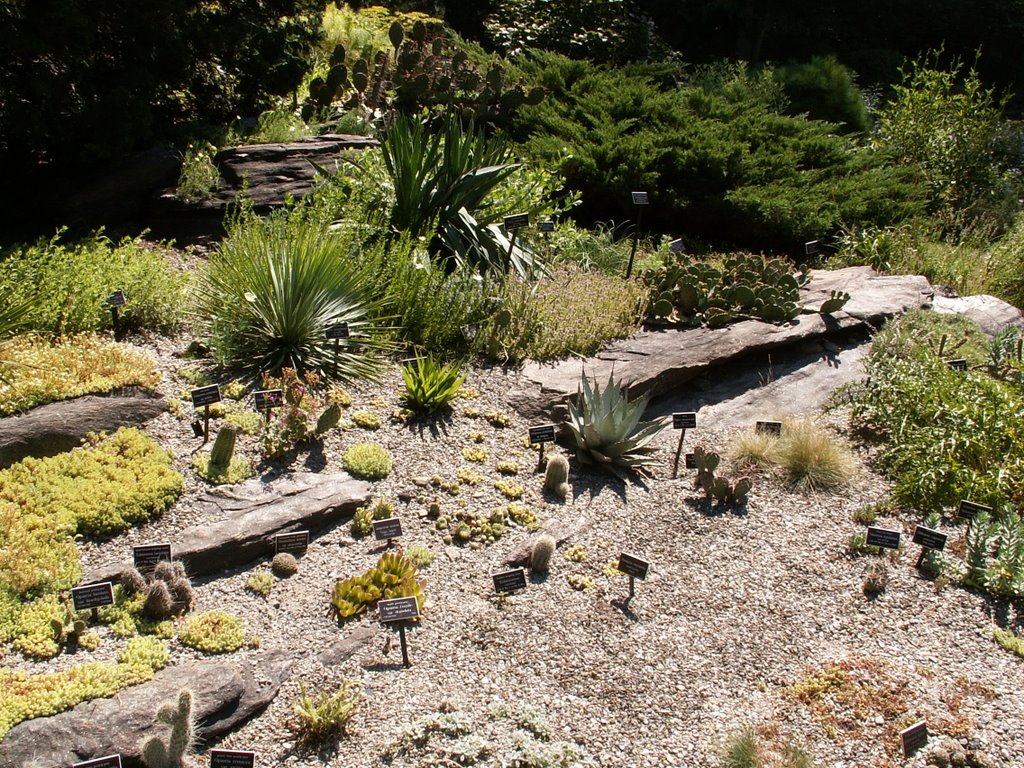
I walked back and forth for maybe fifteen minutes and saw absolutely nothing (and imagine my frustration at being surrounded by all those rocks I couldn’t look under!). To all casual observers I must have looked like a serious rock garden enthusiast, staring at all the little clumps of grasses and succulents from around the world with an intense, studious frown.
Of course that was a frown of frustration, but I reminded myself that it’s so often like this with spotting lizards. You don’t see any at first. You stare and stare at every pebble and leaf, wondering where they all are. Are they all sleeping? Is this the wrong spot? Have you scared them all into hiding?
Suddenly, though, you see one out of the corner of your eye. You turn to look at it, and just as suddenly it’s gone. Then you turn your head and see another, then another, and then you realize they’re all over the place. Maybe it’s a question of them all coming out at once, and maybe it’s that your brain needs the first to know what how to recognize all the others, but that’s how it is with lizards: you see one, then you see them all.
I had not chosen this spot at random, but at the advice of Russell Burke, a biologist at Hofstra who has studied the transplanted Italian wall lizards of Long Island and the Bronx. I had initially sought out Dr. Burke for information of the wall lizards of West Philadelphia.
Wall lizards of West Philadelphia? Surely I would have written about them by now, right? Well, while there once was (in the mid-1900s) a population of Italian wall lizards near the zoo along the railroad tracks towards Market Street, that population has gone extinct.
Some guy may tell you his friend says he knows a guy who found one once, or they overheard a guy talking at the Hamburg reptile show about them still running around the city, but it’s all urban herping myth. One person says “there used to be wall lizards in West Philly,” and, as in a game of telephone, a few iterations later you’ve got a fourth-hand account of them having been found there last Tuesday.
Dr. Burke, as well as several other professional and amateur herpers (while all recognizing the difficulty of definitively proving the absence of a small animal) have reported seeing no wall lizards after many hours of searching and have heard no first-hand reports from other herpers or neighborhood residents. These are active, highly visible lizards, and if no one in the neighborhood has seen them and experts who have spent hours upon hours observing them elsewhere haven't either, they’re not there.
So, with no hope of seeing the Italian wall lizards in West Philly, I had traveled to a place they do live. After fifteen minutes of pacing and frowning, I finally caught my glimpse. Something green dashed off the path as soon as I saw it. I paced a little more slowly and more intently at that point, and after another minute I saw a much smaller lizard dash from plant to plant, each time running just as I was about to take its picture.
A few more minutes of pacing, and then I saw an adult slowly crawling around the rocks. Here it is.

After that it got easy. Here’s a particularly nice one I saw a minute later and a few yards away.

At that point my camera batteries died. I was a little miffed, but I had a few pictures, so I had accomplished that part of the mission. I kept walking slowly back and forth. I saw more adults slinking around. One seemed to be following another, keeping about one foot behind. Another ran away from me and into a large clump of grass, only to run right back out towards me, pursued by a slightly larger neighbor.
More people were showing up in the rock garden at that point, and I only put in a few more minutes of lizard watching. I said arrivederci and headed back to the subway station.
The temperatures were in the high 70s and it was sunny.
Totals:
5-6 Italian Wall Lizards
Here is a link to more information about the Italian wall lizards:
http://www.newsday.com/other/special/naturalworld/ny-walllizard3272636may11,0,7403536.story
Sunday, July 30, 2006
I’ve caught a few dozen pregnant northern brown snakes (Storeria d. dekayi) over the past couple months. Most I immediately let go, but I held onto one really pretty one from the Mt. Moriah Cemetery. I decided to take her home for pictures, and then I decided to keep her a little longer to see her offspring (see the July 3 post).
The idea had been to take some pictures of the babies and then let them go. I’d never done this before, but it’s a fun little natural history project. Of course if you want to try this yourself, pick a common species like brown snakes and house the female in a container that will be escape proof for the babies. Baby brown snakes are as thin as rice grains, so ordinary air holes will be like open windows to them.
I missed the big event while I was on the road for work. I had started thinking the snake was never going to give birth, but Jen called me (I was in Warren, PA) on my cell phone Thursday (6/27/06) morning to tell me that there were fourteen itty-bitty (three to four inches long) snakes crawling around the enclosure. She moved them into a holding container to wait for my return. When I got home Thursday night I took some pictures.
My plan was to release them Saturday when I released the mom back where I found her. Jen, though, had grown attached to the little guys. So, the plan now is to keep them through the fall and the winter and then release them in the spring when they’re a little bigger. That way they don't have to face predators until they're a little bigger, and they don't have to worry about the hazards of hibernation until next year.
How did the plans change? I made the monster mistake of commenting that they would be highly unlikely to survive in the wild. I calculated their survival odds at about one out of thirty-two. Jen was horrified that they all would most likely perish in the next year, and the low odds of their survival made it pretty easy to decide that even if some didn’t make it, we could probably do better over the next seven or eight months than could on their own in the wild.
If I hadn’t caught the mother and brought her home, all those little snakes would be trying to make it in the weeds of the cemetery right now, and the odds are all of them would either be eaten by something else (spiders, centipedes, opossums, birds, etc.) or would freeze or starve to death in the winter. The same would have been their fate if I had let them all go this weekend with their mother. Now, though, I have brought them into our household, and we feel like we have some responsibility to help them beat the odds.
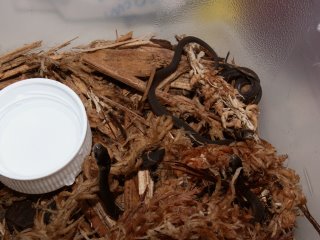
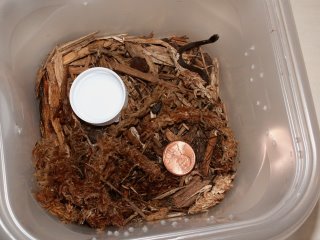
Here they are. That’s a soda bottle cap/water dish for perspective. They really are adorable.
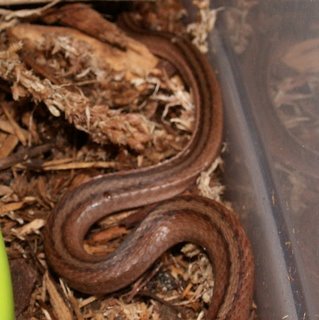
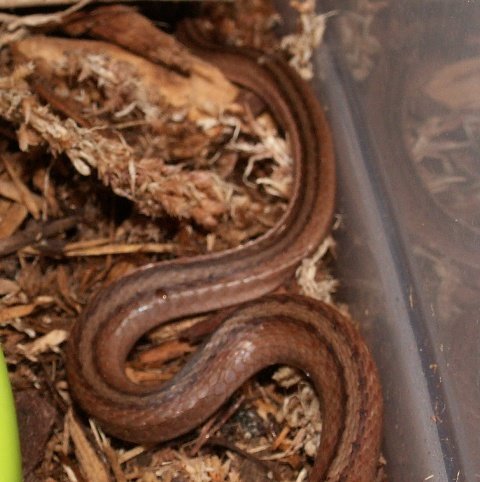
Here’s the mom. See the crease of skin on her side? That used to be all filled out with babies.
The idea had been to take some pictures of the babies and then let them go. I’d never done this before, but it’s a fun little natural history project. Of course if you want to try this yourself, pick a common species like brown snakes and house the female in a container that will be escape proof for the babies. Baby brown snakes are as thin as rice grains, so ordinary air holes will be like open windows to them.
I missed the big event while I was on the road for work. I had started thinking the snake was never going to give birth, but Jen called me (I was in Warren, PA) on my cell phone Thursday (6/27/06) morning to tell me that there were fourteen itty-bitty (three to four inches long) snakes crawling around the enclosure. She moved them into a holding container to wait for my return. When I got home Thursday night I took some pictures.
My plan was to release them Saturday when I released the mom back where I found her. Jen, though, had grown attached to the little guys. So, the plan now is to keep them through the fall and the winter and then release them in the spring when they’re a little bigger. That way they don't have to face predators until they're a little bigger, and they don't have to worry about the hazards of hibernation until next year.
How did the plans change? I made the monster mistake of commenting that they would be highly unlikely to survive in the wild. I calculated their survival odds at about one out of thirty-two. Jen was horrified that they all would most likely perish in the next year, and the low odds of their survival made it pretty easy to decide that even if some didn’t make it, we could probably do better over the next seven or eight months than could on their own in the wild.
If I hadn’t caught the mother and brought her home, all those little snakes would be trying to make it in the weeds of the cemetery right now, and the odds are all of them would either be eaten by something else (spiders, centipedes, opossums, birds, etc.) or would freeze or starve to death in the winter. The same would have been their fate if I had let them all go this weekend with their mother. Now, though, I have brought them into our household, and we feel like we have some responsibility to help them beat the odds.
Here they are. That’s a soda bottle cap/water dish for perspective. They really are adorable.
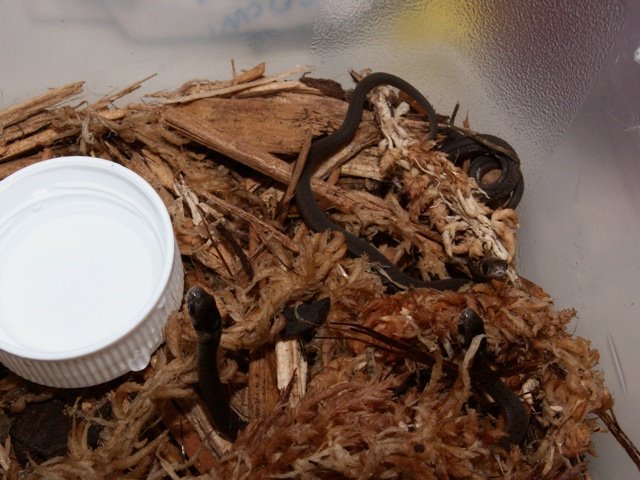
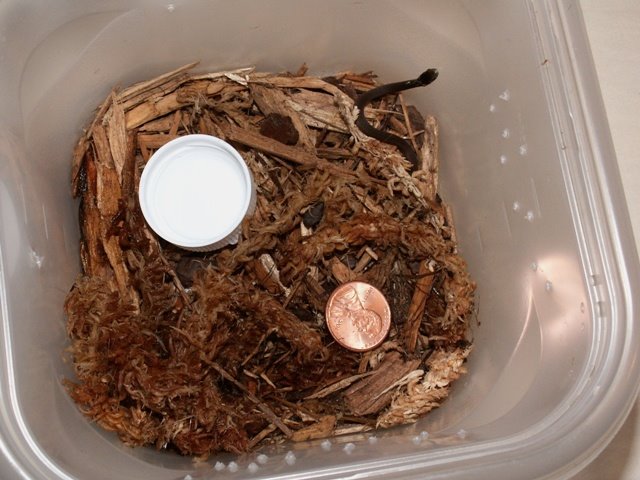
Here’s the mom. See the crease of skin on her side? That used to be all filled out with babies.
Subscribe to:
Posts (Atom)